The first clue to Michael Schanker's style is that he can explain a marketing department in fewer words than many marketers use to order lunch. Its mission, he says, is simple: “Set up sales to win.” No ornamental nouns. No fog bank of transformation language. The sentence sounds like it belongs on a locker-room wall, which may be fitting for an executive whose route to the chief marketing officer's chair included three years carrying a sales quota.
Schanker arrived at OneTrust in February 2025 with a difficult brief. The company had built products across privacy, consent, data governance, risk, and compliance. AI was creating another market, AI governance, while also changing the speed at which every existing kind of governance had to work. The pieces were adjacent. The story connecting them was not yet obvious.
He did not pretend to possess the answer on day one. During his first months he spoke with customers, analysts, and employees, looking for the thread between OneTrust's history and its next act. He had taken the role on a suspicion that the thread existed. Finding it became the work.
The accountant leaves the ledger
Schanker began his career as a CPA. He saw accounting as a place to learn how a business works before deciding what came next. Consulting followed, including large transformation programs and technology implementations. Then he moved closer to the product, joining software companies at a time when a release could take a year.
Product work in that era involved writing requirements for engineers and then waiting six or nine months while the software was built. The pause created an opening. Schanker trained salespeople to explain the coming product and spent time with prospects, translating between what customers wanted and what the company had. The function would now be called product marketing. Back then, he recalls, it was simply outbound.
His early years at Siebel Systems offered a close view of category creation. Customer relationship management had once been a collection of separate sales, service, and marketing systems. Siebel helped turn those pieces into a named category and a unified platform. The experience supplied a pattern Schanker would recognize repeatedly: scattered problems become a market when somebody gives buyers a coherent way to see them together.
Three years on the other side of the table
The financial crisis forced a sharper education. A CEO told Schanker that the business no longer needed half of his time in marketing and half in the field. It needed all of his time on revenue. He moved into sales, carried a quota, and says both he and his team hit their numbers for three straight years. He jokes that it resembles a baseball player retiring with a perfect batting average, although with a modest number of at-bats.
The stint altered his idea of credible marketing. Sitting across from a CFO and explaining why a piece of software solves an expensive problem leaves little room for decorative claims. It also changes one's relationship with salespeople. When a new CMO says he has carried a bag, Schanker notes, the posture in the room changes. The sales team can reasonably hope that the new leader is there to help.
“Set up sales to win.”Michael Schanker's five-word marketing mission
This is his objection to what he calls ivory-tower marketing: activity designed at a distance from the buyer and celebrated by people who do not have to defend it in the meeting. His alternative begins with the customer. What problem does the buyer feel? Can they articulate it? Is it high enough on the priority list to command attention? A sophisticated solution attached to a minor annoyance remains a poor business.
A career spent naming the puzzle
Across ServiceSource, Lithium, OpenGov, Remix, and Coupa, Schanker kept returning to companies assembling new categories. At OpenGov, where he led marketing, the company more than doubled revenue while building its name in government technology. Public-sector agencies were publishing data, improving budgeting, and measuring performance. Schanker's argument was that these were not isolated tools. They were pieces of a larger effort to make government more effective and accountable.
At Remix in 2019, his remit stretched across growth, marketing, customer success, and business development. At Coupa, he spent roughly five and a half years in strategic marketing, CMO, and strategy roles. During that period, Coupa grew from about $300 million to $1 billion in revenue. He compared the company's business spend management proposition to the formation of CRM: separate procurement and spending processes becoming legible as one platform and one discipline.
OneTrust presented a familiar puzzle with higher stakes. Privacy rules such as GDPR and CCPA had pushed companies to understand their data and automate consent. AI then made data useful in new ways, at new speeds, with risks appearing in inputs, model behavior, and outputs. Old questionnaires and occasional reviews could not keep pace. Governance had to become continuous, and the tools used to govern AI would themselves need automation and AI.
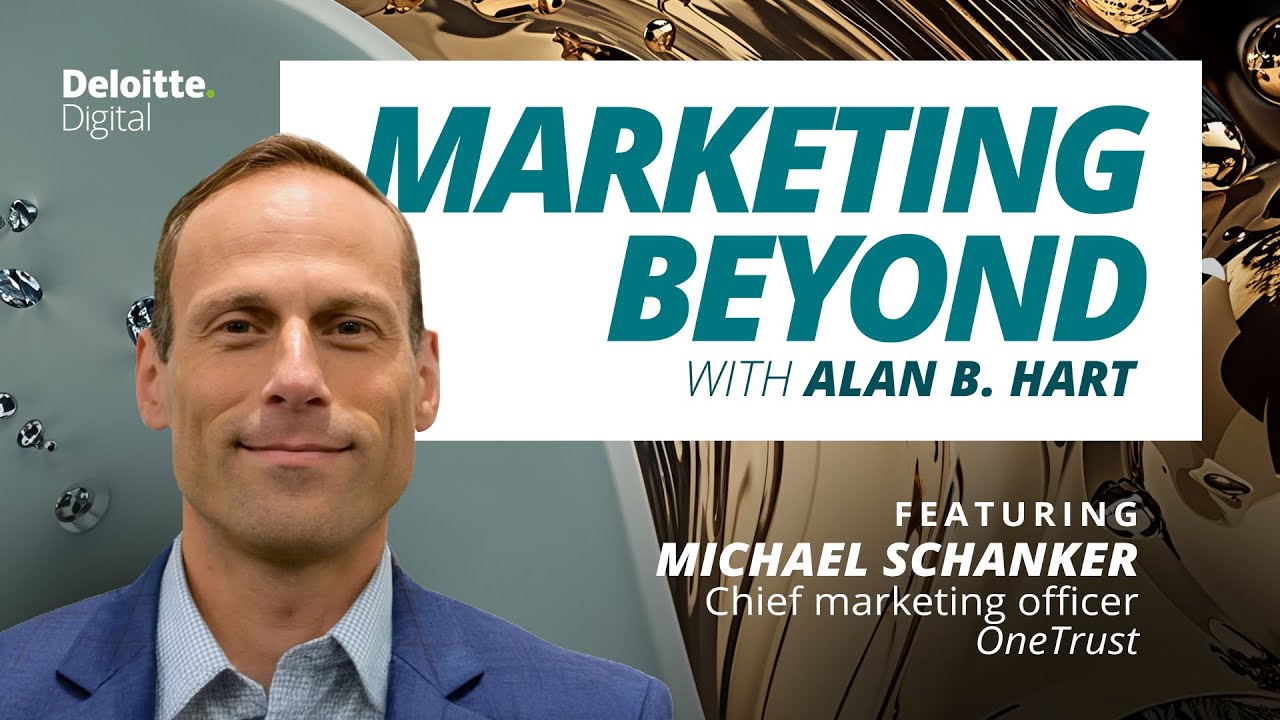
A useful measure of scale. In his Deloitte Digital conversation, Schanker said OneTrust manages 400 million consent transactions a day. The familiar cookie prompt is only the visible edge of a large system for recording permission and purpose.
His framing of risk is notably commercial. A business is not trying to eliminate risk, he argues. It is deciding which risks are appropriate for performance without exposing the brand, the company, or its people to unacceptable consequences. In AI, regulation is only one force. Customers can punish a company that uses their data carelessly well before a regulator completes a case.
Customer zero, clean sheet
Schanker says OneTrust must be “customer zero” for its own software. His marketing organization cannot advise other companies on responsible AI while remaining innocent of the trade-offs involved in adopting it. The team has to test use cases, learn where productivity appears, understand the permissions attached to customer data, and experience the tension between moving quickly and governing well.
That practice supports a broader habit: challenge the process even while it still works. Schanker regards complacency as the serious threat to marketers. A tactic begins on target, customers change, and the same tactic drifts ten degrees away, then fifteen, then twenty. Buying a shiny tool does not correct an outdated assumption underneath it.
His clean-sheet question is bracing: if the team started today, would it choose to work this way? The test is useful precisely because successful routines are hard to interrogate. Failure invites diagnosis. A decent result can linger for years, protected by familiarity.
“Everything starts with the customer.”On building or rebuilding a category
An engineer, an artist, and a cinephile
The severity of the clean sheet is balanced by a warmer explanation of how he became a marketer. Schanker's father is an engineer. His mother is an artist. Both taught at the high-school or college level during their careers. From his father, he says, came logic and analysis. From his mother came expression across a wider canvas. Marketing, in his account, is the amalgamation: engineering and art sharing a desk.
His children provide another kind of operating system. Schanker calls them his human Google alerts. If news breaks about the NBA or the Golden State Warriors, one of his sons will text within minutes. His daughter covers music and pop culture. Information that fails to travel through either channel may not deserve immediate attention. It is a charming household answer to executive overload.
He is also a cinephile who grew up watching movies with his brother. When his own children were young, Marvel and Star Wars offered a socially acceptable excuse to see the blockbusters he already wanted to watch. Yet he worried about what action-heavy, effects-driven films displaced: patience for character, ambiguity, and smaller stories. He sees some of that character work returning in limited streaming series, where eight or ten episodes allow a story to breathe.
For Schanker, this is not a hobby awkwardly converted into a business lesson. Stories let viewers enter another person's interior world. That exercise builds empathy, and empathy is central to understanding the buyer across the table. The hours his parents may once have considered wasted at the movies now look like a durable part of his professional education.
The photograph he did not take
Asked what advice he would give his younger self, Schanker did not offer a framework. He said: “Take more pictures.” After college, he backpacked through Europe for about a month with a friend. He has no photographic evidence of the trip. Memory fades; an old album can restore the room, the street, and the people who occupied it.
His wife makes yearly photo albums for their children. Around the holidays, the family looks through them before the books return to the shelf, ready for an occasional rediscovery. The ritual is pleasingly tangible for an executive immersed in data. Not every valuable record needs to optimize a decision. Some deserve to exist because a life becomes harder to retrieve without them.
Schanker's current work faces the future: AI agents, changing rules, new forms of risk, and a category whose vocabulary is still settling. His career, however, suggests a stable method. Learn the mechanics. Sit with the customer. Carry the consequence of the promise. Find the story that connects the pieces. Then, before habit turns it into doctrine, return to the clean sheet.