The distribution yard is where immaculate diagrams go to acquire mud. Inside the warehouse, robots glide between shelves and software keeps score. Beyond the gate, trucks join the highway. Between those two celebrated systems sits a patch of asphalt full of trailers, dock doors, weather, radios and consequential waiting. Londonne Corder has spent the past seven years teaching executives to see it.
Corder is the chief marketing officer of Outrider, a Colorado company building autonomous electric yard-truck systems. The machinery can identify a trailer, hitch it, connect its brake and electrical lines with a robotic arm, move it across a busy yard and back it into position. The marketing problem is equally physical. A new category must fit around a machine weighing up to 80,000 pounds, the workers sharing its space and the enterprise systems telling everything where to go.
Her answer is a plain pair of words: yard automation. The phrase is useful because it gives a neglected operating zone its own border. It also gives buyers a question sharper than “Should we buy robots?” Where, exactly, does freight stop flowing between production line and open road?
“Operations leaders are at the core of digital transformation.”Londonne Corder, on joining TrackVia in 2017
A journalist learns to market machines
Corder did not begin with robotics. She graduated from the University of Kansas in 1995 with a Bachelor of Science in Journalism, earned with high honors from the William Allen White School of Journalism. Her campus record included Phi Beta Kappa, KU Ambassadors, orientation work and the International Student Association. Journalism gave her a durable professional habit: find the real subject before decorating the sentence.
She spent the rest of the 1990s and the opening years of the new century in corporate communications. In 2001, WIRED quoted her as an Excite@Home spokesperson on the unlikely endurance of stick-figure branding: “They are everywhere.” Then came a tour through enterprise technology's less photogenic but essential rooms. At Brocade Communications, from 2003 to 2010, the subject was storage networking. At Ping Identity, from 2011 to 2015, it was identity software. A public professional profile credits her work at Ping with sourcing more than 60 percent of new-license revenue, and her Brocade work with increasing software's share of revenue from 8 percent to 20 percent in less than two years.
In 2015 she became vice president of marketing at EMS Software, responsible for brand, product marketing, demand generation and the go-to-market plan. Two years later she moved to TrackVia, the low-code application company. The nouns changed from switches to identity to meeting rooms to business workflows. The recurring task was to make infrastructure intelligible to someone with an operating problem and a budget.
Her own writing from that period reveals a useful resistance to technology theater. One essay asked why business culture demands solutions before people have properly defined the problem. Another opened with an admission: she had not written code since high school, when the language was Pascal and the operating system was DOS. It is a brisk way to lower the temperature around low-code software. Expertise can begin with an honest account of what the buyer does not want to become.
The space outside dock door 135
Corder joined Outrider as vice president of marketing in September 2019 and became CMO in January 2023. The move from SaaS to physical autonomy was less of a rupture than it appears. Distribution yards are operating systems made visible. A trailer is an object, a dock is a destination, a move is a command, and an exception is where the tidy flowchart meets a driver, a puddle or a misplaced box.
The overlooked handoff
In a 2026 analysis, Corder uses dock door 135 to make the bottleneck concrete. Late trailers stack up while the door sits idle. Warehouse, transportation and yard-management systems may each work, yet staff still reconcile locations and priorities by hand. Her proposed sequence has three parts: automate routine trailer moves, connect the systems into one real-time workflow and prepare people to supervise robots and handle exceptions.
The case avoids waiting for a machine that can handle every imaginable event. If robots perform the routine 90 percent of moves, she argues, people can manage the edge cases, safety oversight and higher-value decisions. It is a practical posture toward adoption: value now, improvement over time, humans where judgment matters.
These numbers explain why the category is more than a vocabulary exercise. Roughly 20 billion tons of freight pass through yards each year. Yard workers operate around very heavy vehicles and repeatedly leave the cab to connect trailer lines. Outrider says its recent reinforcement-learning work made path planning ten times faster. The narrative has a clean chain: fewer wasted moves, less idle equipment, more predictable docks and fewer repetitive tasks beside large machines.
Safety is a culture, not a feature list
Industrial autonomy tempts communicators to make the demonstration the story. A truck moves without a driver; the crowd applauds; the clip ends. Corder's writing stays with the less glamorous questions that begin afterward. Can workers identify an autonomous vehicle? Do they know whether it is in manual or autonomous mode? When is it safe to approach? How does it behave around a dock door?
“Autonomy contributes to establishing a culture of safety, but it is by no means a replacement for human labor or critical thinking.”Londonne Corder, FMJ, 2025
That sentence captures her preferred bargain. Automation can move repetitive and hazardous work away from people, but equipment does not absolve a facility of training, procedures or attention. Outrider has described a safety architecture with 14 mechanisms addressing more than 200,000 yard-specific hazards. Corder's contribution is to place those engineering claims inside the working culture where they must be understood.
Her colleagues describe the same preference for coordinated systems in human terms. One recommendation says she can get “all the pieces of marketing working as a machine.” Another calls her straightforward, quick to turn broad goals into action, and able to rally a team and remove roadblocks during stressful periods. The metaphors overlap neatly: integrated parts, useful motion, exceptions handled before they become pileups.
The long route is part of the point
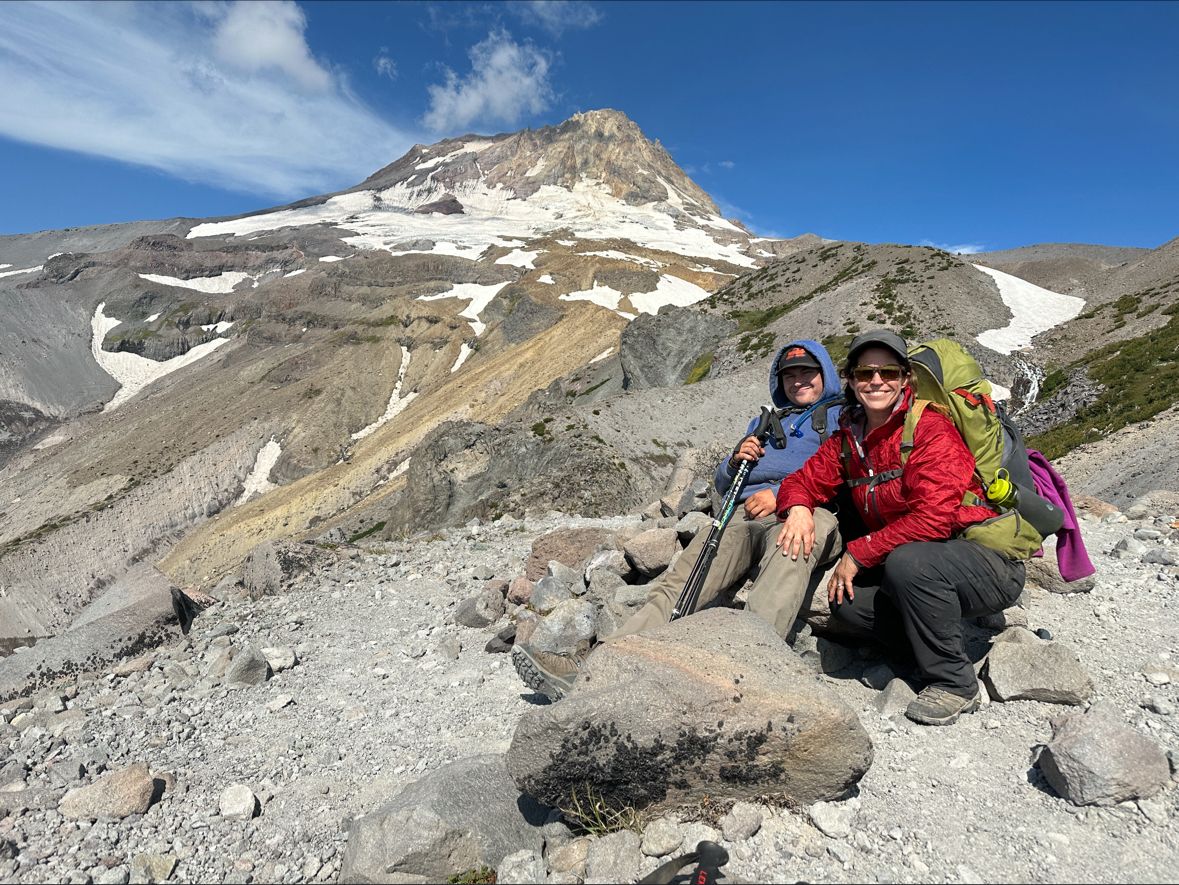
In August 2023, Corder and her 20-year-old son Gavin hiked the 42-mile Timberline Trail around Mount Hood. The trip took four days. In the photograph they are seated on gray volcanic rock, packs still strapped on, with the mountain rising behind them and no conference carpet in sight.
She wrote that the trek reminded her to push her physical limits, spend time in nature and clear her head. The perspective, she said, made her a better spouse, mother, friend, colleague and professional. It is the most personal public note in an otherwise systems-minded body of work, and it explains something the org chart cannot. She values a route long enough to alter the person walking it.
There are smaller clues. A 2026 podcast introduction mentions a past as a semi-competitive gymnast. Her public service includes mentoring early-stage security and compliance companies through SecureSet Accelerator and co-leading the Boulder chapter of Ellevate Network from 2017 through early 2020. The pattern is less solitary achievement than practiced coordination: teams, communities, a mother and son on a trail.
Seven years to make two words stick
Category creation is often sold as a launch event. Corder's version has been a campaign. A creative partner says it has worked with her since 2017 and followed her into Outrider. The company has spent years explaining the same patch of ground through demonstrations, customer operations, press material, safety cases, bylined articles and executive interviews. Consistency is the less romantic sibling of invention, but it is usually the one paying rent.
By 2025, Corder was writing in FMJ about autonomy and workplace safety and appearing on a machine-vision podcast to explain AI-assisted yard trucks. Outrider announced that Supply & Demand Chain Executive had named her to its Women in Supply Chain list. In February 2026, she argued in SupplyChainBrain that the next frontier of warehouse robotics sits outside the building. In May, a long-form podcast conversation ranged from responsible deployment and partner ecosystems to the disappearance of gated content and the rise of AI-influenced buying committees.
The progression matters because her public role has moved with the category. Early communication had to point at the yard and say, look here. Later work could discuss systems integration, worker preparation, measurable return and the buyer's changing research habits. The topic matured from existence to operation.
Corder's career offers a quiet correction to the notion that marketing sits downstream from invention. When a technology crosses software, vehicles, facilities, labor and safety, language becomes part of the infrastructure. Someone must decide where the category begins, which problem it owns and which promises can survive contact with a working yard.
The warehouse door opens. A trailer waits. A robotic arm has to find the same air line in rain, dust and bright sun. The buyer needs a return, the worker needs a procedure, and the public needs a name for the whole arrangement. Londonne Corder's work is to make those requirements occupy one sentence. After decades at the work, the sentence has finally grown wheels.