The oilfield has an unusual supporting cast. Alongside engineers and drilling crews are the people who arrange deliveries, collect insurance certificates, check rates, and ask why an invoice does not match a work order. A well can have hundreds of suppliers. Somebody has to make their paperwork agree. Workrise built its business by getting close enough to that administrative tangle to discover how much work it contained.
- Find the people. An early vendor marketplace found traction with individual workers.
- Follow the transaction. Staffing grew into software and services spanning procurement to payment.
- Choose the industry. After expanding, Workrise returned to energy and, in 2025, the RigUp name.
That last detail matters. Workrise is now RigUp again. The company announced the change on September 4, 2025, recommitting to oil and gas. The two names describe a business that has repeatedly adjusted the distance between its ambition and its expertise.
01 / The customers rewrote the plan
Xuan Yong and Mike Witte founded RigUp in 2014. Their original idea resembled an Angie’s List for oilfield services: a place to find, evaluate, and hire vendors and workers. There was an awkward discovery. Companies already had relationships with large suppliers. The founders had built something useful without finding enough people who urgently needed it.
“we weren’t getting much traction,” they wrote in their 2021 account. Individual workers, however, were using the platform to display their skills and find assignments. Reliable payments and access to the next job mattered. What looked like supporting features were becoming the reason people showed up.

A very crowded oilfield.Mike Witte, standing, and Xuan Yong in 2021. Their customers helped rewrite the original business plan.Photo: Workrise / PR Newswire, 2021.
The company followed that behavior into workforce management. Matching people to jobs opened the door to onboarding, payroll, and compliance. In February 2021, RigUp became Workrise, a name broad enough for wind, solar, construction, and defense. In May, it announced a $300 million Series E led by Baillie Gifford, at a reported $2.9 billion valuation. The pitch had grown considerably beyond the oilfield.
By 2022, the expansion was being unwound. Workrise exited some business verticals and cut staff as it refocused on energy. Contemporary reporting described an organization struggling with the complexity of serving industries with different requirements. The failure was operational: a similar-looking labor problem did not make every market equally easy to serve.
The return to RigUp in 2025 gave that narrower focus a familiar name.
“We are doubling down on the vision we had when we founded the company”
Xuan Yong / September 2025
02 / The invoice remembers the bid
Today’s offering connects several jobs that companies often organize separately. Workforce Management supplies and administers contingent labor. Vendor Solutions helps operators discover suppliers, collect documents, track compliance, and process payments. Capital Management adds project budgets, rate agreements, and visibility into spending against an authorization for expenditure.
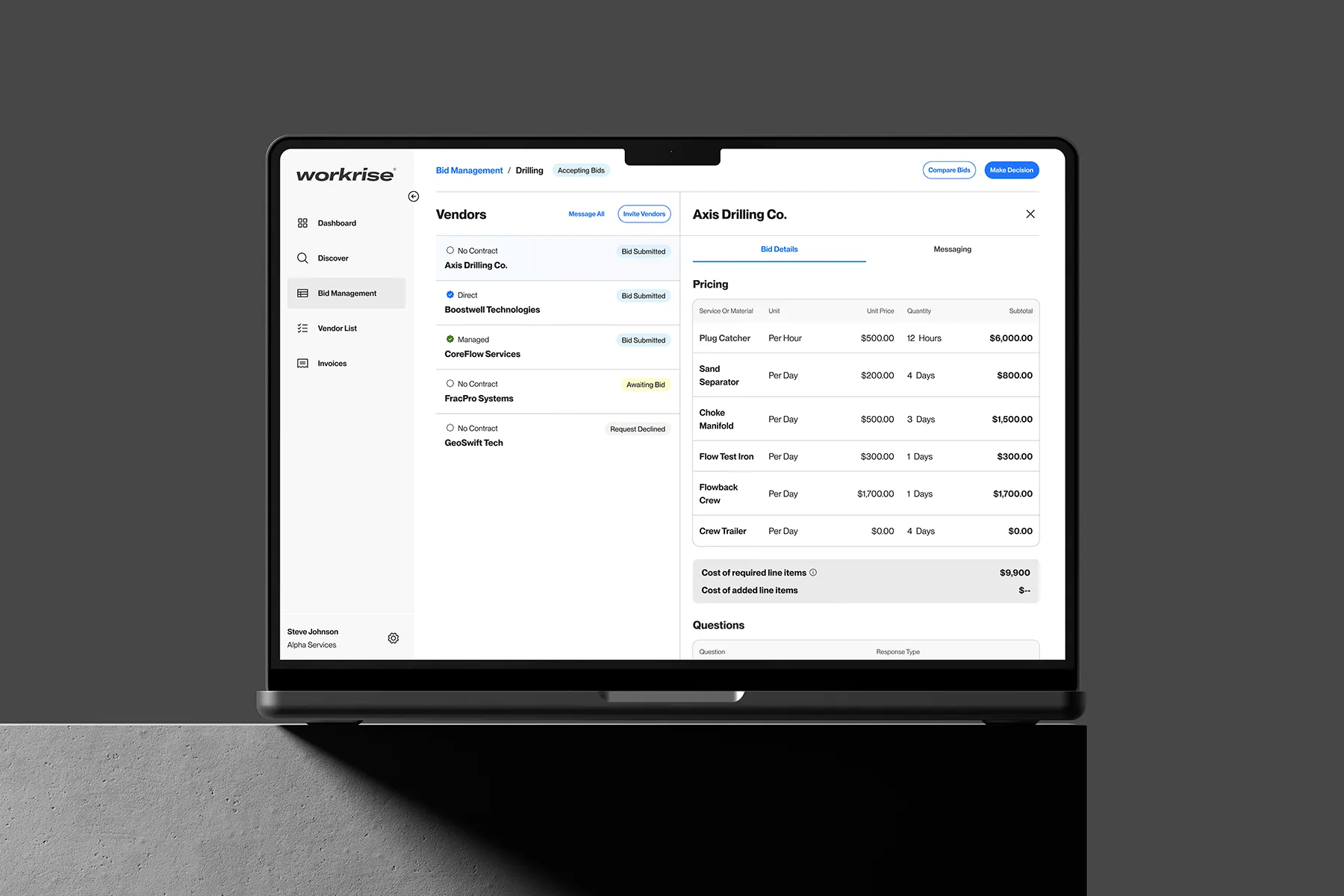
Bid Management, introduced in November 2024, shows the logic particularly well. An operator creates a request for quotation, invites suppliers, and compares their responses. Pricing and safety details sit together. Suppliers can ask questions inside the system. Everyone gets notified when the operator makes a decision.
From “Who can do it?”
to “What do we owe?”
- 01Request & compare
- 02Award & contract
- 03Onboard & verify
- 04Check & pay
The consequential step comes next: the winning bid becomes a work order, which supplies the rules for checking subsequent invoices. An agreed rate has a better chance of surviving the trip from procurement to accounts payable. The product’s appeal lies in that continuity. A prettier bidding screen alone would leave much of the original problem intact.
There are also two ways to divide the labor. Under the direct model, customers retain responsibility for compliance and invoice review, supported by the platform. Under the managed model, dedicated teams verify documents, review invoices, and handle onboarding through payments. The software records the work; people help finish it.
03 / Fifteen days, with a footnote
A company-published East Texas case study makes the service component concrete. An unnamed supermajor expanded through an acquisition and needed local vendors across ten categories. Workrise sourced suppliers, collected documents, arranged contracts, and checked compliance. It reported an average onboarding time of 15 days per vendor.
Average vendor onboarding reported in one East Texas engagement.A company case study, not a promise for every project.
The anonymity limits what a reader can independently inspect. Still, the account explains the mechanism: existing regional relationships, local pricing knowledge, and an operations team doing administrative work. Chord Energy, Civitas Resources, Matador Resources, and Gulfport Energy appear among the company’s public customer references. In its July 2024 product announcement, Workrise said it worked with more than 300 US operators.
The business occupies an interesting gap. Broad procurement suites from SAP, Oracle, and Coupa address purchasing across industries. Energy staffing firms address talent. Workrise combines industry-specific software, supplier access, and service delivery. That combination can matter when the buyer needs someone to obtain a missing document as well as flag it on a dashboard.
04 / What the small print teaches
Commercial terms deserve the same attention as the workflow. A January 2026 support FAQ describes a 2% placement fee for a particular Western Midstream project. It explicitly says fees depend on the client and work order. That is a concrete cost example, with a narrow boundary. Buyers and suppliers should evaluate their own engagement’s fees, payment terms, and division of responsibilities.
The company has also moved deeper into energy execution. It acquired Calgary engineering and staffing firm Codeco-Vanoco in 2024, retaining its brand and leadership. In June 2025, it announced exclusive US licensing of Shell’s U-lateral drilling technology, offered per well. These additions draw on industry relationships and technical expertise beyond recruiting.
The copyable lesson is practical: follow one supplier from the first request to the final payment. Count the handoffs. Find where rates, documents, or accountability disappear. It is a useful exercise even for a company that never buys its services.
The fit depends on the setting. A buyer with few vendors, simple compliance needs, or suppliers outside the relevant network may have less to gain. Incomplete records and reluctant participants still require work. Workrise’s own retreat from some industries is a reminder that expertise has a geography and a vocabulary. Its current proposition begins with knowing both.