Sarah Hospelhorn has a nice trick for explaining data classification: she introduces a penguin. Aristotle divided animals according to where they lived - land, air, or water - which worked neatly until a bird declined to fly. Two millennia later, the same problem stalks enterprise data. A tidy category can collapse as soon as reality waddles into the room.
In another example, Hospelhorn asks what the word “Brooklyn” means. A New York borough? A suburb of Melbourne? A person's name? The answer depends on context, and context is precisely what old classification systems tend to discard. It is a compact lesson in technology, language, and the limits of labels. It is also a miniature of her career.
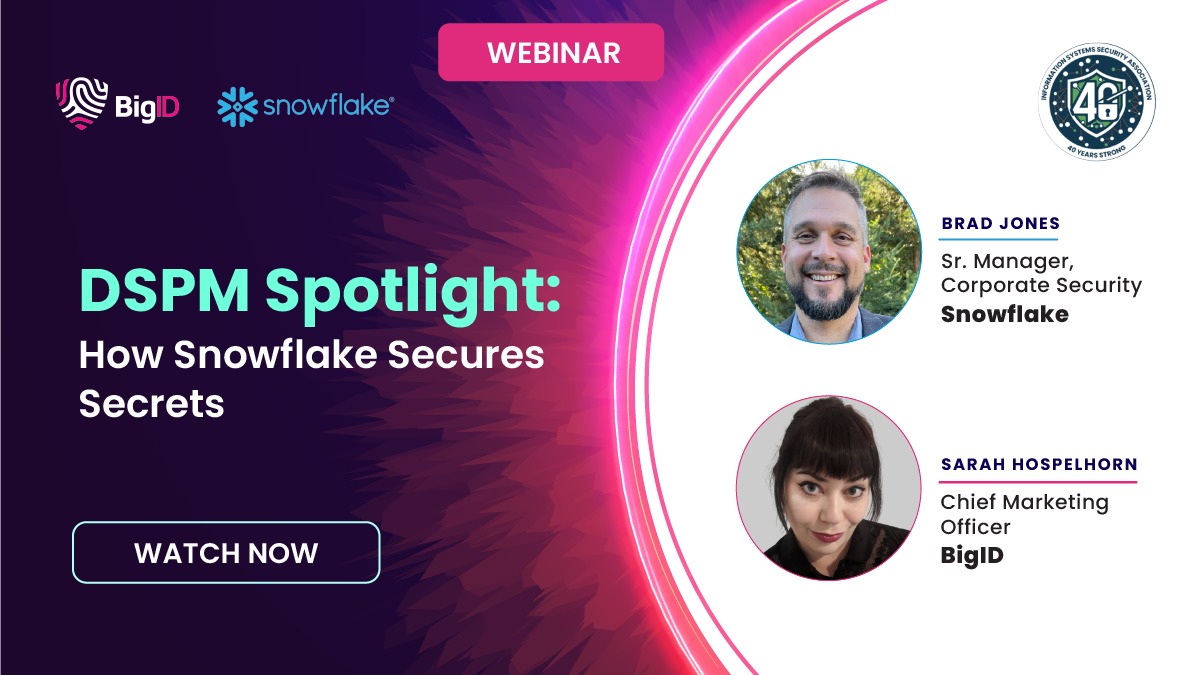
Hospelhorn is the chief marketing officer of BigID, the New York data-security company. Her job sits at the busy crossing of privacy, security, governance, compliance, and artificial intelligence. Each field has its own dialect; each produces acronyms at an industrial rate. Her work is to make the distinctions intelligible without sanding away the consequences. The subject is data. The product is clarity.
An education in connections
Physics supplied the rules. Literature supplied the exceptions.
At McGill University, Hospelhorn studied physics, English literature, and classics, completing both Bachelor of Science and Bachelor of Arts degrees in 2004. It is the sort of combination that makes a career counselor reach for a second sheet of paper. Physics asks what governs the system. Literature asks what the system means to the people inside it. Classics offers evidence that humans have been mislabeling things with confidence for a very long time.
Her early record is just as broad. There were applied research and development internships at mapping-technology company NAVTEQ. There were product and creative roles at WellDrafted Consultants. From 2005 to 2013 she worked as a consulting full-stack developer, while her public employment history also lists years supporting Columbia University's provost and dean of faculties emeritus. Code, coordination, words, institutions: the compartments kept refusing to stay separate.
A career built by widening the lens
Then came MakerBot. In 2012, desktop 3D printing still carried the giddy atmosphere of a science-fiction prop arriving early. Hospelhorn moved through product, sales, and marketing roles as the company expanded. A former colleague, RJ Wafer, later remembered her as a major part of its 2012-2013 growth, combining creative and analytical skills while bridging sales and marketing. He also credited her with helping maintain order during a chaotic period. That is product marketing in one sentence: translate between tribes while the workshop shakes.
MakerBot gave her hardware you could point at. Cybersecurity presented the inverse challenge. The most important thing in the room might be a permission nobody noticed, a relationship between two records, or a forgotten file carrying information it should not. Hospelhorn joined Varonis in 2014, became director of product marketing, and spent almost five years learning how to describe risk whose defining feature is often invisibility.
The category builder
At BigID, the story grew as quickly as the surface area.
Hospelhorn arrived at BigID in 2019 as vice president of global product marketing. The company was addressing a deceptively simple enterprise question: what data do you have? Answering it meant discovering information across structured databases, cloud stores, documents, email, and assorted digital cupboards. The useful follow-up questions multiplied. Whose data is it? Who can reach it? Which rule applies? What should happen next?
Her public writing from this period reads like a sustained campaign against single-purpose labels. Pattern matching can spot the familiar shape of a credit-card number, she explained, yet format alone cannot reveal every identity, relationship, purpose, or risk. Useful classification requires layers: patterns, context, document types, policy, and correlations among them. Technology writers often hide weak ideas behind a thick hedge of terminology. Hospelhorn tends to bring garden shears and a penguin.
She helped lead launches for SmallID, BigID Cloud, the company's Security Suite, and its App Development Framework. In 2021, she advanced to senior vice president of global product marketing. BigID's announcement of her next promotion credited her with building its product-marketing organization and shaping the company's brand and messaging. In July 2022, she became CMO.
The external scorecard was busy. During her leadership, BigID's announcement noted recognition on the Forbes Cloud 100, the Cybertech 100, and the 2021 Inc. 5000, where the company ranked nineteenth overall and first among security companies. Awards are snapshots, and corporate announcements enjoy polishing the frame. The more revealing accomplishment is continuity: the vocabulary she developed for privacy and classification expanded into security, governance, cloud, and eventually AI without losing the basic question of what the data means.
The operator behind the language
Clarity travels farther when everyone gets a copy.
There is another Hospelhorn habit, quieter than category creation and more revealing about how she manages. In discussing BigID's use of marketing analytics, she focused on democratized visibility. Campaign information had existed, but reaching it required manual work across systems and people. Her priority was direct access: let team members inspect granular views, validate strategy, make recommendations, and move.
That preference connects the marketer to the developer. A dashboard that liberates information resembles a good interface: it puts agency in the user's hands. It also echoes the product story she tells at BigID. Finding data is useful. Giving people the context and controls to act on it is where value begins.
Her leadership has extended beyond product launches and campaign measurement. At the time of her CMO appointment, Hospelhorn was executive sponsor of BigID Pride and leader of the company's Women in Tech employee resource group. The company described both as vehicles for community support, social impact, and intersectional advocacy. Former direct report Jessica Murguia has described a leader who cared deeply about people while holding them accountable, pairing strategic thinking with collaboration and openness to new approaches.
The portrait that emerges is not of a slogan maker floating above the machinery. It is of an operator who likes the machinery to be usable by more people. Her best metaphors perform the same service. They hand a specialist idea to a general audience without treating either side as foolish.
The AI chapter
A new machine arrives. The old question gets sharper.
Generative AI enlarged Hospelhorn's brief again. By 2024, she was writing about the data preparation behind AI: inventory, lineage, quality, duplication, sensitive information, access, and regulatory obligations. The dazzling model at the end of the pipeline could not absolve an enterprise from knowing what entered it. If anything, automation made provenance more urgent.
In September 2025, she moderated a DreamBig London panel on using AI and automation to scale privacy operations. In January 2026, her BigID guide to AI security laid out the next set of concerns: shadow AI, training-data lineage, model usage, policy enforcement, leaks, reliability, and changing regulation. The nouns have changed since the MakerBot years. The operating instinct has not. Find the thing, name it accurately, understand its relationships, and make a decision possible.
Her view of marketing is changing alongside the product. In a 2026 industry report, Hospelhorn described a shift from AI-assisted work to AI-augmented work, one that changes traditional models and redefines how work gets done. It is a more substantial claim than faster copy or cheaper campaigns. Augmentation rearranges roles, workflows, and judgment. A tool that merely helps sits on the desk. A tool that changes the operating model moves the desk.
This is where her odd-looking education feels almost overqualified. Physics is comfortable with systems. Literature is alert to ambiguity. Classics keeps a long memory for classification schemes that once looked permanent. AI governance needs all three dispositions, plus the patience of someone who has already translated code, hardware, cryptography, privacy, and security for rooms that did not share a vocabulary.
Hospelhorn's career has no public origin myth wrapped in tissue paper. It has something more useful: a visible pattern of moving closer to complex technology, then turning around to explain it. The task grows each year because the data grows, the rules multiply, and the machines begin making decisions of their own. Somewhere in that sprawl, a word still has several meanings. A category still has an awkward penguin. The work begins by noticing.