The fashionable way to describe artificial intelligence is to say that everything has changed. Kirti Dewan, who markets the machinery used to inspect that change, is more exacting. The tools have changed. The buying committees have changed. The speed certainly has changed. But the central work of marketing has not: understand the market, know the customer, decide what to say, how to say it, and where to meet the people who need to hear it.
That distinction is the spine of Dewan’s career. She is Chief Marketing Officer at Fiddler AI, a Palo Alto company that helps enterprises evaluate, monitor, explain, and govern AI models and agents. Her work sits in a particularly unruly corner of technology. The product is technical. The stakes include performance, security, compliance, and trust. The vocabulary is forever reproducing. A prospect can hear “observability,” “guardrails,” “evaluations,” and “control plane” before the first coffee has cooled.
Dewan’s job is to keep those words attached to consequences. Can a company see what an agent did? Can it understand why? Can it catch drift, enforce a policy, and produce an audit trail? A marketer in this category does not merely decorate the technology. She has to know where the abstraction ends and the operational headache begins.
An engineer learns the value of the useful sentence
Dewan came to marketing through computer engineering. She earned a Bachelor of Engineering from the University of Mumbai, then an MBA in marketing and entrepreneurship from Santa Clara University. The combination is less a novelty than a working instrument. Engineering teaches a person to look for systems, inputs, failure modes, and feedback. Marketing, practiced well, asks many of the same questions while adding the unruly variable of human attention.
Her earlier career crossed research and marketing roles at Gartner, Mercury, VMware, Engine Yard, AppDirect, and Orbitera. It moved between large enterprise companies and venture-backed startups, from established machinery to rooms where the machinery still had to be assembled. There was also a stretch of consulting, the kind of work that requires selling and delivering at once.
One of her favorite stories from that period begins at a product marketing conference. A speaker mentioned openings. Dewan hoped to introduce herself during cocktails, but several rings of people surrounded the person and the moment vanished. The advertised jobs were full-time; she was consulting. She sent a LinkedIn message anyway. It was frank about the mismatch, conversational in tone, and offered help if a project existed. The recipient answered. A meeting followed, then an engagement.
She did not turn the episode into a baroque theory of outbound. Her conclusion was human-sized: write as though speaking to someone, state the facts, and leave room for generosity. “People do like to help other people,” she said. In a business culture that often mistakes polish for persuasion, it is an almost mischievous idea.
Reliability, translated for the business
At Bugsnag, where Dewan served as Vice President of Marketing, the product problem was app stability. Engineers could inspect crashes, errors, and release quality. Dewan’s marketing problem was broader: why should the rest of the company care? Her answer connected stability to conversion, engagement, loyalty, and revenue. A broken app is technical in origin but commercial in consequence.
She built across the entire marketing engine: positioning, brand and product content, marketing technology, lifecycle and account-based programs, analytics, public relations, executive thought leadership, and community. It was operator’s work, not a single grand campaign. The analytics framework examined pipeline disposition, deal velocity, conversion, and the attributes of an ideal customer. The story and the spreadsheet had to remain on speaking terms.
That experience makes her move to Fiddler in November 2021 feel like a progression rather than a pivot. The object being monitored changed from applications to models, language systems, and agents. The need to connect technical behavior to business confidence remained. Software once failed with a crash. An AI agent can fail more ambiguously: a plausible wrong answer, an unexpected tool call, a leak, a policy violation, a costly loop. Reliability acquired a taste for theatre.
The workshop is the strategy
Dewan’s most revealing AI program may be an internal workshop with no stage at all. Every quarter, roughly eight or nine colleagues from marketing and sales gather to work on their own processes. Before the session, they write down pain points, tedious tasks, and things that feel broken. In the room, they explore tools, workflows, templates, and possible automations.
The format is deliberately fluid. Dewan, who generally likes structure, loosens it here because people are experimenting with unfamiliar technology. They need enough comfort to be candid and enough freedom to follow a useful surprise. Budget and headcount debates are set aside so that the immediate problem stays visible. Ideas are tested, measured, scaled, or stopped.
This is transformation reduced to its most credible unit: a troublesome Tuesday afternoon made slightly less troublesome. It also shows how Dewan thinks about teams. Experimentation is not a slogan pasted above the ordinary work. It begins with the ordinary work. A useful tool earns adoption by removing friction, not by appearing in a keynote.
Her hiring ideas follow the same logic. If AI is rewriting execution, familiar credentials may not predict who can invent the next playbook. She has asked whether a demand-generation hire must already come from demand generation, or whether someone trained in financial modeling might bring the analytical imagination needed for AI-enabled growth. It is not novelty for novelty’s sake. It is a request to hire for the problem now on the desk.
A constant state of sales enablement
Enterprise AI does not reward the comforting fiction that a deck is ever finished. New tools appear. Buyer roles multiply. Competitive claims shift. Content that was crisp can become stale while the link still works. Dewan describes the resulting condition as a “constant state of sales enablement.” The phrase sounds exhausting because it can be. Her response is to normalize iteration without making frenzy a virtue.
The team reads widely, stays close to changes in the ecosystem, tests new marketing technology, and keeps feedback loops short. Experiments are not precious. A program that works can grow; one that does not can be killed. Meanwhile the foundational questions remain fixed enough to prevent motion from masquerading as progress: Who is the audience? What problem do they recognize? What language helps them decide?
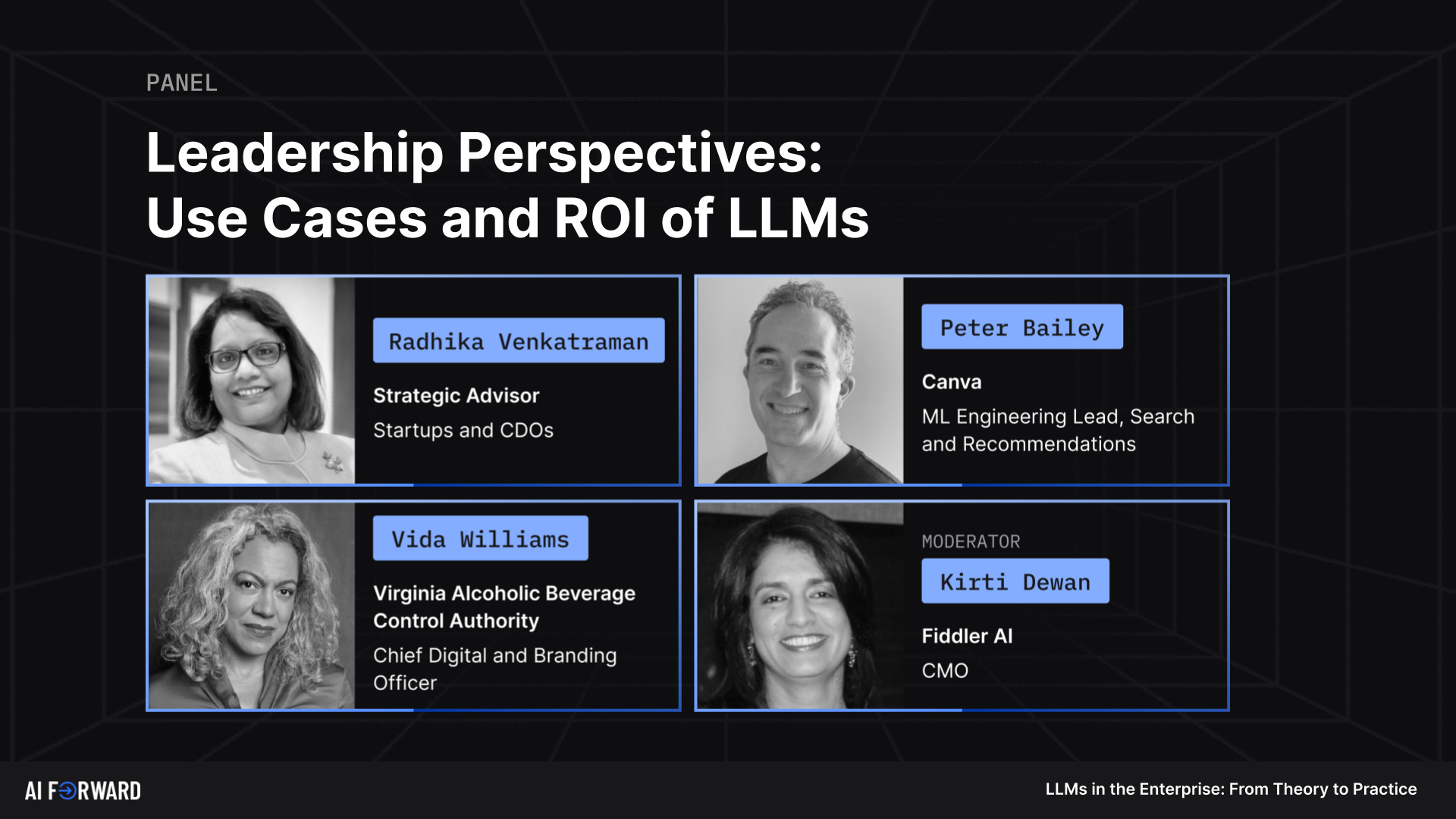
Dewan has put this translator’s posture on public display. At Fiddler’s AI Forward summit, she moderated leaders from Canva, Virginia ABC, and the startup and advisory worlds on enterprise LLM use cases and return on investment. She introduced conversations with technical founders and researchers, then kept returning the discussion to adoption: what is in production, what is merely being tried, what should be built or bought, where privacy enters, and who is accountable.
In 2025, she co-authored Fiddler articles describing agentic observability across development and production. One mapped an observed agent’s lifecycle through thinking, acting, executing, reflecting, and aligning. The argument was that teams need to see not only outputs but behavior. That is a technical thesis with a marketer’s understanding of trust. People rarely trust a consequential system because someone calls it intelligent. They trust what can be examined, explained, and corrected.
Control, without the illusion of certainty
In January 2026, Fiddler announced a $30 million Series C and sharpened its position around a control plane for AI. The company’s language promised standardized telemetry, evaluation, continuous monitoring, enforceable policy, and auditable governance. Dewan celebrated the milestone as the next chapter in giving enterprises visibility into what agents do, context for why they behave that way, and controls that can apply policy in real time.
It is fitting work for someone whose career has repeatedly joined the technical and the legible. Dewan appears to enjoy systems, but she resists treating people like components. Her public advice returns to authenticity, collaboration, sustainable teams, and curiosity. A brief professional biography also records pleasures beyond the dashboard: cards, travel, entertaining, and evaluating potato chips from around the world. Even a disciplined operator may keep one taxonomy salted.
The AI business is currently rich in declarations and poor in settled language. Dewan’s advantage is not that she can predict every new term. It is that she knows how to keep asking what the term is for. The black box becomes useful only when someone can connect its behavior to a decision. The marketing becomes useful at precisely the same moment.