The first batch took fourteen hours. By the time Matt Michaelson and Calvin Bohn finished cooking, it was three in the morning. Their prospective customers were cats belonging to friends. Their delivery fleet would be a rented Zipcar. If you were designing a glamorous introduction to entrepreneurship, you would probably leave out several of these details.
Michaelson kept going. Smalls, the company that emerged from his New York kitchen in 2017, eventually reached $100 million in annual revenue in 2025. That number gives the early cooking marathon a pleasing retrospective glow. At the time, dinner still had to be made, packed and delivered. The business began with the sort of work that cannot be improved by calling it strategy.
A company built around one species, after launching online in 2017.
The boy inspecting the restaurant
Growing up in Portland, Oregon, Michaelson learned to look at businesses from the inside out. Family restaurant meals could become discussions about staffing and the movement of customers. At fifteen, he was examining financial spreadsheets with his father. A restaurant was somewhere to eat, certainly, but it also offered a working model of how money moved.
His early ventures had a practical streak. As a teenage sailing instructor, he arranged private lessons outside the school’s official operation. While studying entrepreneurship at Northeastern University, he imported bamboo bicycle frames and sold them online. He had noticed an appealing product without much of a brand around it. The opportunity involved shipping real objects to real buyers, a useful education alongside the university one.
These episodes suggest a recurring interest: finding the transaction inside the thing everyone else is simply looking at. A sailing school contained potential private customers. A bicycle frame contained an online shop. Later, the crowded pet aisle would contain a conspicuous absence. His curiosity tended to arrive with a calculator.
Before the company, build the desk
Michaelson’s route to New York ran through people. At the Boston startup accelerator MassChallenge, he met Veronica del Rosario while he was an intern and she was a brand manager. Their friendship led to a visit after she joined THINX. He met the founder and was hired without a formal interview process. He moved to New York and completed college online.
He became THINX’s second employee. The office was sufficiently unfinished that he bought wood at Home Depot and built a desk. Before there could be a debate about workplace culture, there needed to be somewhere to sit. It is a useful scene to remember when his later job titles start sounding polished.
His responsibilities developed into growth and digital marketing. He learned how to acquire customers, test advertising and connect spending with sales. The earlier impulse to inspect a restaurant’s workings now had an online equivalent: follow the customer, understand the purchase, then try changing the route.
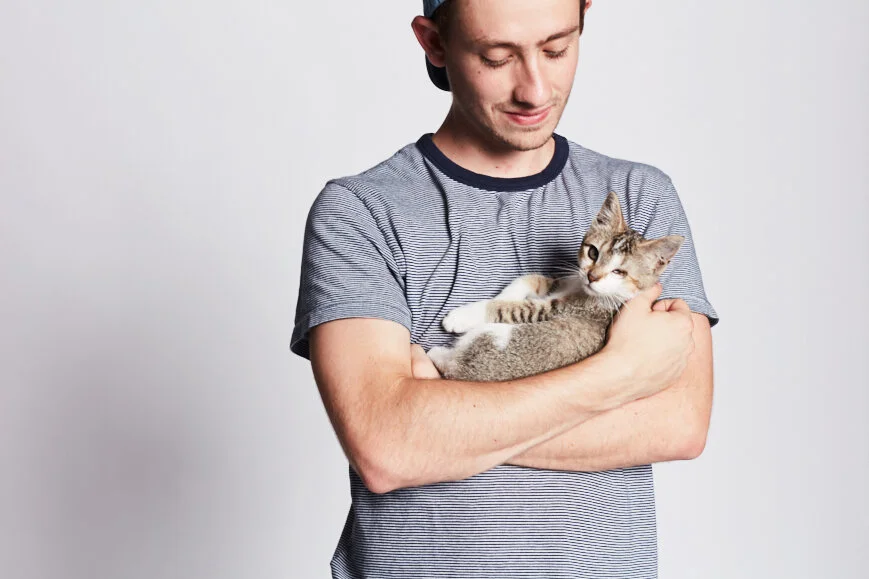
A childhood friend, a rented car, a very late dinner
Bohn, Michaelson’s original Smalls cofounder, had grown up as his neighbor in Portland. They shared a history that predated fundraising or a division of responsibilities. As the company took shape, Michaelson concentrated on demand while Bohn handled the product and, initially, the cooking. The friendship also supplied something less easily purchased: experience disagreeing and finding a way through it.
Their opening observation concerned attention. Several startups were developing fresh food for dogs. Cats seemed to be receiving less of that entrepreneurial enthusiasm. Michaelson had grown up with both animals, and the imbalance bothered him. Choosing cats offered a market opening that also suited his taste for taking a different direction.
The first batches went to friends’ cats. Deliveries spread around New York, followed by bigger kitchens and hired cooks. The early subscription approach included a trial before a larger recurring order, giving households a chance to see what their cats would actually eat. Enthusiasm from the owner was useful. Enthusiasm from the cat was rather harder to substitute.
The name came from a kitchen near Brooklyn’s Marcy Houses, where Biggie Smalls grew up. There was also the convenient matter of cats being small. An ambitious company acquired a name that could accommodate both neighborhood history and an animal fitting into a cardboard box.
- 2017Kitchen batches
and Zipcar runs - 2020$9m
Series A - 2023$19m
funding round - 2024Retail expansion
begins
A meeting with feelings on the agenda
Making room for disagreement became part of Michaelson’s management. He and Bohn described a regular meeting for airing grievances. In a filmed conversation about their working relationship, Michaelson explained that new employees needed to see the founders practicing the candor they expected from everyone else.
There is a particular risk in a business founded by friends: everyone knows the other person well enough to assume that everything is understood. Reserving time to speak plainly makes that assumption harder to maintain. The founders wanted employees to have opportunities to give feedback upward as well as receive it.
Another ritual had a disarmingly direct name: breakfast and feelings. These mornings gave the pair space to check in without a formal agenda. Michaelson increasingly understood his job as arranging how people worked together, including which conversations needed meetings and which could happen by email.
He also emphasized protecting personal time and reducing the list of priorities. The founder who can spot opportunities everywhere eventually has to decide which ones the team can handle. A company cannot put every interesting possibility on its calendar. Even a business devoted to cats needs the occasional closed door.
“Cats are weird, but weird is wonderful.”
Matt Michaelson
The growth marketer learns to leave the screen
Smalls raised a $9 million Series A in 2020, led by Left Lane Capital, with participation from Founder Collective and Companion Fund. Michaelson described preparing the business internally before the raise, including hiring and improving operations. More money would be useful only if the company could handle the customers it brought.
A further $19 million round in 2023 supported plans to enter retail and broaden the offering. Investors included General Mills’ venture arm, 301 Inc., and the Mars-affiliated Companion Fund. The kitchen experiment was now sharing a conversation with established food businesses.
Its advertising was moving into public space, too. A 2023 New York subway campaign used photographs of cats being cats, paired with QR codes that brought interested commuters to the website. The images offered recognition before explanation. A person familiar with a cat disappearing into a shipping box already understood the joke.
That campaign also suited Michaelson’s earlier training. The poster might live on a station wall, but the scan could still be measured. The route from an amusing image to a prospective customer remained visible. Digital marketing habits had found a place on the subway.
Channel choices changed as Smalls grew. For its first eight years, the company spent less than 30 percent of its advertising budget on Meta’s platforms. By April 2026, the founders said that share exceeded 60 percent, while the overall budget had quadrupled over two years. Michaelson’s approach allowed the mix to change with the business.
One species, more doors
Retail expansion began in 2024. By September 2025, Smalls was available in more than 500 US pet stores and had appointed Nate Kredich chief operating officer. His background included The Honest Kitchen and Himalayan Pet Supply. Michaelson was adding experience suited to the next set of problems: getting products onto shelves and supporting the people selling them.
An August 2026 agreement with Supreme Pet widened access for independent retailers across several South Central states. The geography was getting broader while the species remained constant. Distribution could expand without requiring the company to invent a dog business.
By September, Smalls described a footprint of more than 1,000 retail doors. Its “Is Cat” campaign carried the brand across television, outdoor advertising, creators and an exhibition hosted by artist Chloe Wise. The phrases included solitude and dirty martinis. The audience was being invited to recognize a temperament as much as a pet preference.
Del Rosario, now cofounder and chief brand officer, remained central to that work. The friendship that helped bring Michaelson to THINX had continued into a company with an expanding public voice. The product needed buyers; the brand gave those buyers a way to recognize one another.
A smaller figure in a larger ocean
Outside work, Michaelson has described splitting his time between New York and Topanga, California. He enjoys small groups, and surfing is something he prefers doing alone. The ocean offers an agreeable correction to the scale of a founder’s working day: he likes the feeling of becoming small in it.
There is a broader horizon in his business thinking, too. He joined Founders Pledge, and a June 2026 conversation explored committing five percent early to charitable giving. The organization helps entrepreneurs plan and direct donations. A future financial outcome becomes something to think about while the company is still being built.
For all the widening distribution and larger advertising budgets, Michaelson’s central commitment remains unusually specific. He has ruled out expanding into dog food. Cats are still the customer he wants to build around. After fourteen-hour cooking sessions, rented-car deliveries and years of learning how to reach their owners, he has ample reason to keep paying attention.