The coffee shop was closed. Griffin Spolansky and Coco Sotelo sat down outside and talked anyway. They had met only days earlier through an entrepreneurship class at the University of Virginia. He was a student with ideas about starting a business. She already made and sold granola. There was enough to discuss without anyone operating an espresso machine.
They considered becoming partners in her granola business. Eventually, they chose to make something else: a crispy bar in an aisle where Spolansky thought the options were dull. Their company would be called Mezcla, Spanish for mixture. The conversation outside Shenandoah Joe was an early indication of how he worked. An inconvenient detail could change the arrangements without ending the meeting.
Today, Spolansky runs a business with national retail distribution. A $9.5 million funding round in 2026 has given it more room to hire and develop products. But the useful way into his story is through the smaller openings he made for himself: a team tryout, a conversation after class, a shopkeeper willing to listen.
The third day of tryouts
Before he had a bar to sell, Spolansky had a place to earn. He arrived at Virginia in 2016 after a year at Colgate and tried out for the lacrosse team as a walk-on. His coach’s account of the audition is pleasingly unsentimental. The first two days gave the staff little reason to add him. On the third, his ability to collect ground balls and score with a long stick caught their attention.
A tryout is an unusually direct form of feedback. Nobody owes the applicant a place, and enthusiasm has to become something a coach can use. Spolansky joined the roster that fall. In his first playing season, he appeared in eight games, often on the faceoff wing. There was a role for him; he still had to do the work inside it.

By 2019, he was a senior defenseman wearing No. 17. He played in 13 of Virginia’s 20 games, and his first collegiate start came against Marist on Senior Day. Virginia won the national championship that season. The distinction belongs to the team, and the individual record is worth keeping in view: his path included the quieter assignments and the long wait for that first start.
Those details make his later interest in athletes less abstract. He had worked inside a system where effort was visible, criticism arrived regularly, and a group’s result depended on people accepting different jobs. Years later, he would borrow from that experience when deciding whom to hire.
Leaving class with a business partner
In the fall of 2018, Spolansky took an entrepreneurship course taught by Bala Mulloth. Guest speakers came in to describe their businesses. Sotelo spoke about hers. After her presentation, he went out to talk to her. The first move in the partnership was simply refusing to let an interesting introduction end with the lecture.
He already had some practice at selling things. At 13, he had taken bottles of his grandmother’s salad dressing to farmers’ markets around New York. At 16, he and a friend started a men’s clothing line. Food and clothing supplied different problems, but both put a young seller in front of someone who could decline to buy.
Mezcla also gave him a chance to explore an idea beyond the product. Early packaging carried a QR code that led to a digital gallery of community artwork. The wrapper could introduce a snack and give someone else a place to show what they made. With branding agency Matterful Brands and its founder Joey Rosa, Spolansky worked on turning that ambition into something a customer could hold.
He chose to pursue Mezcla full-time after turning down a job offer. His parents were disappointed, he later recalled. Graduating with an economics degree in 2019 supplied a respectable credential; choosing a company without an established route to market supplied a rather less reassuring dinner conversation.
The recipe had another opinion
In Sotelo’s kitchen, the idea had to become food that could be manufactured and sold. They experimented with recipes while Spolansky balanced classes and lacrosse. A promising taste was only one part of the assignment. Making a batch and producing something that would behave consistently over time were separate problems.
They sought outside help, including a food scientist. Spolansky’s accounts of finding manufacturing partners also describe the less photogenic work of asking for introductions. He contacted people through LinkedIn and social media, looking for someone who knew a manufacturer who could make bars. Each connection could shorten a search that neither founder could solve through a kitchen experiment.
“We really want to give the consumer a different eating experience.”
Griffin Spolansky
The resulting puff-crispy texture became central to Mezcla’s identity. Early flavors included matcha vanilla, cocoa peanut butter and hot chocolate, with country names attached to their ingredients and inspirations. Spolansky was trying to sell the pleasure of a particular bite. The wrapper could attract attention, but the product had to give someone a reason to return.
Mezcla launched in August 2020. That date is a useful dividing line between developing a company and finding out how customers will treat it. A bar can satisfy its founders and still have an entirely different career in a shop.
Fifty doors, opened individually
Spolansky began building retail distribution by visiting small stores in Boston. He went door to door, selling to bodegas and other local retailers. Eventually, Mezcla had about 50 accounts. That cluster helped it attract a small Northeast distributor, which opened a route to additional stores.
There was a circular difficulty: a brand needed distribution to reach accounts, while a distributor wanted evidence of accounts before taking on the brand. “It becomes a chicken or egg problem,” he explained. Walking into stores gave him a way to work on one side of the circle without waiting for permission from the other.
- 01Visit the storesBoston bodegas and local retailers
- 02Build a clusterAbout 50 early accounts
- 03Add distributionA Northeast partner, then more doors
The method also put him close to the people deciding whether the bars deserved space. Before purchasing expensive retail data, Mezcla asked buyers how the product was doing and what the company could improve. The early work involved selling, listening and returning with a better answer. A shelf was an ongoing conversation with a very limited vocabulary: units sold.
By October 2024, Mezcla was preparing to reach roughly 4,000 stores. Early 2026 reporting put it at approximately 9,000. Those figures describe a change in the scale of the job. A founder who once carried the pitch into a shop now needed a company capable of supporting many shops at once.
Promises that survive the next round
As the retail business expanded, Spolansky brought in investors with experience in consumer products. An approximately $4 million Series A, reported at the end of 2023 and in early 2024, was led by Dream Ventures and Santatera Capital. Richard Blankenship and Alejandro Gonzalez joined the board. The relationships added people who would be there when the next decision arrived.
In a July 2026 interview with Tina Bou-Saba, Spolansky described refusing to inflate numbers for investors. He also recounted an early investor whose initial $50,000 commitment grew into $3 million invested over time. His explanation connected repeat investment to delivering what he had promised. It is a modest-sounding discipline with consequences that compound.
The 2026 Series B brought Bluestein Ventures into the lead and Lindsay Levin, formerly RXBAR’s chief marketing officer, onto the board. Announced plans included building the team, developing products and supporting distribution. Each new retail commitment creates work beyond the announcement: production, inventory, deliveries and the continuing expense of persuading shoppers to choose a bar.
Company financing and distribution, at the time of the announcement.
A swimmer joins the lacrosse player
Operations manager Justin Grender had been a swimmer at Virginia. He and Spolansky had not crossed paths there, but their shared experience helped them connect. By April 2026, Grender was two years into his role at Mezcla, part of a team reported as 12 people.
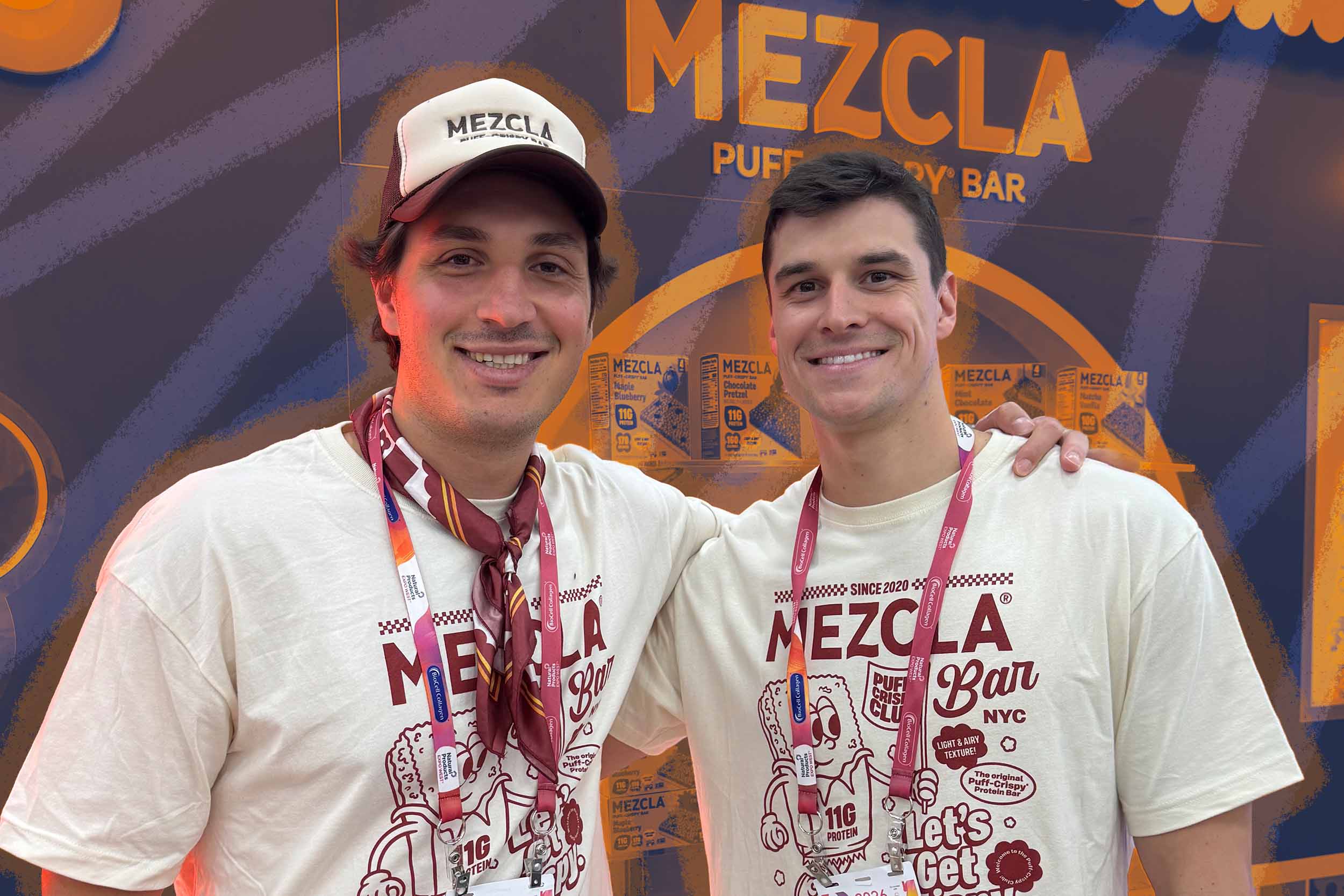
Spolansky described Grender’s responsibility in concrete terms: getting product to retailers, moving trucks across a geography that included Canada, Chicago, Florida and California. “I attribute a lot of our success to him,” he said. It is a useful corrective to the usual founder photograph. The person beside the CEO may be the reason anything reaches the customer.
His hiring preferences reflect that view of work. He looks for intensity, a willingness to accept criticism and the ability to deal with adversity. Grender recognized something of a college athletic program in the company’s working culture. The connection extends beyond nostalgia: Spolansky is using a familiar environment to explain what he expects from colleagues.
Learning to make the name readable
Growth has supplied Spolansky with fresh evidence about the limits of his own decisions. In describing Mezcla’s packaging changes, he noted that shoppers could remember a flavor without remembering the brand. Some flavor names were awkwardly split across lines. Colors needed to hold their own beside competitors.
The team’s response included a bigger logo, more readable flavor names and stronger imagery. A June 2026 update also introduced Frosted Strawberry, Mint Chocolate, Chocolate Pretzel and Salted Caramel Chocolate. The changes extended a continuing effort to make the product easier to recognize and choose. The founder’s enthusiasm had to fit into the few seconds a shopper might spare.
That is where Spolansky’s story remains interesting. He has collected visible markers of progress, including a place on the 2023 Forbes 30 Under 30 list. Yet the current assignments still resemble the early ones in their demand for attention: approach someone, make the idea understandable, listen to the answer, adjust.
There was no coffee at that first meeting with Sotelo. There was, however, a second person willing to keep talking. Spolansky has spent the years since turning that opening into work other people can join.
Keep the conversation going
Watch, listen, and read more.
- Mezcla · explore the brand
- Griffin Spolansky · LinkedIn
- Griffin Spolansky · TikTok
- Mezcla · Instagram
- TEDx · Accountability and ownership
- Shelf Help · the retail interview
- There Is No Alternative · scaling Mezcla
- UVA Today · the classroom meeting
- UVA Athletics · collegiate record
- ForceBrands · the early art-gallery idea
- Pantry · the first 100 stores
- UVA Today · working with Justin Grender
- Food Business News · 2026 funding
- The Mezcla team · packaging and flavor development
- Forbes · investors and the Series A