At Bandit’s first New York City Marathon pop-up, Nick West had a job that required very little executive vocabulary. Product was in the basement. Customers were upstairs. The chief executive carried stock between the two. The company would later joke about his hundred flights of stairs, alongside collapsing clothing racks and a store build that finished at four in the morning. A group run followed at seven. There are glamorous ways to enter fashion. This sounds like moving house with a deadline.
The scene belongs to the 2022 marathon weekend, when Bandit was beginning to discover what happened when its online following arrived in person. It also offers a useful introduction to West. His background was in e-commerce, where the transaction can disappear behind a screen. Here, the distance between demand and supply was a staircase. Someone had to climb it.
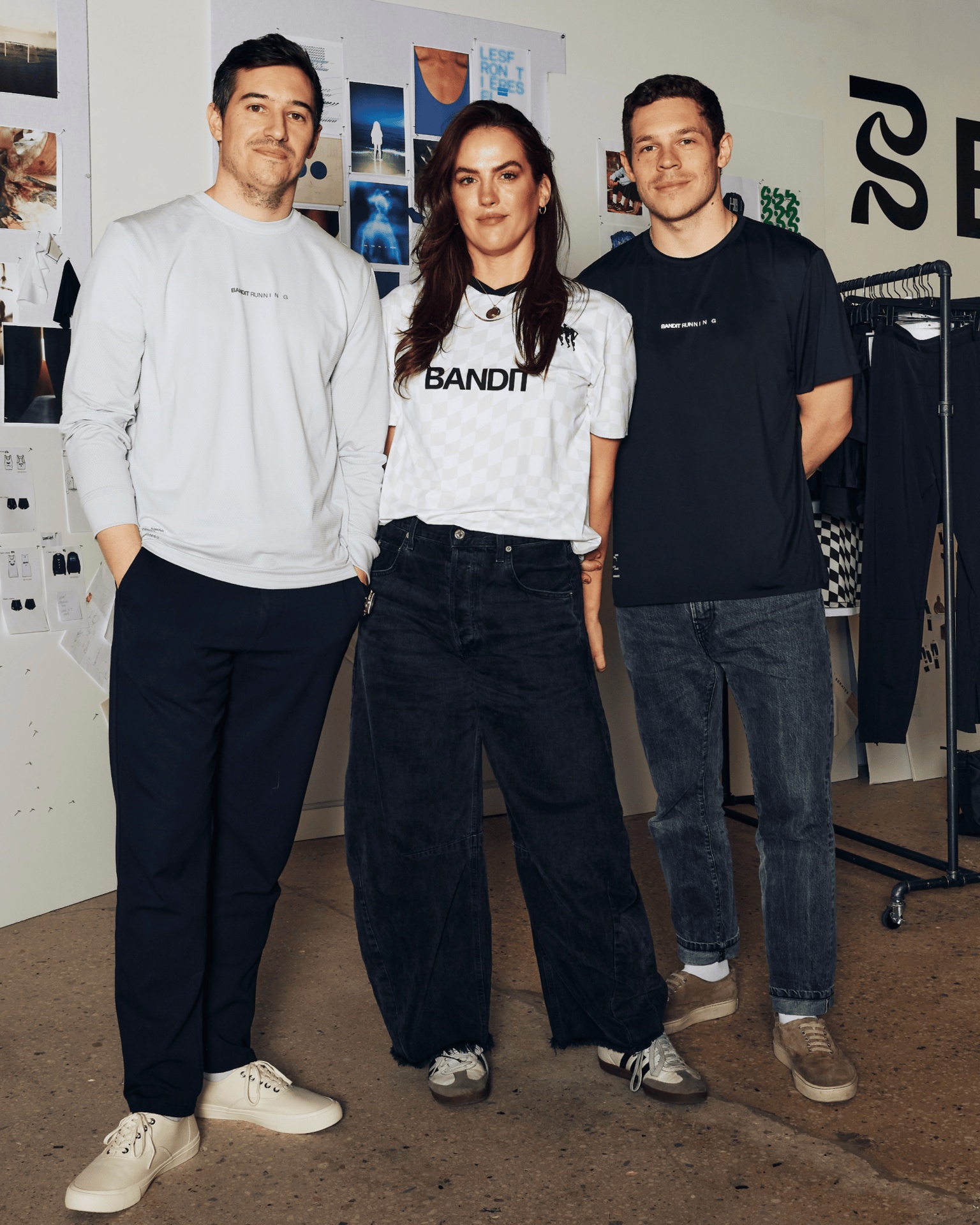
West is Bandit Running’s co-founder and CEO, working alongside his brother Tim, its founder and creative director, and co-founder Ardith Singh, who leads design. Their company has grown from running socks into performance apparel, stores, films and events. Yet the interesting part of Nick’s story is how much of the work still depends on proximity: to his brother, to customers, to the sport the business serves.
A brother’s invitation, badly timed
Tim started Bandit in a Brooklyn basement apartment in October 2020. Nick’s arrival came later. The company dates his joining as co-founder and CEO to November 2021, when he was in the middle of an MBA and expecting a second child. It was a substantial addition to an already crowded calendar. Joining a sibling’s young apparel business rarely makes the calendar simpler.
The brothers had grown up around New Jersey’s surf and skate culture. Both worked at Jet.com. That combination matters: one world offered an education in how people attach themselves to brands; the other offered experience in making an online business function. Bandit would need both. Affection might get someone to try a pair of socks. It would take a competent operation to deliver the next pair.
Nick’s career also included Walmart eCommerce and Cerebelly, where he held operating and e-commerce leadership roles. He brought experience in selling across digital and retail channels. His advisory work now covers the same practical territory: consumer brands, fundraising, distribution and the everyday decisions that turn an idea into a functioning company.
At Bandit, those skills sat beside Singh’s product experience and Tim’s creative instincts. The neat division is tempting: Nick handles business, Tim handles brand, Ardith handles design. Tim has pushed back on that account. He collaborates with Nick on creative work too. Their relationship appears less like three sealed departments than a continuing conversation, with each person bringing a different set of questions.
The first sale was an invitation back
A sock is an unusually sensible opening move for a business with larger ambitions. People wear through them. They buy replacements. They can try a new brand without replacing their entire running wardrobe. Nick has called the running sock a “trust-building product.” The expression has the pleasing modesty of a promise you can test on your next outing.
Early Bandit grew through word of mouth. Tim set himself a first-year rule against paid advertising and against pushing the product on friends. Nick understood the difficulty of that choice. Building emotional connections in person takes time; the payoff does not arrive on the tidy schedule of a marketing dashboard. A company can measure an immediate conversion more easily than someone deciding, months later, that these are their people.
The pop-ups became an education in their own right. Small events let the founders learn about staffing, spending and sales before attempting bigger ones. The point was to accumulate knowledge while mistakes remained affordable. Even the disorder on Bleecker Street had value: customers showed up, and the team saw a reason to return. In 2024, the address became home to Bandit’s Manhattan flagship, with Rhythm Zero handling the café.
- Tim starts with socksA Brooklyn basement
- Nick joins as CEOArdith joins as co-founder
- Performance apparelThe first full collection
Put the shop where the runners are
Nick wanted an early Brooklyn store to sit in the path of runners. The rent also mattered. A young business choosing its address has to satisfy more than its imagination. In Greenpoint, the practical need for storage and shipping could share space with a place customers might actually enter.
That choice made the shop useful between purchases. A water cooler outside gave passing runners a reason to stop. Runs gave them a reason to return together. The storefront put the founders within earshot of people using the clothes, with the office nearby. It made feedback less ceremonial. A conversation at the shop could reach the next collection without first becoming a presentation.
There is a danger in making this sound effortless. A shop has bills whether a group run is well attended or rained on. Customers who enjoy a Saturday morning still expect an order to arrive. For Nick, the appeal of this model sits alongside its obligations. The same people who make a business feel personal are close enough to notice when it lets them down.
On a running route more than on a shopping route.
Nick West, on choosing a store location
A customer can spot a contradiction
Bandit’s January 2025 answers to customer questions showed those obligations in plain view. The team addressed shipping delays after a warehouse transition collided with stronger-than-expected orders. It also explained why new products were bought cautiously, while established items moved into a more consistently available core collection. These were ordinary retail problems, presented to people who had experienced their consequences.
That is an essential part of the Nick West story. An appealing campaign and a late parcel belong to the same company. The person buying the shorts does not divide the experience into creative and operations. Growth puts those functions in conversation, sometimes loudly. The job of an operator is partly to make the promise and the delivery date resemble each other.
The partnership with ASICS had a similarly unceremonious beginning. Nick described the two teams visiting each other’s nearby Boston Marathon pop-ups in 2023 and getting acquainted. The relationship developed into collaborations and The Program, Bandit’s marathon-training initiative. It is a small example of his business’s recurring method: meet people in a place where they already have a reason to be, then find useful work to do together.
The contract with an exit door
The Unsponsored Project gives that usefulness a more explicit form. Conceived by Tim Rossi and launched in 2023, it supports track and field athletes who lack conventional sponsorship. The striking detail is the clothing: unbranded race kits. In a sport where an athlete can end up advertising a company that pays them nothing, an empty patch of fabric can carry a fairly pointed message.
Nick’s own account of the 2025 edition described support for more than 50 athletes at the USA Track & Field Championships. They received apparel and financial help, with a release clause allowing them to accept a professional contract elsewhere immediately. Six alumni had signed with footwear brands by then. Those departures were presented as progress. Keeping every athlete attached to Bandit would have defeated the stated purpose.
The 2025 package included a ten-day contract, $1,500 in cash, race and warm-up kits and a $1,000 Bandit gift card. These details matter because goodwill becomes easier to assess when it has terms. An athlete can use money for the costs of competing. A release clause can preserve an opportunity. Neither requires the audience to take a slogan on trust.
For a CEO, there is an interesting discipline in approving a programme whose visible success can involve another brand signing the participant. Bandit receives attention and a clearer place in the sport. The athlete keeps the freedom to move. The arrangement makes Nick’s recurring language about serving runners something people can inspect.
Plus racing and warm-up kits. Athletes can leave immediately to accept a traditional sponsorship.
Twelve people, one Olympic delegation
Bandit also made uniforms for Saint Vincent and the Grenadines at the 2024 Paris Olympics. The opportunity arrived after the team’s previous sponsor withdrew. Nick agreed to help, and the company developed the uniform in less than seven months, moving through five rounds of design and feedback. At the time, Bandit had twelve people. An Olympic deadline is an efficient way to make a small team’s calendar look ambitious.
A planned campaign shoot in Saint Vincent was cancelled because of a hurricane. The team instead shot in Paris shortly before the opening ceremony. That sequence says something about the scale of the undertaking: design, production and storytelling all had to reach the same finish line. Nick’s role involved committing a company that was still small enough for every extra project to be felt.
The products themselves have their own record. Singh’s six-pocket Stamina Nova Crop appeared in TIME’s Best Inventions of 2024. Four pockets across the back and two at the sides addressed the mundane question of where to carry things. Nick’s contribution is not the design credit. It is helping build a company in which that kind of specific product work can reach customers, alongside the events and stories surrounding it.
Still close enough to hear the answer
A March 2025 conversation with Nick caught him refreshing his phone as Bandit’s spring collection went live. The launch followed eleven months of work. Another release had required a 2:30 a.m. shoot, a whiteboard, an iPhone and Nick unexpectedly modelling shorts. The stairs had acquired a wardrobe department. Scale, evidently, had yet to eliminate the occasional emergency assignment.
By May 2026, Nick was discussing artificial intelligence and the future of e-commerce. He revealed that Bandit had run its first website A/B test only the previous month. Early on, he had deliberately put the effort into emotional attachment to the brand. At a larger scale, even a small improvement in conversion had become worth pursuing. He also described connecting roughly 200 internal datasets to understand the business. The operator who prioritised meeting runners was now investing in the machinery behind the transaction. His example for deciding what to build himself remained refreshingly physical: Bandit had brought Rhythm Zero into the store because running a coffee shop belonged to somebody else’s expertise.
Tim’s assessment of his brother offers a useful final detail: “Nick also bleeds brand.” It complicates the picture of a CEO kept backstage with the spreadsheets. Nick helps shape what people see, then has responsibility for much of what makes the experience hold together. His ambition for Bandit includes lasting relevance and international reach. The evidence so far is more tangible than the ambition: a shop on a running route, a contract with a way out, and an executive available when the stock is downstairs.