In Wrexham, a former Iceland supermarket acquired an unusual new purpose. The building became a place where people could start businesses. Opened in May 2018, the Wrexham Enterprise Hub put freelancers and small companies in a town-centre room with workspace and business support. The interesting question was what would happen once they began spending their working days together.
- TownSq combines local workspace with startup courses, introductions and practical business help.
- Customers range from solo professionals to councils commissioning enterprise programmes.
- The room needs a business model: Wrexham’s hub closed after its funding contract ended.
TownSq, the company operating the hub, was founded in 2017 by Gareth I. Jones and Mandy Weston. Their work supporting entrepreneurs dates to 2011. They had already seen communities form around shared space in Caerphilly. TownSq gave them a way to take that approach elsewhere. Certified as a B Corp since April 2019, it gives its community ambitions an independently assessed corporate framework. Their ambition sounds almost mischievously literal: put a TownSq in every town square.
A useful room, with useful neighbours
The company sits between several familiar markets. It rents workspace like a coworking operator, teaches business fundamentals like a training provider, and delivers programmes for public partners. Its customers include freelancers, remote workers, small businesses and people with an idea they have yet to turn into a living. Councils have a different reason to buy: they want local enterprise and occupied buildings.
A customer can book a desk, rent a private office or hold a meeting. They can attend workshops, join Startup Club, seek specialist advice or hand administrative work to TownSq Admin. TownSq Online extends access to community and support beyond the buildings. The attraction is the proximity of these things. Finding a room and finding someone who understands your problem can happen in the same visit.

In a 2020 interview, Jones explained that he had been uneasy with the coworking label. It could sound exclusive; his concern was creating an inclusive environment. What Caerphilly had shown him was that talented people did not need to relocate to a large city to find an entrepreneurial community. The desk was a means of getting them into contact.
The founder who already had a profession
Consider Niamh Honey, an osteopath who moved back to North Devon from Bristol after the pandemic began. She wanted to open her own practice. Her father suggested Node, TownSq’s Barnstaple workspace. There she enrolled in Startup Club and subsequently rented a ground-floor office for her clinic, specialising in women’s pelvic health.
Her account makes an important distinction. She knew her profession; business ownership brought another set of tasks. Startup Club helped fill those gaps and build confidence. Later, she described the difficulty of fitting notes and bookings around clinical work. A successful solo practice still has only one owner. The community helped; it did not manufacture extra hours.
“We’re not a unicorn farm”TownSq’s Startup Club
The programme’s own description is admirably unromantic. Its six sessions cover fundamentals including financial planning, marketing and sales, delivered weekly in the evenings or over two intensive days. Evening delivery leaves room for a salary while an idea develops. Kingston Council lists its local Startup Club as free to attend. That is a useful invitation for someone who has curiosity before capital.
Three purchases, three different prices
TownSq’s revenue model follows the work: workspace memberships and room hire, administrative services, commissioned support programmes, and software for other operators. The main site advertises five days of workspace for £25, excluding Kingston and Town Hall. Bicester lists coworking from £35 plus VAT a month. These are entry offers and local prices; they do not price every office.
Location exclusions apply
Starter package
Community plan; Stripe extra
TownSq Admin’s starter package buys eight hours a month for £224. Tasks include diary management, inbox work, bookkeeping and design; unused time can roll over for up to three months. For a founder considering help, the practical calculation is whether delegated work frees time worth more than the package. Buying support requires deciding what someone else can actually take over.
Cowork Local sells bookings, membership and asset management to workspace operators. Its Community plan lists a 10% booking fee; Pro lists £100 a month without booking fees, with Stripe charges separate. Comparing those headline charges alone, £1,000 of monthly bookings produces the same £100 cost. Above that level, the flat fee merits attention, subject to the plans’ terms.
The building cannot pay itself
The Wrexham hub belonged to a £4 million project to launch and grow enterprise spaces across Wales, funded through the Welsh Government and European Regional Development Fund. That was a wider project budget. It should not be mistaken for TownSq raising £4 million from investors.
The hub’s contract and funding ended on 31 May 2023; its closure was announced for June. Here is the uncomfortable part of community infrastructure: useful activity does not automatically produce enough income to keep a particular room open. Anyone borrowing the model needs a durable agreement about who pays for support, premises and the people bringing everyone together.
London House, TownSq’s Ystrad Mynach workspace, offers a smaller lesson. Its January 2025 magazine reported difficulty attracting users initially, followed by progress through open days and community events. Opening the door was only the first step. Giving local people a reason to walk through it required more work.
From civic buildings to football clubs
Expansion provides the counterweight. In April 2026, TownSq reported that Kingston’s original offices were fully let and around 150 members used its coworking desks. Bridgeworks opened in a former nightclub with six additional offices and an event space. In June, Crewe’s renovated Municipal Buildings opened with 20 offices, four meeting rooms and more than 40 coworking desks.
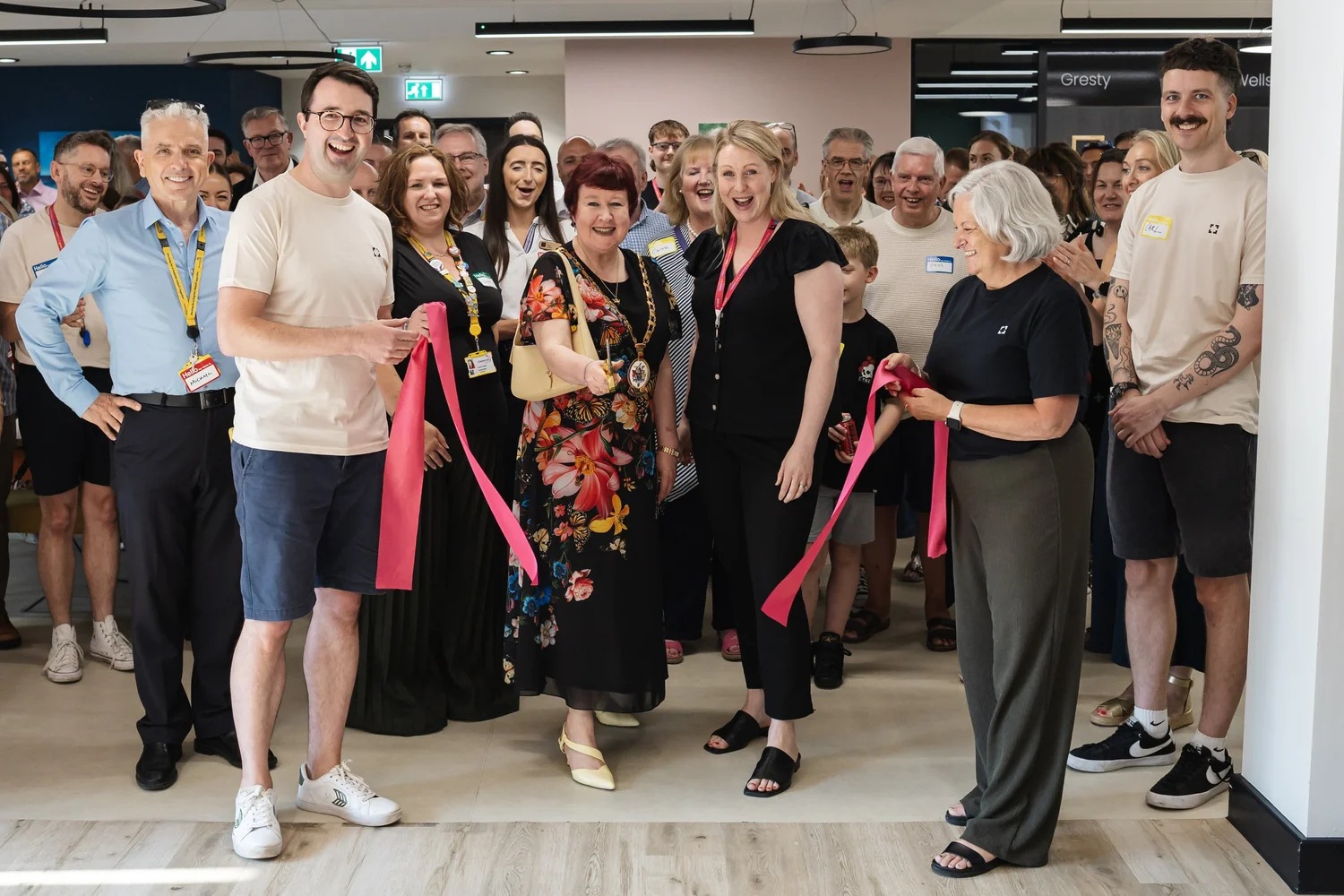
September brought a partnership with the Football Association of Wales to help Cymru Leagues clubs develop relationships with business communities. The setting changed; the method remained recognisable. For readers copying TownSq, the useful lesson is to pair a place people can reach with help they can use, then create repeated reasons to meet. A beautiful empty room has rather limited networking skills.