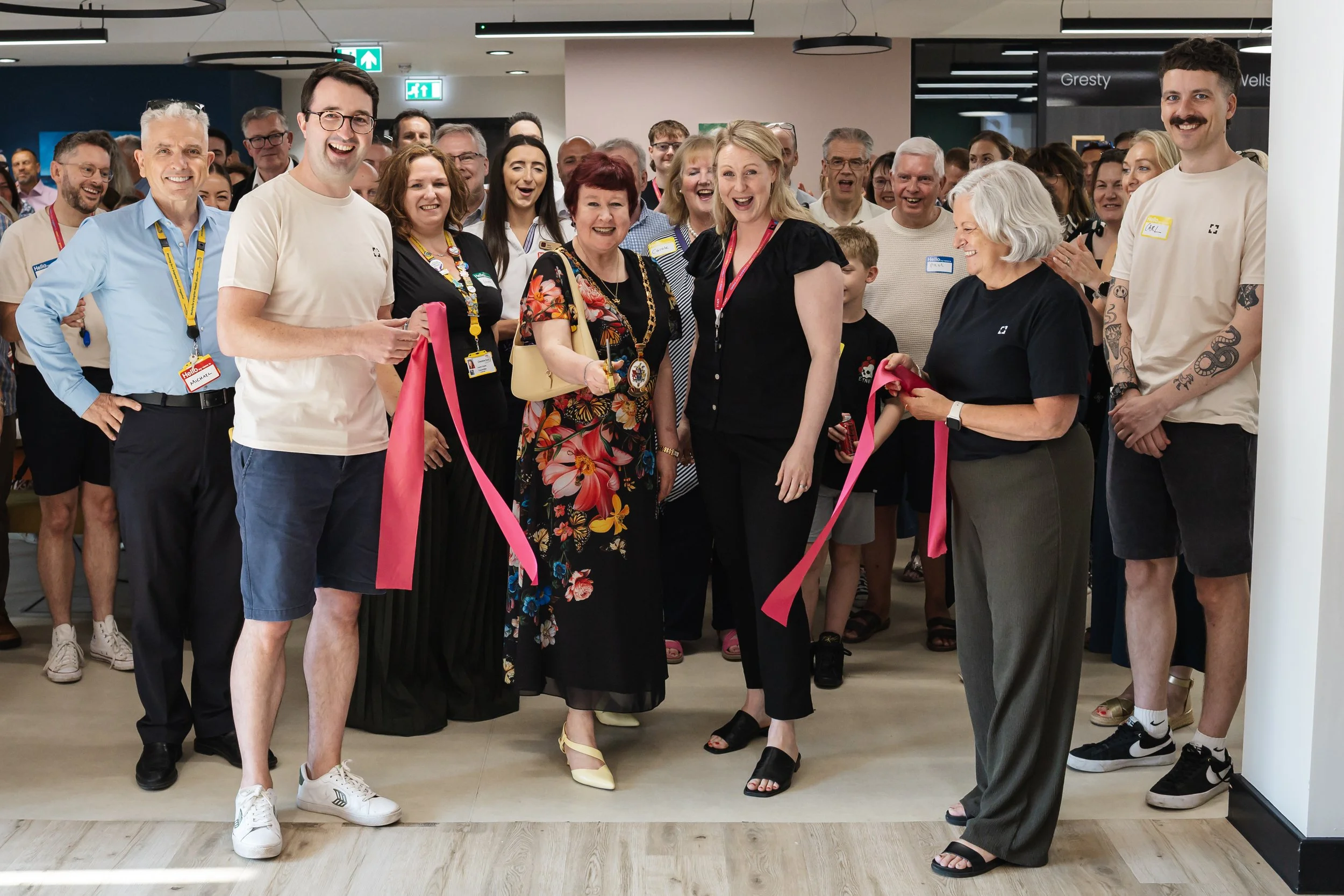
A former Iceland supermarket in Wrexham is an unlikely place to look for a theory of entrepreneurship. It offers a useful starting point for Gareth I. Jones. In May 2018, the building opened as the Wrexham Enterprise Hub, a place for freelancers and small businesses to work, meet and learn. Jones had been born in Wrexham. His new company, TownSq, was testing its ambitions on familiar ground.
The building’s change of use had a pleasing literalness. A shop that once supplied households would now help people earn their living. The hub became the flagship of a £4 million project to develop enterprise spaces across Wales. Its later impact figures included 149 new enterprises and 238 new jobs. Those are outcomes of a community and its support programme, rather than a personal tally for the person at the top.
Jones’s role was to help create the conditions. He and co-founder Mandy Weston had already spent years doing that in Caerphilly. With TownSq, founded in 2017, they were asking how far the idea could travel while keeping the work itself close to home.
Wrexham Enterprise Hub · historical programme outcomes
A job he could grow into
There is a danger, when writing about founders, of arranging their childhoods into a neat procession towards the company they eventually started. Jones’s own account makes that difficult. He has said he did not know what he wanted to do growing up. Running a business gave him room to learn and to make work he cared about.
In an essay about finding his place in the world, he recalled a long period of feeling that he could not see where he would fit. His eventual advice was practical: try things, seek different perspectives, ask people about their lives and listen carefully. The uncertainty was part of the process. A career could emerge from paying attention.
That outlook suits a business built around other people’s possibilities. Jones and Weston began their work with entrepreneurs in 2011. Welsh ICE became their first shared enterprise community in Caerphilly. They later sold their stake and started TownSq, carrying the experience into a company designed to work across the UK.
The big city can wait
Jones’s argument for local work begins with a view of talent. In a 2020 coworking interview, he talked about capable, passionate people living throughout communities. He wanted people to see that fulfilling work and interesting projects could be available without leaving for a big city. TownSq gave him a way to test that proposition in different places.
The same conversation supplied a less solemn detail. Jones recalled jumping on tables and dancing in a promotional video. Entrepreneurship support can involve policy boards and economic development; apparently it can also involve furniture with an unexpected second career as a stage.
His public responsibilities have included the Prime Minister’s small-business council and Welsh creative-industry initiatives. In May 2022, GEN UK appointed him National Director for Wales. He wanted Welsh entrepreneurs to make better use of the international network and tell their story more widely. Staying rooted in a place, in his version of the idea, still leaves room for reaching out.
Before the desks, draw the map
A workspace arrives in a community that already has a working life. Jones describes beginning with an ecosystem map: a workshop that gathers people who can explain the area’s businesses, funders, advisers, educators and networks. The purpose is to understand what exists before deciding what to add.
His examples are specific. One place might have plenty of public business-support organisations and no intellectual-property specialists. Another might have investors who remain hard to find because there are few accessible events or networks. An impressive list of institutions can conceal a missing connection.
Mapping helps TownSq decide where to put effort and whom to support. It also makes duplication harder to justify. Read this alongside his involvement with Platform Places, which brings together people working on town-centre property, and a pattern appears: Jones spends time with the people around a building as well as the building itself.
The dream has opening hours
When Jones talks to aspiring entrepreneurs, he asks what they are looking forward to doing. The question sounds almost too obvious. It becomes more revealing when the attractive business idea turns into a working week.
His example of opening a cafe or bar invites the founder to think about late nights and covering shifts. He recommends small experiments, imagined schedules and a close look at the chores. Making a product, branding it and selling it can bring different kinds of satisfaction. Wanting one part of the job says little about wanting all the others.
There is warmth in that advice. It takes the person’s ambitions seriously enough to ask whether they would enjoy the life required to fulfil them. A business plan can look quite handsome while concealing a rota its author would rather never work.
Jones applies similar scrutiny to digital ideas. In a 2023 essay, he challenged the assumption that building an app should be a founder’s default move. Existing habits, the cost of pursuing the idea and actual demand all deserved attention. Persuading someone to install software is only the beginning of persuading them to use it.
Build something that lasts
Another of his recurring questions concerns the shape of a social mission. Drawing on his time as an UnLtd Future Pioneer, he developed an analogy about bridges and rafts. A raft can get something across a river quickly. A bridge takes more investment and time, but keeps serving people after construction.
The comparison lets him think about immediate help and the slower work of changing conditions. It also illuminates the attraction of a shared workspace: a place can support successive businesses, introductions and projects. The value need not end with the first person through the door.
In 2024, TownSq partnered with Irish workspace-management company Baseworx. Jones described a shift towards services and partnerships that could support local economic communities over time. The teams had first met at a conference in Amsterdam. A local ambition had produced an international conversation, followed by a practical way to help more spaces operate.
A weekly appointment with the blank page
Jones’s writing began with an experiment of its own. For 2022, he set himself a New Year’s resolution to publish a fresh piece every week. By January 2023, he had produced more than 50,000 words. He had not previously thought of himself as a writer.
He found that the practice improved his ability to write quickly elsewhere, including letters and reports. The project then became The Good Founder, shaped around the challenges of launching and leading a business with a purpose.
“I never thought of myself as a writer.”
Gareth I. Jones, reflecting on his 2022 writing challenge
His year-end review for 2023 was candid about the mechanics. He had published 37 times, compared with 51 the year before. He discussed moving newsletter platforms, trying different publication times and wanting readers’ opinions. He also admitted that a conversation with someone who had enjoyed a piece could mean a great deal. The person encouraging connections between founders appreciated a connection with a reader.
Who gets counted as a business?
His 2024 paper, What If There Were No Freelancers?, turned towards people whose work is woven through other businesses. He argued that freelancers bring personal trust, adaptability and specialised knowledge that can travel between clients and industries.
The diversity of those working lives makes a single public voice difficult. Jones called for more respect, security and fair treatment, alongside community. That position fits his interest in the person behind the business plan: people can be economically useful while remaining poorly understood by the systems intended to support them.
His own business has continued to grow in Caerphilly. When TownSq announced its Ystrad Mynach space in 2024, Weston stressed the commitment to keeping its headquarters in the county borough. Expansion had given the founders more places to work with. It had also given them reasons to invest at home.
The weather has a vote
By January 2026, Jones was discussing glass screens at Ffos Caerffili, the container-style market operated by TownSq and event organisers Crafty Legs. Wet and windy days could discourage visits. Making seating areas more sheltered was a practical response.
For someone associated with entrepreneurship ecosystems, it is a satisfyingly concrete problem. People need somewhere to gather, and in Caerphilly that somewhere benefits from keeping the wind out. Jones wanted the market to become an obvious starting place for a day or evening in town.
Other changes that year involved the company’s own foundations. Peter Trott became chair in February, succeeding Professor Dylan Jones-Evans, who had been involved since TownSq began. In June, the Crewe hub officially opened in the historic Municipal Buildings. Its mix of offices, meeting rooms, event space and shared desks gave another town-centre address a new working life.
A place on the team
In September 2026, the Football Association of Wales announced a partnership with TownSq to help Cymru Leagues clubs develop relationships with local, regional and national businesses. Jones wanted more small businesses to participate in the opportunities around Welsh football.
Football is a familiar interest: his Business Wales profile lists five-a-side and supporting Arsenal, alongside reading and travel. The partnership connects a personal enthusiasm with a longstanding professional concern. Clubs already bring people together. TownSq’s job is to help make those relationships useful for enterprise.
There is a parallel concern in his recent writing about AI. After encountering remarkably similar cover letters during recruitment, he asked how businesses could adopt the technology while retaining their humanity and distinctiveness. A tool that makes everyone sound alike creates a peculiar problem for anyone trying to understand the individual.
Across the buildings, workshops and essays, Jones keeps returning to people finding room to do worthwhile work. His route has taken him from Caerphilly to other towns, from shared desks to markets and football clubs. The town square in the company’s name remains an apt ambition: somewhere people can meet, bring an idea, and discover who might help them get on with it.