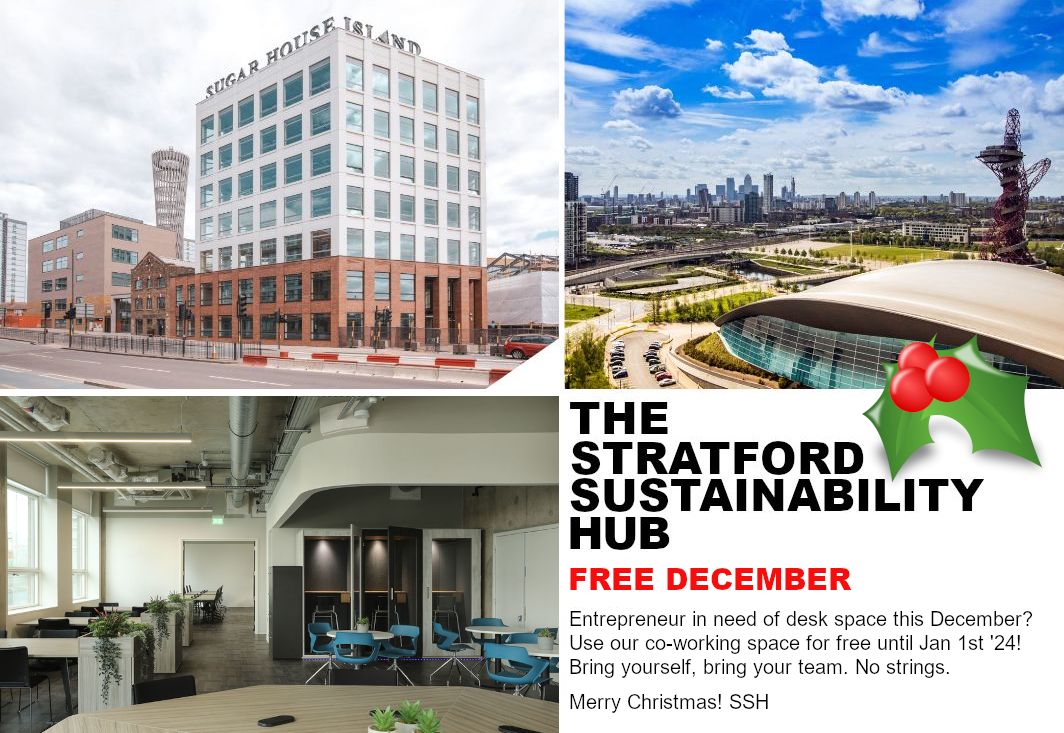
The desks were free. The invitation was cheerful. The final condition had teeth: “No loafers!” In late 2023, the Stratford Sustainability Hub offered entrepreneurs and home workers spare office space over Christmas, with a limit of 100 people. Applicants needed an actual project and a willingness to engage with others. A free seat came with the expectation that somebody would do something useful in it.
The promotion ran through January 1, 2024, ahead of a planned formal launch. It made a practical proposition: a recently finished floor had room; people working on businesses needed somewhere to work. The offer included assigned desks, business amenities and opportunities to meet other people. It was an invitation to become a regular presence, rather than drift in for a single afternoon.
That small experiment is a good introduction to the Hub. Its subject was sustainability, but its immediate tool was office space. Bring people with projects into a shared setting, give them somewhere to work, and create occasions for useful conversation. The building supplied the seats. The members had to supply the purpose.
A London address, a very local proposition
The setting was 1 Sugar House Lane, Stratford, East London. A January 2024 Kind Community breakfast invitation gives that precise address. The Hub’s own launch promotion also explicitly names East London. The geography matters: this was a workspace within reach of London’s founders and professionals, with activities organised around showing up in person.
Sugar House Island’s Dane’s Yard is a canalside district combining office buildings with outdoor spaces and places to spend time after work. The estate markets its walking and cycling connections as part of the offer. For a business community, the surrounding neighbourhood has a mundane but consequential job: make it possible to meet, work, eat and return without turning every encounter into an expedition.
The same address appeared in Newham Council’s directory under Divisible Space, offering everything from a hot desk to private offices and headquarters suites. Phone booths, meeting pods and event space were part of that building’s commercial offer. This places the Hub within a recognisable market: flexible workspace with a particular business community attached. Its specialism was the people it sought to attract and the subjects it put in front of them.
The desk had a price. So did the expertise.
The Christmas offer is best read as an introductory experiment. The underlying building had an ordinary paid workspace offer. A Divisible Space brochure hosted by Newham Council listed a day pass at £20 plus VAT, a five-day pass at £90 plus VAT and a ten-day pass at £160 plus VAT. A fixed desk was advertised at £279 plus VAT per month. These are historical building prices, rather than a current Hub tariff.
The brochure also offered managed suites with design, fit-out and ongoing management bundled together. For a growing team, that arrangement addresses the administrative side of having an office: someone has to organise the space and keep it running. The building could accommodate different levels of commitment, from occasional attendance to a dedicated base. That flexibility helps explain why a sustainability community could sit within a broader office business.
Knowledge had a separate price tag. Colocentric advertised one-day workshops delivered with Beeyon at the Hub for £500 plus VAT. Their subject was data-centre sustainability, including energy use, server resources and performance measurement. The intended audience included senior managers, procurement teams and people responsible for environmental, social and governance compliance. A workshop ticket bought specialist instruction; a workspace pass bought somewhere to work. Those are distinct purchases, even when they share an address.
Calculated from Divisible Space’s brochure: £20, £90 and £160 respectively, excluding VAT. Historical building offer, not current Hub pricing.
Breakfast, with a business question attached
The January 2024 Kind Collab Breakfast Club announcement gives the community idea a schedule. Doors opened at 8:30 a.m.; the session began at 8:45. Earthly Biochar co-founder Connor Lascelles was advertised as the speaker, discussing his business and nature-based solutions. The programme paired a founder’s story with business-growth questions, speed networking, snacks and coffee.
There was also a request for a housewarming gift, perhaps a potted plant. It is an unusually domestic detail in a business invitation. The message was that a new workspace could be something attendees helped establish. Kind members were directed to use a ticket discount code, giving an existing network a reason to gather at the new address.
Caner Veli had already publicly thanked the Hub and Rob Scriven for providing workspace while discussing his Purpose or Profits programme for ventures making physical products with an impact mission. The relationship put the Hub alongside a business-support community concerned with selling and growing, as well as environmental intention. For a founder, the attraction is easy to understand: a specialist conversation becomes more useful when it reaches customers, pricing and the practical difficulty of running a company.
Then somebody brought up the bidet
One Hub post recounts an encounter with Bikke Chettri, founder of Chakow, whose proposed product was a self-install bidet. The writer admitted to initially wanting to escape the conversation. Bathroom habits were an awkward subject, and the product was an unexpected opening act for a sustainability hub.
The conversation nevertheless turned toward toilet paper: its packaging, manufacture, use and disposal. The post described interest replacing discomfort, while asking whether evidence about alternatives could persuade people to change familiar habits. That is a more interesting account of changing someone’s mind than a polished claim that everyone embraced innovation from the start. The first obstacle in this particular encounter was embarrassment.
The episode illustrates a useful role for a place like the Hub. An entrepreneur can bring a concrete object into a conversation and discover the objections it provokes. The environmental merits of a product still require evidence, and a lively discussion is not a life-cycle assessment. But discovering that prospective users find the subject uncomfortable is commercially relevant. A founder who cannot get people to discuss a problem will have a difficult time getting them to buy its solution.
What happens when a greener product meets an everyday habit?
An editorial takeaway from the Chakow encounterThe company among the companies
By June 2024, Veli’s account of Reset Connect included the Hub among the businesses represented with Kind Community. He described its contribution as flexible workspace. The surrounding list included haircare, food, cycling equipment and products made with recycled plastics. It was a small but telling piece of positioning: the office provider appeared alongside businesses making things people could use.
An October 2024 Kind Convention post also listed the Hub among the Purposeful Profits cohort that pitched. The Hub therefore appeared in two roles in that network: providing a setting for entrepreneurial activity and presenting its own proposition as a business. Both appearances are concrete examples of participation, rather than measures of how successful its members became.
The alternative for a potential member is not necessarily another sustainability-branded hub. It might be home, a conventional serviced office or a local coworking provider. Spaces, for example, markets workspace at Sugar House Island’s Type Building. The useful comparison is therefore quite specific: does a shared sustainability interest produce conversations worth making time for? A desk can be compared on access, facilities and price. A community has to earn its value through the people and activities it brings together.
The building’s next chapter came in 2026
On January 13, 2026, Scriven announced that Juntos Offices had acquired Divisible Space, with new branding planned for Furnival Street and Sugar House Lane. He described discussions, negotiations, fundraising and planning during the second half of 2025. This was an announcement about the workspace operator; it should be read at that level when considering the setting in which the Hub developed.
Juntos’ James Hennessy was unusually direct about the commercial task at Stratford. “Sugar House Island won’t fill itself,” he wrote in his acquisition announcement. He described an emerging destination whose occupancy required work. It is a useful corrective to the assumption that a handsome building and a community proposition automatically produce a full office.
That tension had been present in Scriven’s thinking for years. In a 2020 article about Divisible, he discussed the competing desires for collaboration and privacy. Clients might want company, yet also want control over meeting rooms, temperature and internet capacity. The earlier argument helps explain why flexible workspace is a balancing act. A good conversation can improve a working day; a constant demand to participate can also interrupt it.
“Sugar House Island won’t fill itself.”
James Hennessy, Juntos acquisition announcement, January 2026
Give people a reason to come back
The Hub’s early activities suggest a modest, repeatable approach for anyone organising a business community. Start with a specific group and an actual place to work. Arrange a session around a real business problem. Bring in somebody who has worked on it. Leave room for people to ask questions and make introductions. These are lessons drawn from the format, rather than a claim that attending a breakfast guarantees a customer or an investment.
The conditions matter. Spare space makes a temporary free offer possible; a fully occupied building has a different calculation. A local breakfast depends on people being able to reach it. A shared office suits some kinds of work better than others. Teams handling confidential discussions need privacy, while a maker needing production equipment must judge whether office facilities solve the problem at hand.
The most appealing part of the Stratford experiment is its willingness to be concrete. There was a desk to sit at, a morning to attend, a specialist subject to discuss and, unexpectedly, a bathroom product to argue about. For people trying to turn an environmental intention into a working business, that is a useful starting point. Bring the project. Be prepared to explain it. Give the person at the next desk something more interesting to respond to than a mission statement.