Gabriel Espín had a perfectly sensible reason to move offices. His business needed more space. Yet the thing he disliked about leaving had no place on the floor plan: the other entrepreneurs. While working on Anyplast with Juan Carlos Morales, he had developed a habit of taking questions out to the terrace, where other founders could offer advice. Moving meant losing that easy access to people who understood the work.
In 2016, Espín, Morales and Franz Pallerés founded Aticco in Barcelona. They had experienced coworking as customers and believed they could improve it. The company took its name from its first home, an attic. There is something pleasingly literal about the name. Before there was an expanding group, there was an address with a view.
Ten years later, Espín is running a business that has carried the idea into other cities and other services. The question running through his career remains unusually concrete: how much more useful can a place become when the right people share it?
The engineer and the material nobody wanted
Espín studied industrial engineering at the Universitat Politècnica de Catalunya. His professional education later included executive programs at ESADE and IESE. Before offices became his business, he worked on 3DFilPlast and co-founded Anyplast, an online marketplace for recycled plastics.
Anyplast addressed an unglamorous problem. Manufacturers generated plastic material that could have value for someone else, but buying and selling it was cumbersome. The platform brought offers and demand together, with services around samples, testing, certification and transport. It dealt in the practical work between having something available and finding someone who could use it.
In a December 2015 introduction, Espín described a service intended to save businesses time, administrative effort and commissions. A year later, explaining the idea, he focused on inefficiency in the trade and the cost of material ending up in landfill. The pitch depended on making an exchange work for both sides.
That earlier venture offers a useful way to read his subsequent career. Connecting industrial buyers and sellers is a different activity from introducing entrepreneurs over coffee. Still, both make the distance between separate businesses worth examining. Something useful may already exist nearby; the difficulty is getting it into reach. This is a reading of the two ventures, rather than evidence that Espín had planned the second while building the first.
An attic becomes a business
Aticco’s founding group brought different experience to the venture. Espín and Morales had worked together on Anyplast. Pallerés brought knowledge of coworking. Their shared office experience gave them a customer’s view of what could be improved, and they started building a version they wanted to use themselves.
The early work included renovating the premises, painting and assembling furniture. Anyplast became the first customer. It is an origin with less distance between the founders and the service than a polished launch photograph might suggest. They were making the place usable while also depending on it.
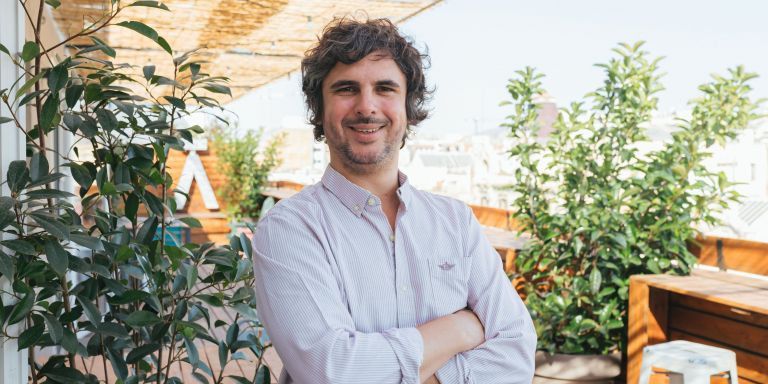
Friends and family helped with the work in the company’s early days. The first workspace grew into further locations around Barcelona. By 2019, Espín and Pallerés were speaking to other operators about expanding without a hedge fund. Their experience had become something to explain onstage, rather than merely something to get through.
The founding detail that matters most is the founders’ position as users. They had a reason to care about how an ordinary day felt inside the building. An office could have enough desks and still leave a person without anyone useful to ask. Aticco’s opportunity lay partly in making those conversations easier to have.
The numbers behind a friendly room
A sociable workplace still has a financial model. Buildings require investment, and an operator needs an arrangement with the owner before it can welcome a single member. Espín’s account of Aticco’s growth pays attention to those arrangements alongside the language of community.
At the end of 2022, the company had 33,000 square metres of coworking space and about €11 million in annual sales. These are dated milestones, rather than a description of the company today. They mark the point at which the original attic had become a substantial operating business across Barcelona and Madrid.
- 2016An attic in Barcelona.
Aticco begins. - 202233,000 m² across
the coworking portfolio. - 202620,000 m² in one new
building: Diagrame. - OCT ’26Two operating centres
acquired in Lisbon.
Separate milestones. The Diagrame figure describes one building; the 2022 figure describes the portfolio.
In early 2023, Espín was explaining the growing role of management contracts. Under that model, a property owner could fund the fit-out and participate in the operation’s returns. Aticco reported that a quarter of its spaces were then under management agreements, with the remainder held through conventional leases.
The distinction matters because growth requires more than demand for desks. It also requires owners willing to work with an operator. Management agreements gave the company another way to bring buildings into the business, alongside taking a lease. The relationship with the landlord became part of the product’s machinery.
By its 2024 review, Aticco was reporting an investment round of almost €10 million to support expansion. The business that had once presented its growth without a hedge fund was developing further sources of capital. A founder’s financing decisions have their own timeline; a conference title need not become a lifelong vow.
The expansion also brought costs. Cospace SL, the operating company behind Aticco, recorded a €2.43 million loss for 2025 on revenue above €16 million. Company representatives attributed the loss to investment and amortization. Its management agreements had meanwhile grown to cover 53% of surface area by the end of that year. The figures put some weight behind the talk of changing models: the company was expanding while altering how it worked with property owners.
A founder needs more than a desk
Espín’s professional biography now spans Aticco’s workspaces, shared living, startup support and investment community. The connections between those activities are straightforward. A person building a company may need somewhere to work, somewhere to live, experienced advice and access to people prepared to back the business.
AticcoLab gave the group a more formal way to support that work. It began operating in 2020 under Quino Fernández. Early programs brought startups into contact with mentors and investors, while corporate partnerships included work with DAS and the Cellnex Foundation.
One feature of the early accelerator was the role of choice: participating startups could assemble a board of four mentors from the platform’s network. That made an introduction part of a continuing working relationship. Advice had a structure and a schedule, beyond the chance conversation that had helped Espín at the beginning.
Aticco Living extended the group into shared accommodation. Aticco Ventures added a business angel community. The combination widened the company’s relationship with entrepreneurs, giving it reasons to remain involved beyond the monthly office bill.
“para mí el equipo es lo más fundamental”
Gabriel Espín, 2023
“For me, the team is the most fundamental thing.” Translation from Spanish.
Espín’s own account of company-building puts considerable weight on the team: professional knowledge, commitment and the desire to keep going. He also values colleagues whose company remains welcome after work. His definition leaves room for both responsibility and a beer afterward. Anyone can put collaboration in a presentation; choosing people you still want to see when the presentation ends is a more personal standard.
A much larger room, a harder test
Aticco Diagrame opened in Barcelona’s 22@ district in 2026 with 20,000 square metres over five floors. Reported opening occupancy was 75%. The scale invites comparison with the original attic, though a large building introduces its own questions about how different kinds of businesses share a place.
Its occupants included international companies such as Back Market, alongside smaller businesses and independent professionals. Espín described Barcelona’s ability to attract talent as part of its appeal to incoming companies. In his telling, the city helps the operator, while the operator contributes another place for the city’s businesses to work.
The mix also makes the community proposition more demanding. A sole proprietor and a large company may appreciate the same location for different reasons. A room can accommodate both; useful relationships require more care. As the company grows, the original attraction of knowing whom to ask becomes an operational challenge.
Aticco also faced public scrutiny in July 2026. Plataforma per la Llengua filed a complaint over a dismissal involving an employee’s use of Catalan. The company disputed linguistic discrimination and said the dismissal concerned professional conduct and performance. Around 40 employees later defended its multilingual working practices. In October, company representatives said the matter was resolved. That statement did not establish an adjudicated finding on the competing accounts.
The episode belongs alongside the company’s stated values. A business built around people is assessed through workplace decisions as well as the services it sells. Expansion gives those decisions a larger audience.
Lisbon, with the lights already on
On 14 October 2026, Aticco announced the acquisition of Nimbler Spaces in Lisbon. The deal added two operating centres in the city’s business district, with a combined 7,948 square metres and reported occupancy of 99%. The locations would operate as Aticco Marquês and Aticco Picoas.
Buying an existing operation changed the way the company entered the market. There were already customers, working premises and an established business. The announcement presented this as a way to gain scale immediately, rather than wait through the normal process of launching new spaces.
A further Lisbon building, Aticco República, was described in the October announcement as planned for the second quarter of 2027. That distinction is important to the story’s timing. Two centres arrived through a completed acquisition; another remained a project ahead.
Espín’s ambition now reaches beyond the city where he first found a useful community. In discussing European growth earlier in 2026, he paired expansion with the intention to preserve the company’s identity. That is easy to say and harder to demonstrate, particularly when an established group of customers joins through an acquisition.
The next test is ordinary enough to fit inside the first office: whether the people sharing a place find it useful to be there together. Espín began as a founder reluctant to lose that experience. He now runs the company responsible for helping others find it.
Continue the conversation
Company, personal profiles, interviews and further reading.