A garden designer is a useful person to meet in a coworking story. Lydia Hastings, founder of Fairnilee, spends her working life thinking about native plants, wildlife and the small ecosystems people can restore outside their windows. She also sends invoices. In an August 2026 Flywheel member interview, she describes running a company of one: designing, sourcing, installing, maintaining and managing the business herself.
What she values about Flywheel is other people who recognize the predicament. Her account of learning from fellow owners gives the company’s community pitch a concrete shape. Entrepreneurship can mean a technology company chasing investors. It can also mean figuring out how to price tomorrow’s garden installation without a colleague to ask.
Flywheel Coworking has made room for both. Its footprint runs through Winston-Salem and Concord in North Carolina and Greenville in South Carolina, with an independent affiliate in Mount Airy. The geography is the argument: useful business relationships should be available in the places where people already have lives.
A furniture company, an ad agency and a workplace designer
The ingredients were unusually literal. Wildfire, Workplace Strategies and Storr Office Environments formed Flywheel together. Marketing, workspace design and furniture were present at the creation. When it opened in 2014 at Winston-Salem’s 525@vine, the space covered more than 11,500 square feet, with areas for private work, meetings and socializing.
Brad Bennett, Wildfire’s co-owner, described a resource network and programming that would put expertise within members’ reach. Early offerings included experts’ office hours and informal educational sessions. The coffee bar and pool table made the space approachable; the intended payoff was getting a business question answered.

Peter Marsh remains a cofounder at the center of that approach. Flywheel’s leadership page identifies Andrea Howell as partner and chief operating officer. Marsh also helped found the affiliated Flywheel Foundation, which supports entrepreneurship programming. Those overlapping roles connect the organizations, but the coworking operator and the nonprofit have distinct jobs.
The company describes its work as developing, designing and operating entrepreneurship centers. That is a broader assignment than furnishing an empty floor. It has also designed and operated coworking at Davidson College’s Hurt Hub before handing operations to the college, experience that helps explain its interest in institutional partnerships.
The desk comes with a menu
For an individual customer, the proposition starts with an ordinary decision: how often do you need somewhere else to work? Winston-Salem’s published menu includes a $22 day pass, a $70 monthly plan for five business-hour visits and a $125 plan for ten. A reserved desk costs $350 a month; a private office is listed at $775.
Joining fees change the first bill. The five-day plan lists $25, while the private office lists $250. Access hours and meeting-room allowances depend on the plan. The website even suggests a day pass for escaping visiting in-laws, a refreshingly specific use case for flexible real estate.
Meeting customers have a separate reason to come. Nonmembers can rent rooms by the hour; Winston-Salem lists a four-seat room at $30 an hour and a larger room at $100. Members receive lower rates. Outside catering is allowed, with no food-and-beverage minimums or preferred caterer requirement. For a small team organizing an offsite, that can simplify the planning.
The commercial model combines recurring workspace payments with room rentals, address services and additional business support. Conventional offices, other coworking spaces and the home office all compete for that spending. Flywheel’s pitch is strongest when a customer wants both somewhere to work and a practical reason to meet the neighbors.
The calendar was the first casualty
Concord supplies the less photogenic part of the story. Long before the Cabarrus Center opened in 2021, local studies had identified a recurring problem: business resources existed, but they were fragmented and hard to navigate. A shared address offered a way to make the support easier to find.
Then the pandemic made shared space a difficult proposition. In an April 2026 retrospective, former Cabarrus EDC executive director Page Castrodale recalled questioning whether it would work when everyone was working from home. Marsh’s explanation for proceeding was concrete: the center was already designed and its financing lined up.
“We weren’t going to back out.”
Peter Marsh, recalling the Cabarrus Center opening
The membership timetable took the hit. The retrospective describes roughly 18 months as typical for building membership at such spaces; Cabarrus needed closer to two to three years. The lesson is about carrying time. A furnished building can be ready well before enough people are ready to use it.
A follow-up anniversary account shows what the shared address was meant to accomplish. Rowan-Cabarrus Community College’s Small Business Center reported better visibility after relocating there. The center also brought together retail support, mentoring and other partners, giving business owners several routes into assistance.
Kim and Kinzer Messenger, owners of The Task Tacklers and Handyman Home Solutions, were paired with mentors through the center’s VMS program after joining in March 2025. Their account emphasizes introductions to vendors, clients and professional advice. It is a useful example of the mechanism: bring the right people within reach, then help an owner make the connection.
Pepsi leaves the building. Founders move in.
Greenville gives the model an industrial backdrop. Flywheel opened on July 10, 2024, as the anchor tenant of Crescent One in Hartness Development’s Crescent Startup Community. Its 23,000-square-foot space included private suites, coworking areas, seminar rooms and places to gather.
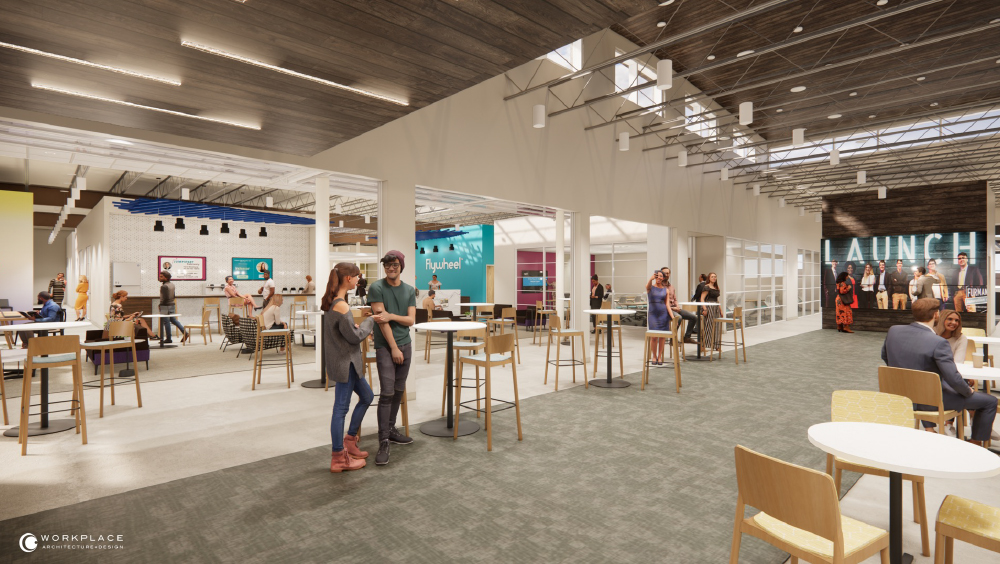
The address was once a Pepsi-Cola bottling property. An April 2024 Greenville News report put the broader development project at $18 million, funded through local investors led by Hartness Development and financing involving Ameris Bank and SC JEDA. That figure belongs to the property project; it should not be read as money raised by Flywheel itself.
Furman University added another reason to gather there. Its Innovation Lab opened in 2024 through collaboration involving the Hill Institute for Innovation and Entrepreneurship, Flywheel and Hartness. Student entrepreneurs could work alongside a broader business community, with the university’s entrepreneurship and leadership interests meeting in one location.
The arrangement illustrates Flywheel’s position in the market. A developer supplies the real-estate setting, educational partners bring people and programs, and the operator makes shared work function day to day. None of those roles automatically produces the others. Putting them together is the substantial part of the job.
Putting a price on the next conversation
Flywheel’s Momentum Services makes the support offer more explicit. Promoted in June 2026, the $75 monthly add-on includes a standing business-coaching meeting with Flywheel leadership, a business address and mailbox, and two additional meeting-room hours. It also provides access to professional services sold separately for an agreed scope of work.
Those services span practical needs such as marketing, software development and bookkeeping. A member should read the $75 as a defined bundle, rather than assume every specialist’s work is included. The program’s value depends on whether the monthly conversation helps identify a real next task and the appropriate person to handle it.
Mentor Deck supplies a related layer of assistance, administered by the Foundation and available to all Flywheel members. Its rules deserve attention: confidentiality is expected, conflicts are restricted, and mentors cannot solicit business or invest in a venture they advise unless the mentee invites them. A venture can also request a team of three or four mentors.
“Follow up or fall out”
A published Mentor Deck value. An introduction needs a next step.Concord’s Groove Studio takes another business obstacle off the list. Announced in October 2025, it was developed with FocalGroove’s Mark Shropshire and Bayo Fodeke to help creators who find podcast production intimidating. Services extend from recording and lighting to editing, graphics and publishing. A room becomes more useful when someone helps you use it.
A regional network, with local opening hours
In May 2026, Flywheel announced a partnership with Hartness and Launchpad to connect startup activity across the Carolinas. The announced division of labor was straightforward: Hartness provides the setting, Launchpad brings incubator and accelerator programming, and Flywheel extends access through its flagship locations.
Launchpad’s Tech Village occupies 6,000 square feet at Crescent One and advertises access to neighboring Flywheel amenities. Its offer targets technology founders and operators. That adds a more specialized community alongside Flywheel’s broader membership, while the partnership sets out plans to integrate programming across Winston-Salem, Concord and Greenville.
Ordinary workspace reciprocity has its own limits. Flywheel’s published policy allows up to four days a month total at other locations, requires advance notice and restricts visiting access to business hours. Home-location meeting credits do not travel. Mount Airy’s Interworks is an independently operated affiliate, connected through consulting and access arrangements.
For other communities, the copyable idea is to organize the resources already nearby: a college, experienced owners, an available building, people willing to make introductions. Concord’s slow membership development suggests that patience must be part of the budget. For members, the test is equally practical: visit on a normal workday, try the space and identify the help you would actually use.
A worker who needs only occasional silence may be well served by a day pass. A company needing extensive private space or unrestricted access across cities has different requirements. Flywheel’s more interesting customer is someone like Hastings: capable at the work, carrying the whole business, and glad to find people who understand what happens between doing the job and running the company.