The most revealing thing about CEME Business Campus may be what occupied its Rainham site before CEME did: engine blocks. Ford left them outside to rust, a deliberate stage before the metal was sealed and machine-finished. Then Ford stopped assembling cars at Dagenham in 2002. The field became a neat little metaphor for East London's industrial problem - an asset in plain sight, waiting for somebody to work out its next useful form.
CEME was the answer built on top of it. The Centre for Engineering and Manufacturing Excellence opened in 2003 as a purpose-made place for engineering education, enterprise and research. Ford donated the land. Public agencies, colleges and universities joined the partnership. A contemporary construction account put the centre itself at £23 million and the broader project at £36 million. It went from concept to completion in 30 months, despite what its architects politely called “extremely challenging budgetary pressures.”
The closure was the brief
CEME did not begin with a lifestyle-workspace pitch. It began amid four stubborn market failures identified in the London Riverside regeneration programme: brownfield land that needed remediation, weak entrepreneurship, long-term unemployment and a low-skill, low-wage economy. The end of car assembly supplied urgency. The first campus brought students, apprentices, researchers and businesses into the same 13,000-square-metre building, with workshops visible through a glazed facade.
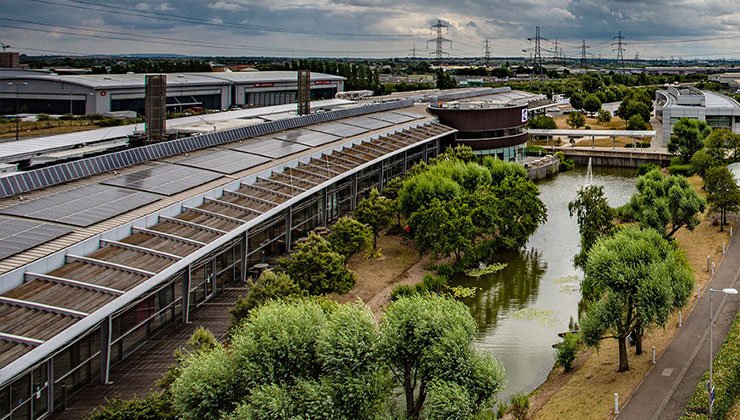
The early proposition was a “one-stop-shop” learning environment. Its 150-metre internal spine connected classrooms, workshops and an informal communal strip called the Street. The architecture was not decorative whimsy. It was supposed to let learners see production and let employers see learners. The spherical auditorium pod, lake and timber deck made the public investment legible from the A13.
Remediate donated Ford land and connect further education, higher education, research and employers.
Make property income support jobs, skills and business growth rather than shareholder distributions.
Offer the campus-management model elsewhere and propose a linked innovation district across the Thames Estuary.
That sequence is also the closest thing here to a change of mind. CEME did not abandon training, but it widened the unit of intervention. Instead of asking only how to teach engineers, it began asking how a campus could keep small employers alive, help them expand and connect their demand for skills to colleges and public programmes. In 2024 it started marketing its operating method to other campus owners. In 2026, with TIN Ventures, it proposed a Regional Innovation & Enterprise District spanning East London, South Essex and North Kent.
The property is a machine
CEME's business model is refreshingly un-mystical. It earns money from space and services. It rents serviced offices, hot desks, fixed desks, virtual offices, classrooms, workshops, meeting rooms and event venues. There is catering. There is reception and mail handling. There is gigabit internet, 24-hour security and, because this is an industrial edge-of-London campus, parking for 600 cars.
The distinctive bit is the assortment. A two-person firm can take roughly 150 square feet. A larger team can take 1,150. Workshops come with three-phase power, water and delivery access. Training providers can rent vehicle bays, an eight-person welding area, milling and turning equipment, electronics labs or classrooms by the day or month. A meeting room starts at £45 plus VAT, while catering starts at £10 plus VAT per person. Office and workshop rents are quoted rather than posted.
A 30-day rolling office, business address, reception, internet and fewer surprise facilities bills.
Classrooms and industrial kit without first building a welding bay or converting an office.
Room to expand on-site, plus grant, finance, research and tax-credit introductions.
A 525-square-metre atrium that can admit vehicles, plus a lakeside deck and full catering.
Customers are not limited to clean-tech founders. The campus houses more than 100 businesses and training organisations; one 2023 skills report counted about 130. Engineering, manufacturing and technology are its home terrain, but property services, creative production and driver training show the range. Recent tenants and users include E-Italia, Hughes & Associates and Drivetech. The Big Sky has used the campus as a filming location. The atrium's private access road allows a vehicle to roll indoors, a useful detail if the product launch is literally a product on wheels.

A landlord that keeps making introductions
Serviced-office competitors can copy reception desks and broadband. Industrial landlords can offer loading doors. Colleges own better teaching credentials. CEME's defence is to overlap those categories, then actively work the gaps between them. Its Business Growth Academy runs networking events, masterclasses and a newsletter, and offers routes into research facilities, funding advice and investors. Coventry University London and the University of Warwick have supported modular learning. Its wider partner set includes Ford, Thames Freeport, NOCN, Bosch, UCL, the University of Kent, MTC and Ikigai Capital.
This matters because the campus is not a marketplace with infinite liquidity. It is a curated, finite neighbourhood. A hydrogen start-up may need test infrastructure, a university relationship, a technician and capital. CEME can rarely supply all four itself, but it can put the relevant institutions within conversational distance. The recurring Hydrogen Summit is less a product than a piece of connective tissue. The campus already has hydrogen refuelling infrastructure and is trying to develop a Hydrogen Innovation Centre as the region builds a low-carbon industrial route.
One recent case makes the proposition concrete. In May 2026, CEME celebrated campus company H2CHP's £1.5 million funding round to scale a fuel-flexible electric generator aimed at low-carbon power. It would be too neat to credit a landlord for a tenant's financing. The more defensible claim is that CEME deliberately creates the conditions in which technical companies can stay near facilities and relevant networks while they grow.
CEME says businesses based there grow four times faster than the national average. That line deserves the usual caution applied to comparisons between a selected tenant group and a whole economy. More grounded operating measures are still impressive: the organisation reported 96 percent occupancy in 2024, and said more than 30 percent of tenants had experienced significant growth and chosen to remain as they expanded. It also said it had attracted £1.3 million in new business since 2023.
Where the self-sustaining part shows up
The Charity Commission provides the useful reality check. For 2024, CEME reported £4.64 million of total income and £4.66 million of expenditure. About £2.82 million came from trading activity and £1.71 million from charitable activities. It employed 22 people and had 11 trustees. This is not venture funding, and CEME has no disclosed valuation. It is a company limited by guarantee, registered as a charity, balancing commercial occupation with public benefit.
An independently prepared impact assessment published in June 2026 widened the lens. It attributed £139.4 million in annual economic value and more than 2,600 supported jobs to CEME's ecosystem of businesses and partners. It put 2025 social value at £23.57 million, or £3.54 for every £1 invested. Impact models depend on assumptions, but the report at least makes the intended chain visible: campus spending and tenant growth feed suppliers, wages, employment, wellbeing and tax receipts.
What another city can actually copy
The seductive version of the CEME story is “build a handsome campus and growth appears.” The practical version is more demanding. Ford's land gift, public regeneration money, proximity to the A13 and a thick network of colleges and major employers are not downloadable. Nor is 19 acres cheap to maintain. CEME's method works best where there is real employer demand, specialist training infrastructure and enough patient capital to survive the years before a network becomes useful.
The portable parts of the playbook
- Bundle the boring costs. Reception, internet, energy and maintenance let small firms budget without becoming facilities managers.
- Offer an expansion path. Let a company move from a desk to an office to a powered workshop without leaving its local network.
- Put skills next to demand. Training works harder when providers can hear directly from the employers who need the next cohort.
- Program the overlaps. Introductions, research access and finance clinics turn neighbouring tenants into a business community.
- Measure the public result. Occupancy pays the bills; jobs, growth and social value explain why the model matters.
Without those conditions, the formula becomes an expensive property project carrying a busy events calendar. Specialist workshops can sit idle. Networking can become ritual. Flexible leases can raise churn instead of growth. And a campus outside a strong transport and industrial corridor cannot manufacture a supply chain by holding a summit. CEME's own origin is a warning against copying the furniture while ignoring the local market failure.
There is also a productive tension in the next chapter. CEME wants to export its campus-management model and anchor a regional innovation district. One move packages local expertise; the other depends on deeper local ties. The proposed district would connect universities, founders, investors and public agencies across three sub-regions. Its credibility will depend less on the diagram than on whether CEME can reproduce the small, repeated acts of coordination that made Rainham useful.
The campus after the campus
CEME's story is not a tidy rescue narrative. Ford still makes engines nearby, but the thousands of assembly jobs that defined Dagenham did not return in another costume. What emerged instead is smaller-grained: a welding class here, a growing generator company there, a dozen-person boardroom, an office that can be left on 30 days' notice. Regional economies are rebuilt through such uncinematic units.
That may be the company's most useful argument. Economic development need not sit in a policy document separate from commercial operations. At CEME, the rent roll, the classroom timetable, the workshop power supply and the introductions are parts of the same machine. The old engine blocks weathered outdoors because the next stage required it. Rainham's campus has spent 23 years testing whether places can be prepared the same way.