By January 2026, STC and its Oceaneering teammates had worked through 398 use cases for a maritime system. That number is worth pausing over. A use case asks what a system must do in a particular situation. Multiply that question by hundreds, then connect the answers to behavior, structure and requirements, and an engineering project begins to look less like a drawing and more like an argument that must hold together.
- STC connects requirements, designs and tests through digital models.
- Its named program partners include Oceaneering and Palantir.
- Customers can buy engineering help, software, integration and training.
STC’s May 2026 announcement says the maritime work helped uncover design gaps and supported impact analysis and operating and maintenance procedures. The interesting deliverable is the network of relationships underneath those activities. When something changes, engineers need to know what else the change touches. A tidy document can record a decision. A connected model can help trace its consequences.
398 ways to ask whether it works
Strategic Technology Consulting, now an Arcfield subsidiary, operates in model-based systems engineering, usually shortened to MBSE. The name sounds forbidding. The practical ambition is straightforward: describe a system formally enough that different specialists can work from connected information rather than reconcile separate accounts of the same design.
For Oceaneering, STC says that meant developing the digital engineering environment, supplying training and bringing modeling expertise to the team from 2023 onward. The relationship continued through competitive technical evaluations and Oceaneering’s down-selection in early 2025. A subcontract announced in May 2026 extends the work into requirements configuration management, architecture refinement and specialized analysis, including secure, restricted environments.
That sequence matters. STC helped establish the working environment and the skills to use it, then continued into detailed engineering. The model becomes useful through repeated use: questions expose missing connections; those connections make the next question easier to answer. The 398 use cases are a concrete indication of that work, rather than a measure of finished hardware.
A diagram with obligations
STC’s service menu reveals the difference between drawing a system and engineering one. Its practitioners build functional, logical and physical models; analyze performance through simulation; connect requirements with CAD and physics-based models; and develop verification artifacts from modeled test cases. The point is to preserve the relationship between what was requested, what was designed and how it will be checked.
Consider the company’s role on the Army’s Tactical Intelligence Targeting Access Node, or TITAN. STC announced a Palantir subcontract in May 2024 after joining the team in January 2021. Its stated assignment was a collaborative digital engineering environment, integrating disparate tools and simplifying data transfer and analysis across the team.
TITAN processes information from multiple kinds of sensors. STC’s job sits behind that visible capability: helping the engineering participants share a consistent account of the system. That places the firm between modeling software vendors and the organizations responsible for delivering a working program. Its product includes the expertise needed to connect the tools.
The distinction also helps a buyer ask better questions. Which engineering repositories will be connected? Who maintains the model when the design changes? Which verification artifacts can the team generate from it? These questions follow the published service scope and are more informative than asking whether a project simply “uses MBSE.” A modeling tool can be present while the important handoffs still happen somewhere else.
The tool is only part of the sale
The business reflects that position. STC offers engineering services, consulting, custom plug-ins, software and training. Dassault Systèmes lists it as a provider of CATIA Magic and No Magic software, implementation, support and training in the United States and Canada. STC also lists Platinum Partner status. A customer can therefore obtain the modeling environment and help putting it to work through the same relationship.
Arcfield announced its acquisition of STC in August 2023. The attraction, as then-president Dan Reineke described it, included Arcfield’s position as a prime contractor and its government relationships. A specialist engineering practice gained a parent with access to additional programs and markets. The acquisition fits the operating model: sell expertise where complicated systems already have budgets, schedules and accountable customers.
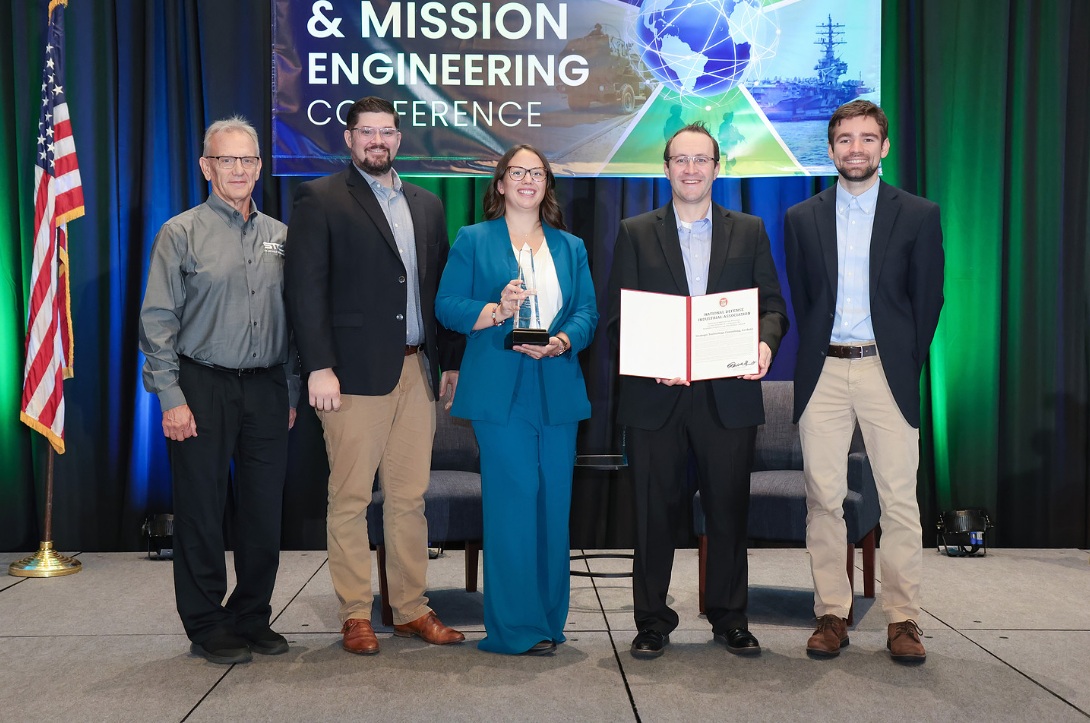
In October 2025, STC announced the NDIA Ferguson Systems Engineering Excellence Award. It reported roughly 80% shorter coordination cycles for key customers, earlier discovery of design issues and projected savings of $1 million to $5 million per workstream. Those are selected, company-reported results and projections. They describe the economic target: less reconciliation, earlier correction and less avoidable work.
Give the assistant a paper trail
In April 2025, STC introduced Intelligent MBSE, adding AI to this workflow. The advertised tasks include extracting requirements from legacy documents, generating SysML architectures, tracing architecture elements to requirements and automating engineering artifacts. Its deployment options include cloud and on-premises environments.
The product’s emphasis on traceability is the revealing detail. STC says responses include source information and evaluation metrics. Its description pairs retrieval-augmented generation with human engineering judgment. An answer needs a route back to the material that supports it, particularly when the next person must assess a design decision.
“Our mission is to make the complex understandable”STC’s stated mission, excerpt
Teach the method, then repeat it
STC’s May 2026 launch of DE Academy adds self-paced training in applied MBSE, SysML v1 and v2, and accredited certification preparation. Live courses remain part of the offering. The company is addressing the adoption problem alongside the technical one: teams need people who can use the environment during ordinary program work.
The reusable material deserves attention, too. STC’s enablement services include model libraries, templates and management plans. Reuse gives the next team a starting point and a set of agreed conventions to examine, rather than another blank workspace.
There is a practical lesson here for an engineering manager. Start with a requirement that matters. Connect it to the design and the verification activity. Agree on modeling rules, check them automatically and preserve useful templates for the next program. These steps follow STC’s published enablement approach. Their usefulness depends on keeping those relationships current and getting the team to work with them. The next changed requirement will reveal whether the connections hold.