A submarine is an awkward place to discover that two perfectly respectable machines have nothing to say to each other. The sonar may work. The computer may work. The weapon-control equipment may work. Yet the vessel depends on their working together, under conditions that leave little room for an extended conversation with technical support.
That gap between a good component and a useful system is where Progeny Systems becomes interesting. The General Dynamics Mission Systems business develops software and hardware for naval combat, sensing, security and readiness. Its less glamorous specialty is making complicated equipment cooperate. In defense, the connection can be as consequential as the device.
- The work: integrate, modernize and support Navy software and hardware.
- The proof: DARTS evolved from research into years of submarine test support.
- The customer: primarily the U.S. Navy, with work across other military and government organizations.
- The useful idea: budget for the interfaces, the operators and the years after delivery.
01 / INTEGRATIONThe trouble between the parts
In the Navy’s account of the research behind DARTS, the difficulty was wonderfully plain: different companies produced components for major ship systems, and those components had to interface. Virginia-class submarines brought together an elaborate collection of non-propulsion electronics. Collecting combat-system data required connections across that collection.
Progeny developed hardware and software to make those connections. The resulting Data Analysis Reporting Tool Set gave the test community a way to collect and examine data from the system as a whole. It addressed an uncomfortable fact of engineering: the performance of the finished assembly cannot simply be inferred from the reputations of its suppliers.
weapon systems
data collection
readiness decisions
02 / DARTSThe research project that stayed aboard
The project entered Phase II in 2000. An initial Phase III contract followed in 2011; further DARTS work arrived in 2015 and 2021. That sequence is a useful antidote to the idea that innovation ends when a prototype demonstrates its trick. A submarine test tool has to be adapted, installed, supported and maintained through actual events.
The Navy describes Progeny tailoring DARTS to particular tests, installing and removing equipment, providing operational support and maintaining the test database. The business extended into configuration management and equipment storage. Here, a product comes with the people and procedures needed to make its results useful.
Figures from the Navy’s 2023 N99-100 case study. Different stages of the same topic; these are neither company revenue nor a calculation of investment returns.
The program continued beyond Progeny’s acquisition. In May 2026, ExecutiveBiz reported a $66.2 million DARTS award to General Dynamics Mission Systems for submarine testing work, with ordering through May 2031. The award belongs to the parent business. Its significance here is continuity: the problem that began with integrating equipment remains worth paying to solve.
03 / MODERNIZATIONWhen commercial computers outpace a submarine
Another Navy case study identifies a different mismatch. Tactical systems relied on VME, an established embedded-computing architecture, while commercial computing advanced beyond its bandwidth performance. A submarine does not become obsolete all at once. One part of its technology can fall behind while the surrounding platform remains useful.
Progeny researched a more efficient digital-processing architecture using commercial-off-the-shelf technology. It combined that work with research into simpler weapons interfaces: streamlined displays, fewer manual actions and access to information beyond a single console. The Navy’s description leaves room for operators to approve or modify machine-recommended tactics.
The engineering problem therefore included human attention. A faster processor is helpful; information that arrives in a form an operator can use is helpful in another way. Progeny’s work connected those questions rather than assuming that more computing power would settle both.
The same integration logic appears in naval aviation. A Navy account of Progeny’s P-8A Applications Based Architecture describes infrastructure for adding capabilities with minimal changes to existing mission software. Allowing new applications to join established systems can spare a program the disruption of rebuilding everything around each addition.
The performance of a finished assembly cannot simply be inferred from the reputations of its suppliers.Our reading of the integration problem
04 / SECURITYCybersecurity with a job to do
Progeny’s Cybersecurity Toolkit, or CSTK, uses a centrally managed architecture. An application manager gives operators control of security clients distributed across tactical hosts. The company describes the approach as reducing the burden of managing security capabilities across the network.
Its cybersecurity subsystem operates within the AN/BYG-1 combat control system installed on U.S. Navy submarines. Progeny also describes deployment to surface combatants using AEGIS and Ship Self Defense System combat systems. These are security services inside an operational environment, where the tactical systems must continue doing their jobs.
This helps place Progeny in the market. A buyer is procuring engineering that fits an existing military platform, with its interfaces and authorization requirements. A catalogue of generic security features would say relatively little about whether that buyer’s problem had been solved.
05 / MAINTENANCEThe trouble with tomorrow’s certificate
A public Progeny presentation offers an unexpectedly familiar view of this world. Its network-monitoring illustration shows full disks, a failed drive and an expiring certificate. The surroundings may be naval; the irritations would be recognizable to an office administrator.
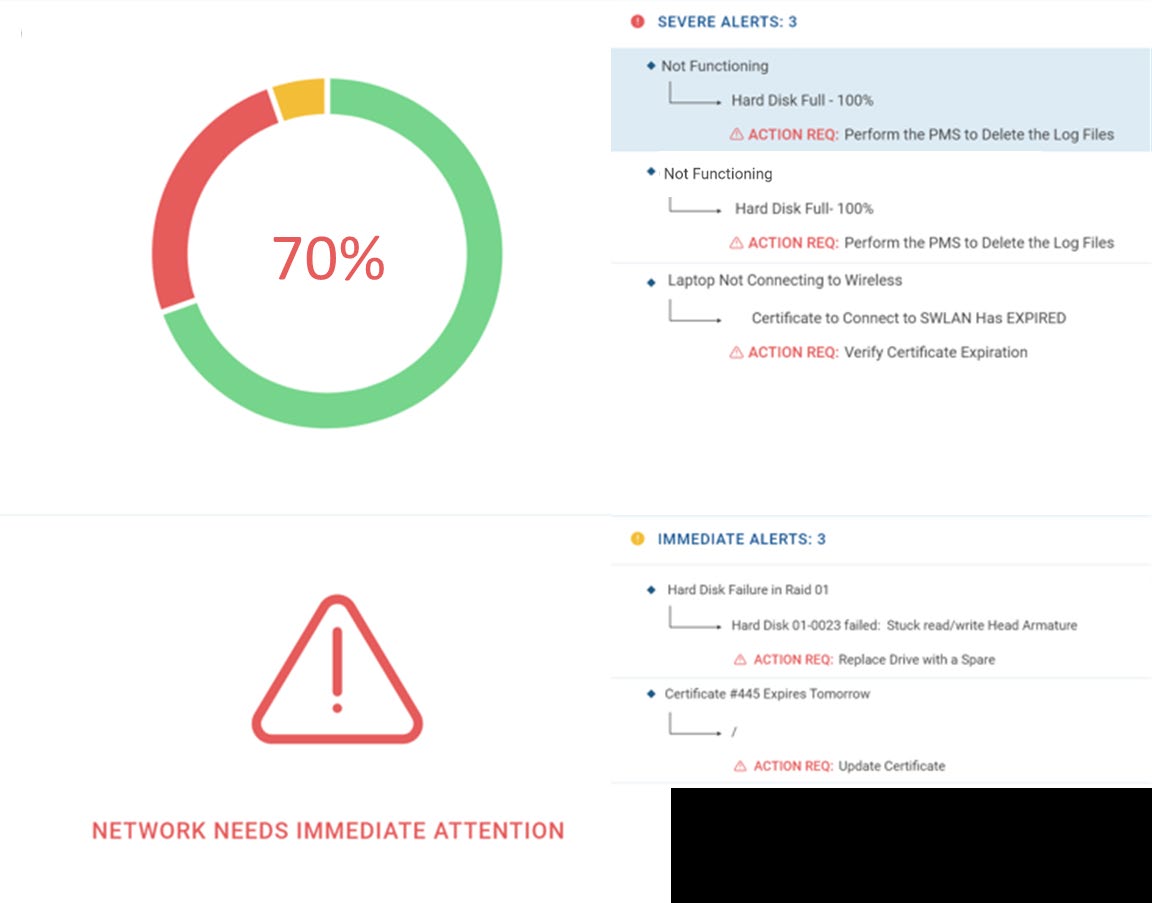
The presentation describes an Enhanced Monitoring Tool that gathers operating-system metrics, logs, maintenance information and configuration data through agents. Its proposed benefit is visibility into a distributed network’s condition. It is a research-stage description, rather than evidence that every advertised feature has entered fleet service.
Readiness also includes people. Progeny’s mission-readiness portfolio helps commanders assess individual crewmembers, watch teams and critical ship systems. Its mobile work supports watchstanding, operations and qualifications. In February 2024, the business announced a $22.4 million Navy contract for shipboard and shore-based maintenance management-decision tools, potentially reaching $116 million if all options were exercised.
06 / THE BUSINESSThe contract behind the capability
Progeny earns its place through research, engineering, production and continuing support. Its published awards include cost-plus arrangements and procurement of hardware and software. The contract is a better guide to the business model than the word “software”: customers fund defined work and program obligations, with options extending some relationships.
A January 2024 sonar-subsystem award began at $30.94 million, with a possible cumulative value of $82.88 million. Those figures describe the award and its options, rather than money already earned. Keeping that distinction matters in a sector where a large headline number can contain years of conditional work.
Progeny is also a customer. In April 2022, Curtiss-Wright announced that Progeny had selected its modular open systems computers and digital-processing modules for MK54 and MK48 torpedo upgrades. The supplier put the estimated lifetime agreement value at $70 million. Buying specialized commercial technology and integrating it into a military application is part of the proposition.
Its distinction is the combination: naval software, acoustic and weapon expertise, manufacturing, and operational testing. That combination does not make it the sole available engineer. Rite-Solutions, for example, announced a 2025 submarine-focused Combat Systems of the Future award. The relevant comparison is the work package and the experience required to deliver it.
Progeny’s test-and-evaluation services cover dockside and at-sea work, sensor accuracy and combat-system certification support. A December 2025 employer feature on mechanical engineer Zach Sprys, working on torpedo systems in Canonsburg, adds a reminder that this ostensibly digital business also involves physical equipment and manufacturing knowledge.
07 / THE RECORDThe paperwork has a history, too
Progeny began in 1995 and was acquired by General Dynamics Mission Systems in 2022. Small-business research helped develop its programs. That history also contains a settlement that belongs in any fair account of the company.
In April 2025, the Justice Department announced that General Dynamics Mission Systems paid $600,000 to settle allegations concerning Progeny’s involvement in SBIR proposals before the acquisition. The allegations concerned affiliation and eligibility statements in proposals submitted by Quality Support and Minimum Entropy, with which Progeny had teaming arrangements. The Justice Department expressly stated that there had been no determination of civil liability.
The distinction is essential: a settled allegation is not an established finding. The episode nevertheless shows that a research program has eligibility rules as well as engineering objectives. Both belong to the account of how a contractor grows.
08 / TAKE IT ASHOREThe part anyone can copy
There is a practical lesson here for people who will never purchase submarine electronics. When several suppliers contribute to one system, somebody needs responsibility for the interfaces, the evidence that they work and the maintenance after installation. Otherwise, every component can satisfy its own specification while the owner inherits the argument.
That is an editorial inference from Progeny’s public work, not a promise that its methods suit every project. A simple, self-contained product may not justify the overhead. For long-lived systems with multiple vendors, funded testing and continuing upgrades, integration deserves a place in the budget from the beginning.
A useful acceptance question follows: can the people operating the assembled system see what is happening, make the necessary decision and keep it working? Progeny’s record makes that question tangible. A submarine contains remarkable parts. The working relationships between them deserve some of the credit.