A camera is an inconvenient object around which to build a software company. It has a lens, a shutter, and no particular interest in your business plan. For Tomer Tagrin, though, one camera supplied the necessary irritation. He and his friends wanted a good birthday present for a friend. They bought a camera online and paired it with a photography course. The reviews had been reassuring. The camera disappointed. The reassurance, it turned out, had been misplaced.
Tagrin’s account of that purchase contains the seed of Yotpo, the company he co-founded with Omri Cohen in 2011. A stranger’s recommendation had helped move money from one pocket to another. Yet the recommendation was unreliable. There was room for a business in that gap between what a merchant promised and what a customer could believe. A bad gift had acquired a second purpose.
The useful detail is that Tagrin approached the problem as a shopper. His eventual customers would be brands, but the initial grievance belonged to the person looking at a product page. That perspective helps explain the durability of his subject. Reviews, loyalty programs, and now AI recommendations all gather around the same small, consequential moment: a person deciding whether to trust something enough to pay for it.
A friendship begins with a complaint
The co-founder relationship had begun with a less diplomatic form of feedback. At university, Cohen sat near the front and took notes. Tagrin remembers himself as the noisy student farther back. Cohen turned around and asked him to be quiet. Tagrin’s reaction was immediate: “I’ve got to get to know this guy.” They became friends. It is a pleasing origin for a reviews company: the first consequential customer comment was a request for silence.
Tagrin studied at Tel Aviv University and worked as a chip designer at Intel before Yotpo. The engineering background is part of his story, although the problem that drew him into commerce was stubbornly human. A technically sound storefront can still leave a buyer uncertain. A persuasive recommendation can still be wrong. Software would have to account for the people on both sides of the screen.
Cohen became Yotpo’s co-founder and chief operating officer; Tagrin its co-founder and chief executive. Their classroom encounter gives the partnership a texture that a pair of job titles cannot. One wanted to hear the lecture. The other wanted to know the person who had interrupted him. Whatever their later division of responsibilities, their shared account starts with a disagreement they found worth continuing.
The customer gets a microphone
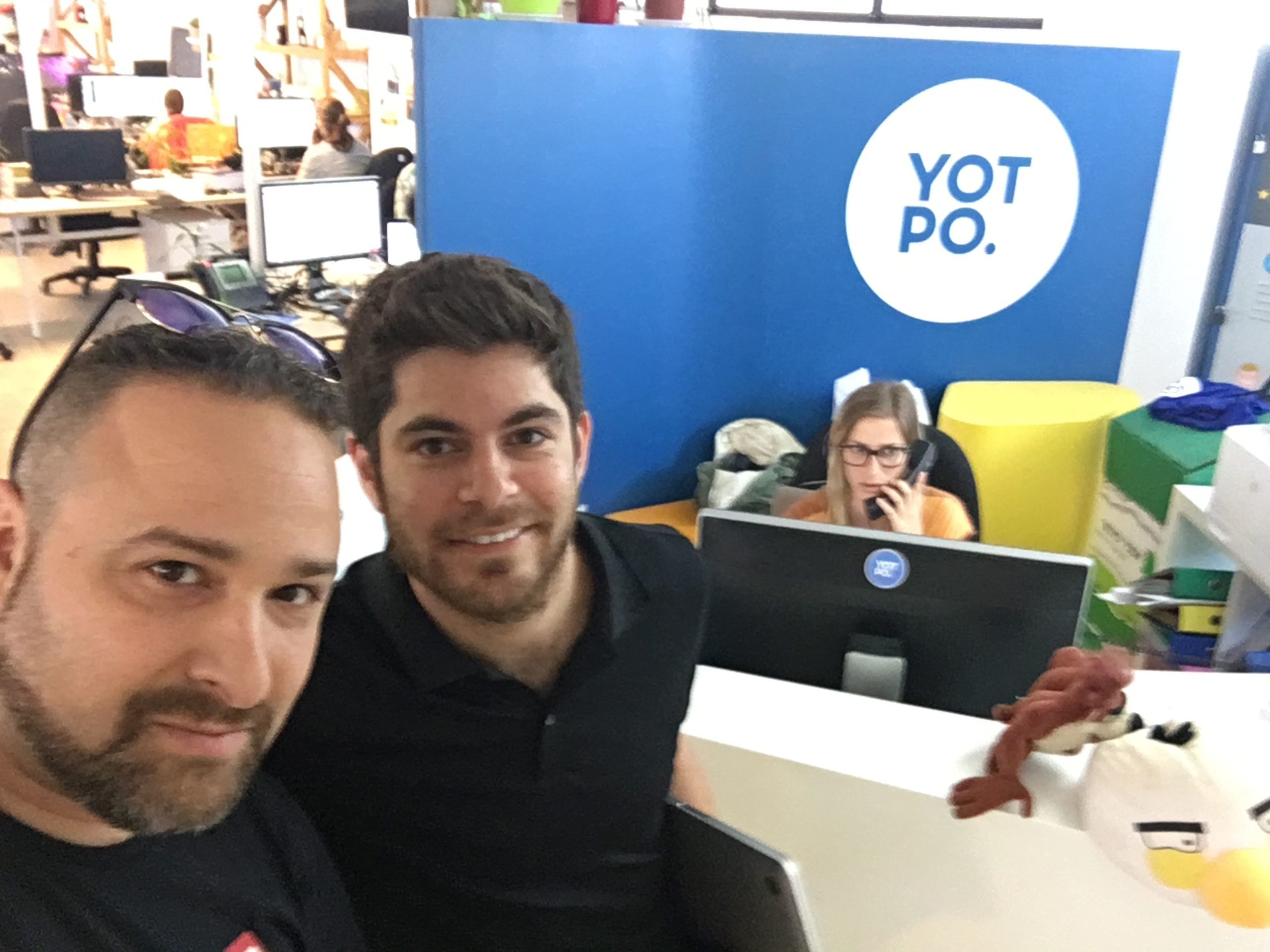
By 2017, Tagrin was explaining his ideas to employees at a rooftop all-hands meeting. His argument reached beyond the star rating under a product. Customer photographs, comments, and other contributions could help a brand attract attention and give people a reason to care. He wanted businesses to listen as well as display. The customer’s voice could travel farther than the checkout page.
That position became a recurring theme in his writing. In a 2018 essay about retail, he argued that smaller brands could learn from direct relationships with buyers and respond quickly to feedback. The attraction was practical: a company could use what customers said to improve its product and service, then hear what happened next. Listening became a working method, with another round of decisions attached.
This is also where Tagrin’s view of commerce becomes more interesting than a sales pitch for reviews. A brand does not simply need a flattering sentence. It needs information it can act on. The same customer who reassures another shopper may also tell the merchant what fits badly, what arrived late, or what deserves another production run. Praise has uses; a useful complaint may have more.
When free became a business
The scale arrived in stages. In a 2019 interview, Tagrin described 4,000 paying customers alongside 60,000 users of Yotpo’s free product. He reported that 57 percent of paying customers used more than one of its four products. These were the numbers of a company learning how to turn an initial installation into a broader commercial relationship.
Yotpo had also acquired Swell, the loyalty business. Reviews and rewards could sit beside one another: one helped a shopper decide to buy, the other gave an existing customer a reason to return. For Tagrin, a relationship with a brand could extend across several visits and several kinds of participation. A purchase was one event in that relationship.
He was based in New York, with the company’s roots and a substantial team in Tel Aviv. The geography put his working life across the two places rather than inside a tidy startup origin story. By then, the classroom friends had customers, offices, and products that needed to work together. Convincing someone to install software was only the beginning of the job.
A very large number, with a date attached
In 2020, Yotpo raised a $75 million Series E. Tagrin’s reflection on the round was noticeably concerned with the people around the company: employees, customers, partners, and investors. Earlier in his career, he wrote, a financing milestone had felt like a destination. With a larger organization, it brought a different mixture of gratitude and responsibility. The celebration had acquired a longer guest list.
The following March brought a $230 million Series F, led by Bessemer Venture Partners and Tiger Global. The post-money valuation was $1.4 billion. Those figures belong to March 2021, when online commerce was drawing fresh investment and Yotpo was pursuing a broader place in brands’ marketing operations. They describe that financing, rather than a permanent price tag attached to Tagrin.
The expansion plan included engineering, sales, international growth, and possible acquisitions. A company born around the credibility of a review was now assembling more of the machinery surrounding a customer relationship. More tools meant more opportunities to serve a merchant. They also meant more products to develop and more promises to keep.
In August 2021, Tagrin was named an EY Entrepreneur Of The Year New York award winner. His response credited Cohen and the Yotpo team. The recognition belonged to a particular stage of the business: the founders had gone from a shared problem to an organization used by brands well beyond their original circle. The award arrived; the operating decisions continued.
- 2011Yotpo founded
- 2021$230M Series F
- 2025Email & SMS exit
- 2026AI discovery in focus
The awkward usefulness of an imperfect review
Tagrin’s discussion of reviews includes an observation that unsettles the usual pursuit of spotless ratings. He has argued that a wall of five-star praise can be less convincing than a rating that admits some disappointment. As he put it, “nobody believes everything is perfect.” Shoppers bring their own experience of the world to the page. A little friction can make the account recognizably human.
His thinking about loyalty has a similar practical edge. A merchant should decide which customer behavior it wants to encourage, then make participation easy. A complicated program asks the shopper to do homework. The business may enjoy its elaborate rules more than the customer enjoys using them. Reviews and loyalty therefore meet at a shared constraint: people have to find the exchange worth their effort.
“nobody believes everything is perfect”
Tomer Tagrin, on customer reviews
Then he closed part of the shop
By May 2025, Tagrin was talking publicly about Yotpo 2.0: changes to product, pricing, service, and marketing. He discussed a faster product organization, relationships with agencies, and a future in which AI would weaken code alone as a competitive advantage. After years of adding capabilities, the company was reconsidering how it worked.
Later that year, Yotpo made a consequential retreat from breadth. It announced the retirement of its native email and SMS products, with full deprecation scheduled for December 31, 2025. Its migration guidance directed customers toward Attentive and Omnisend, with assistance for the transition. Reviews and loyalty would remain central to the business.
The operational detail matters. Customers had subscriber histories, campaigns, and holiday plans tied to those products. Yotpo advised moving ahead of the peak shopping period and warned that waiting until after Black Friday and Cyber Monday would leave roughly a month before the shutdown. A strategic decision in a chief executive’s calendar becomes a practical deadline in someone else’s.
In an October 2025 conversation, Tagrin discussed the shutdown as a decision to create focus. He also described Yotpo Labs as a way to develop new ideas inside the organization. There is an uncomfortable pairing here: stopping established work while making space for experiments. It puts a founder’s judgment on display more plainly than another funding announcement does.
The next person making the recommendation may be software
Tagrin now writes CommerceGPT, a newsletter about changes in discovery, search, and retention. Its subjects include brands’ visibility in AI answers and the ways shopping assistants influence product discovery. The newsletter gives his long-running interest in recommendations a new setting. The buyer may ask a question before ever visiting a merchant’s site.
Yotpo’s Discover product addresses that setting. It tracks how products appear across AI engines and offers agents for content, on-site improvements, and activating real customer participation. Its stated inputs include reviews, loyalty, and commerce data. The commercial proposition is recognizable: help a brand become easier to find and more credible at the point of consideration.
There is a tension worth keeping in view. A business that helps merchants influence recommendations must continue to care about the shopper who relies on them. Tagrin’s origin story gives that obligation an unusually specific shape. Somewhere at the other end of the process is a person buying a camera, hoping the enthusiastic strangers have told the truth.
His career has moved from collecting customer voices to linking products together, then to choosing which products to close and where to start again. The continuity is the recommendation itself. Who produces it? What makes it persuasive? What happens after someone acts on it? Those questions have kept Tagrin occupied through several changes in the software surrounding them. The birthday present was disappointing. It has proved difficult to put away.
Keep the conversation going
Writing, interviews, and the decisions behind the story.