Jeff Raider and Andy Katz-Mayfield stood on wooden crates in a German factory, addressing the people who knew how to make the thing they had just bought. The two Americans spoke for perhaps 20 seconds. A manager translated for a minute. Neither founder knew enough German to judge what had happened to his speech in transit. Raider later joked that the manager might have been telling the workers they were crazy.
The workers applauded. Harry’s, the shaving company the friends had launched in 2013, now owned a blade manufacturer. An online shop had acquired a very substantial offline responsibility. There were employees to reassure, machinery to understand and promises to keep. The founders could sell a handsome handle on the internet; the people facing those crates knew what made the edge work.
He had already helped launch Warby Parker. Yet here was another beginning, with a language barrier and makeshift furniture. For someone trying to build a brand that would last a century, a crate was a perfectly serviceable first podium.
The entrepreneur who wanted a steadier job
Raider grew up in Wellesley, Massachusetts, watching his mother build a company. The experience initially persuaded him that entrepreneurship was a difficult way to earn a living. He saw how much of herself a founder had to put into the work, and how uncertain the outcome could be. Stability had considerable appeal.
He studied international affairs, considered the policy world, and found his way into consulting at Bain & Company and then private equity at Charlesbank Capital Partners. Those jobs offered responsibility within an established structure. He could work on companies and help shape decisions without having to create the entire enterprise himself.
His education ran through Johns Hopkins, where he completed his undergraduate degree in 2003 and graduate studies at the School of Advanced International Studies in 2004, and then Wharton, where he earned his MBA in 2010. He has credited the intensive graduate work with teaching him to take complicated information, identify what mattered and form an opinion. Eventually that habit would be applied to objects considerably smaller than a foreign-policy briefing.
Four friends, one expensive pair of glasses
At Wharton, Raider joined Neil Blumenthal, Dave Gilboa and Andrew Hunt in developing Warby Parker. The company launched in 2010. Raider’s own dissatisfaction was mundane and persistent: glasses cost enough that he had kept an old pair even as his prescription changed. The purchase was supposed to solve a problem. The price made postponing the purchase seem reasonable.
Warby Parker offered a different proposition, including glasses starting at $95. A GQ feature helped bring an early rush of demand; the company sold out in less than a week. That was good news with an awkward customer-service sequel. People wanted glasses the young business could not immediately provide.
In an early interview about Harry’s, Raider recalled the effort to treat every customer respectfully when Warby Parker was overwhelmed. It was a lesson he carried into the second company. The founders around him remained advisers, too. They had already watched a small team become a much larger one, and their experience was useful precisely because they had lived through the unglamorous parts.
Raider stepped back from day-to-day entrepreneurship after business school to honor a commitment to an investment firm. He retained his connection to Warby Parker and continues to serve on its board. His first company had changed what he thought a job could feel like. It would prove rather difficult to keep that discovery confined to eyewear.
A complaint with a handle attached
The call that led to Harry’s came from Katz-Mayfield after an unsatisfactory trip to a drugstore. Razor blades were locked away. Waiting for someone to open the case made an ordinary errand laborious. The bill for blades and shaving cream came to about $25. The products and their packaging hardly made the inconvenience more endearing.
Katz-Mayfield and Raider had worked together at Bain and Charlesbank. They shared the irritation and began asking whether the approach Raider had learned at Warby Parker could work for shaving: a product they wanted to use, a price they could understand, and a brand that did not require an advertising fantasy to explain itself.
There was still the small matter of producing it. Harry’s took roughly 18 months to launch. A razor is an excellent object for exposing the difference between having an idea and making a product. The handle has to feel right. The cartridge has to work. A customer can admire the packaging for only so long before taking the blade out.
Raider has described being humbled by how hard everyday objects are to manufacture well. The bathroom offers a surprisingly thorough examination of industrial competence. Harry’s could simplify the shopping experience, but simplicity for the buyer demanded plenty of complication somewhere else.
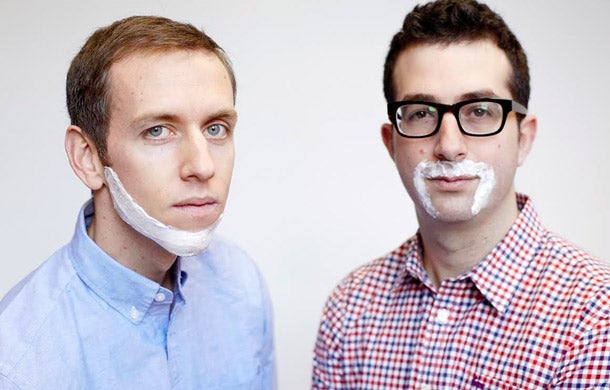
Before the blades, the invitation
The team also had to solve a problem that manufacturing could not: who would turn up when the website opened? In his account of the launch campaign, Raider described a team of ten preparing for March 2013. They had spent the better part of two years researching the market and designing the product. An empty shop would have been a poor reward.
A week-long prelaunch campaign gathered nearly 100,000 email addresses. The website asked visitors to sign up and then invite friends. Referrals could earn shaving products. The invitation was simple enough to pass along, and the rewards belonged to the business people were being asked to discover.
The lesson was more practical than the headline number. Harry’s gave interested people a task they could easily complete and a reason to involve someone else. Raider later shared the campaign’s thinking and code publicly, with contributions from the team. The launch became something other founders could inspect, rather than merely envy.
Email addresses collected before Harry’s opened its online shop.
The factory changes the conversation
Buying the German manufacturer in early 2014 brought the business back to a different sort of invitation. Workers needed to believe that these founders would invest in the place and honor their commitments. Raider has described listening to requests, including one for a communal café, and following through. Trust accumulated through actions people could see.
Ownership also put Harry’s in a different position from a brand that simply ordered a finished product. The founders were responsible for production as well as presentation. A factory makes a business feel less abstract: there are people, equipment and decisions that cannot be revised with a quick change to a webpage.
Raider’s account of the speech on the crates ends with applause and, in a 2014 postscript, weekly German lessons. There is something pleasingly practical about that response. The founders had acquired a manufacturer; now they needed to acquire a little vocabulary. A century-long ambition still contains a great deal of homework.
“We give a shave!”Jeff Raider, describing the founders’ attention to product details, 2014
The shelf is a different sort of test
Harry’s expanded into Target in 2016 and Walmart in 2018. The company’s online beginnings had supplied direct conversations with customers; stores supplied another way to reach them. Raider’s retail philosophy allowed for both. People should be able to buy the products where shopping already made sense for them.
At a 2019 Wharton retail conference, he described the importance of a clear proposition and a fair price across channels. Harry’s followed sales with emails, and about 10 percent of customers replied. Requests for body wash helped guide a new product. A reply to a sales email could become more useful than a polished presentation about what the market supposedly wanted.
Listening also meant accepting criticism of a tiny detail. Customers wanted to hear a click when a blade connected to the razor. Harry’s responded. An audible click is scarcely a grand theory of consumer behavior. It is, however, a reassuring answer to the question of whether the thing in your hand is properly assembled.
The process had failures. Raider later discussed Headquarters, a hair-care line introduced with Walmart, as a case where the company had moved into retail before building the direct customer relationships that had helped its other brands. The line did not work as planned and was handed to Walmart. The episode put a limit around the formula. Distribution alone could not supply the learning the founders had skipped.
The deal that did not end the story
In 2019, Edgewell Personal Care agreed to buy Harry’s for $1.37 billion. Raider and Katz-Mayfield prepared for a future that would put them in charge of a broader group of North American brands. It was an opportunity to think beyond the razor that had brought them there.
In February 2020, the Federal Trade Commission sued to block the acquisition, alleging that it would eliminate an important independent competitor. Edgewell terminated the agreement. A proposed purchase price remained a proposed purchase price. Harry’s continued on its own.
The planning did not all go to waste. Raider has explained that preparing to run a larger consumer-products business helped the founders think about their own future. They already had Flamingo, launched in 2018, and later acquired Lume in 2021. The company could use what it had learned to support other brands, while letting those brands retain their own relationship with customers.
- 2010Warby Parker launches
- 2013Harry’s opens online
- 2014The German factory joins Harry’s
- 2020Edgewell deal ends
- 2025Mammoth Brands takes its name; Coterie joins
A mammoth, and some time off the calendar
In April 2025, Harry’s Inc. became Mammoth Brands. The company reported $835 million in 2024 revenue and nearly $100 million in adjusted EBITDA. Its portfolio then included Harry’s, Flamingo, Lume and Mando. Raider and Katz-Mayfield remained co-founders and co-CEOs. The parent company finally had a name roomy enough for the businesses inside it.
Coterie joined during 2025, extending the portfolio into diapers and baby care. The acquisition announcement said its CEO, Jess Frenchman Jacobs, and president, Grace Weingard, would retain their roles. Raider’s stated approach is to give founders freedom alongside operational support and retail relationships. The challenge now reaches beyond improving one product: he has to help other people build without making every brand sound like his own.
There is also a smaller measure of whether the enterprise is working. Raider’s mother, Ann, built Consumer Card Marketing and still found her way to his sports games. He remembers her cheering slightly after everyone else, so her voice was distinguishable. At Harry’s, a policy called Golden Time lets employees protect short periods during the working day for personal commitments. Raider uses it for his children’s basketball and lacrosse games.
He has taken his son Charlie to the German factory, bringing the business into family life rather than leaving it as an unexplained destination. The factory that once required a translated speech now offers a child a way to see what his father does. Raider’s ambition for Harry’s was to build a hundred-year brand. There is room in that calendar for a game, too.