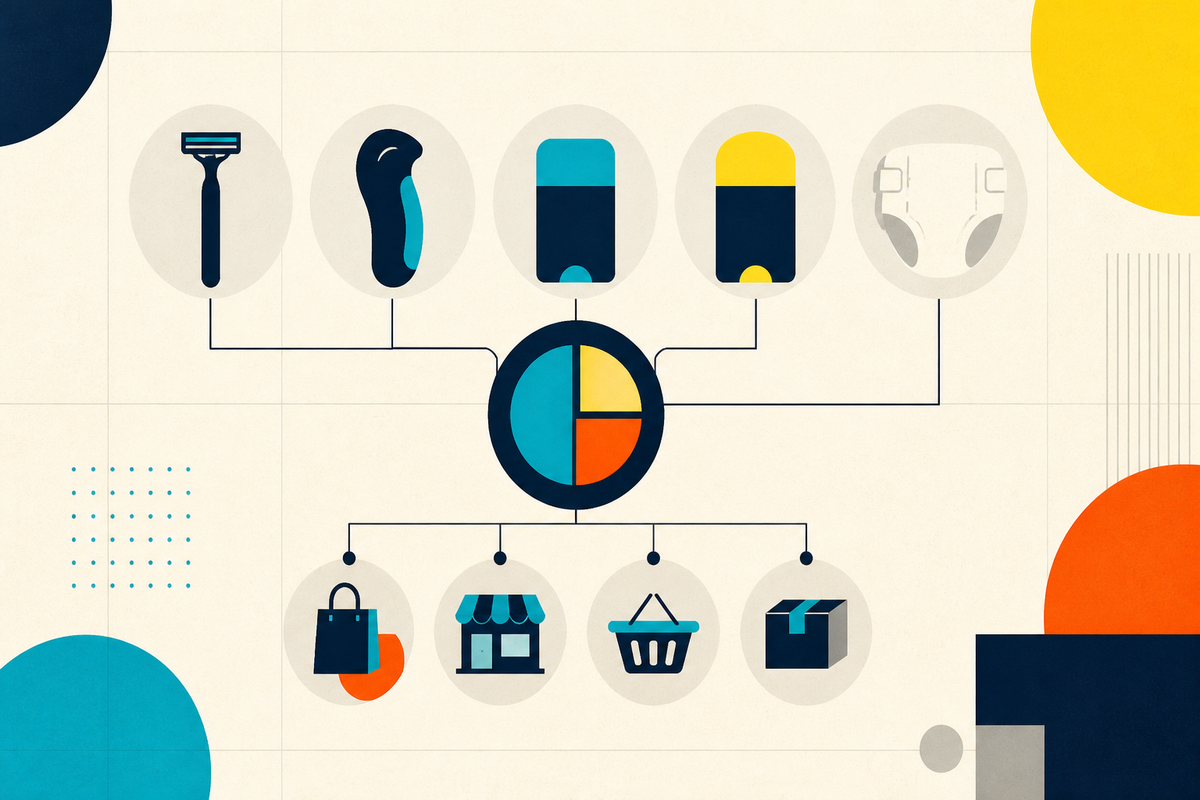
A razor handle is a small object to carry a large corporate idea. Yet the handle that launched Harry's in 2013 contained the outline of Mammoth Brands: begin with an ordinary frustration, talk directly to the person experiencing it, improve the object, then build enough industrial muscle to put the result everywhere that person shops. The New York company now sits behind five labels - Harry's, Flamingo, Lume, Mando and Coterie - covering shaving, body care, whole-body deodorant and premium diapers. The products share no visible master brand. Underneath, they share a system.
That distinction matters. Mammoth is not trying to persuade a parent buying Coterie diapers that the same sensibility should choose a Harry's razor. It is trying to give each brand access to the expensive things young consumer companies usually have to improvise: product development, manufacturing, supply chain, data, technology, hiring, finance and relationships with major retailers. Brand teams keep their customer and voice. The parent supplies the rails.
The result is a company that reported $835 million in revenue and nearly $100 million in adjusted EBITDA for 2024, after compounding revenue at more than 20 percent over five years. Those are not app-company economics disguised by a subscription button. They come from moving physical objects through factories, warehouses, websites and retail aisles, then persuading people to buy them again.
The complaint that became a company
Andy Katz-Mayfield was tired of buying costly razor blades. He and Jeff Raider, a Warby Parker co-founder and former colleague from Bain & Company and Charlesbank Capital Partners, launched Harry's with a proposition that now sounds familiar: handsome, fairly priced grooming products sold online, without the locked cabinet and fluorescent indignity of the drugstore razor aisle. Direct sales did more than lower distribution friction. They opened a conversation.
Customers asked to find Harry's in stores. They wanted grippier handles. They said the blades were not sharp enough. Mammoth's own history tells the responses almost like a sequence of product tickets: enter retail, change the handle, improve the blade. The last request led to the least internet-startup move imaginable. Ten months into the company's life, Harry's bought Feintechnik, a German blade factory whose roots reach back to 1920.
The Eisfeld plant gave Harry's control over a difficult component and a century of manufacturing knowledge. It also signaled that the founders were not merely arbitraging Instagram attention. A competitor could buy ads or copy a subscription offer. Reproducing precision blade production, product engineers and retailer trust would take longer. Mammoth's difference still rests in that combination of new and old: digital customer intimacy attached to stubbornly physical capabilities.
Two engines, not one template
Mammoth Labs is the portfolio's workshop and deal desk. One side incubates brands. Flamingo launched in 2018 after the company applied lessons from Harry's to women's hair removal and body care. Mando followed in late 2022, adapting Lume's whole-body odor-control approach for men. The other side acquires companies whose founders have already found a sharp unmet need. Mammoth bought Lume in 2021 and added Coterie in 2025.
Lume is the cleanest example of product expertise arriving before platform scale. Its founder, OB-GYN Dr. Shannon Klingman, believed unwanted odor was too often being treated as a medical diagnosis rather than an everyday chemistry problem. She developed an acidified deodorant intended for use beyond the underarm, bootstrapped the company and spoke about the body with a candor that legacy advertising avoided. Mammoth says it more than doubled Lume's size within two years of acquiring it. The parent did not invent Klingman's insight; it accelerated the route from insight to mass market.
Coterie stretches the thesis beyond personal care. The premium baby-care company was founded in 2019 around higher-performing diapers and wipes. When Mammoth announced the deal in October 2025, Coterie had sold more than 700 million diapers, served hundreds of thousands of families and passed $200 million in trailing net revenue, growing nearly 60 percent year over year. It was profitable and still sold almost entirely direct to consumers. Mammoth saw the familiar unfinished bridge: a loved online product on one side, much larger omnichannel distribution on the other.
The portfolio test is specific: can Mammoth take an online-led brand from passionate niche to broad retail without replacing its peculiar language, standards or founder judgment with corporate beige?
Where the model earns its keep
For shoppers, the practical benefit is not access to Mammoth itself. It is better competition in categories that can become lazy: razors sold at inflated prices, deodorant constrained by old assumptions, diapers whose performance parents simply endure. Each label offers a different answer. Harry's and Flamingo make grooming products available online and in mass retail. Lume and Mando offer odor control across more of the body. Coterie sells premium diapers, wipes and adjacent baby care built around absorption, softness and safety standards.
For founders, Mammoth pitches a middle path between going alone and disappearing inside a conglomerate. Jeff Raider has said founders retain the freedom to pursue their vision while gaining talent, retail relationships and operating infrastructure. That is attractive precisely because consumer growth becomes awkward after the first rush of direct sales. Retail buyers want supply reliability. New categories require testing. Media gets more expensive. Inventory mistakes absorb cash. A shared platform can turn those recurring obstacles into established functions.
The business model is correspondingly plain: sell repeat-use products through ecommerce and stores, protect gross margin through scale and selected vertical integration, and grow through line extensions, new channels, internal launches and acquisitions. Subscriptions help where routines are predictable, but Mammoth's evolution suggests that omnichannel reach matters more than loyalty to any single distribution doctrine. Direct-to-consumer is a source of signal and early demand. Retail is where a household brand becomes habitual.
The portfolio paradox
Mammoth sits between venture-backed challengers and century-old consumer groups. In shaving it meets Gillette and Schick; in deodorant, Dove, Secret, Native and Degree; in diapers, Pampers, Huggies, Honest and newer premium labels. At the parent level, Procter & Gamble, Unilever, Edgewell, Church & Dwight and Colgate-Palmolive possess deeper distribution, bigger budgets and long institutional memory. Mammoth's counter is speed, direct feedback and a portfolio small enough for its co-CEOs to stay near the brands.
That advantage is fragile. Shared services can become slow services. A repeatable playbook can become a reflex applied where it does not fit. Five distinctive brands can begin using the same jokes, creators and product cadence. Mammoth therefore has to centralize the invisible and protect the visible: consolidate infrastructure while leaving customer insight, founder taste and category expertise close to each team.
The company openly worries about culture as it scales. Its stated values include “Grow Forth,” an invitation to experiment and learn, and “See the Person. Serve the People,” a reminder that a spreadsheet row represents somebody's face, skin, morning or child. In 2025 it described more than 25 generative-AI pilots and company-wide adoption, emphasizing exploration over tidy time-saved metrics. Its careers material details employee resource groups and benefits; its social-impact record includes more than $20 million donated or committed, over 20 nonprofit partners and two million people directly affected.
Mammoth Good, created in 2025, gives that work a portfolio-wide target: reach 3.4 million people, roughly one percent of the United States population, over ten years through mental and physical wellbeing initiatives. Individual brands still choose causes that fit. Flamingo, for example, has worked with Girl Scouts of the USA, the New York Liberty, Gotham FC and the Women's Sports Foundation on body appreciation and movement. Harry's supports mental-health partners including The Trevor Project and BEAM.
A mammoth-sized next chapter
The corporate name arrived in April 2025, twelve years after Harry's launched. It was less a makeover than an admission that the original label could no longer explain the company. The mammoth had appeared as a beloved Harry's icon; now it stood for the breadth of the parent. The renaming also made room for future brands without forcing them into a shaving company's shadow.
There is an irony in the journey. In 2019, Edgewell agreed to buy Harry's for $1.37 billion. The Federal Trade Commission sued to block the deal, arguing it would remove a disruptive rival, and the transaction was abandoned in 2020. The founders apologized to employees and kept going. Planning to help run a broad North American consumer portfolio had expanded their field of view. In 2021, Harry's raised $155 million at a $1.7 billion valuation, capital explicitly intended to help acquire other consumer brands. The company that could not join an old CPG group set out to build a new one.
Whether Mammoth becomes an enduring house of brands will be decided in unglamorous places: retailer meetings, formulation labs, inventory forecasts, customer-service transcripts and the factory floor in Eisfeld. That is appropriate. The strategy began with listening to people complain about a handle. Its future depends on keeping those complaints audible as the organization around them gets much larger.