The original MANSCAPED pitch could be understood before the product was switched on. Men had body hair. Some of it grew in places served poorly by the same clippers used on a beard. Most grooming companies preferred not to discuss the details. MANSCAPED discussed little else.
That willingness to be specific became the business. Founded in San Diego in 2016, the company began with below-the-waist care and introduced its Lawn Mower electric trimmer the next year. The object was useful, but the name did more than label hardware. It gave customers a way to talk about a sensitive purchase with a grin instead of a whisper.
A decade later, MANSCAPED says it is trusted by more than 13 million men. Its collection is sold directly in 39 countries, through Amazon in more than 100, and in retail chains ranging from Walmart and Target to Harrods, Tesco, Boots, Best Buy and Canadian Tire. What began as a narrow direct-to-consumer proposition now looks like an omnichannel personal-care company with ambitions above the neck.
The product was also a permission slip
MANSCAPED did not invent body grooming or the electric trimmer. Philips, Braun, Panasonic and Wahl already knew their way around motors and blades. The opening was cultural and ergonomic: design a tool for a particular body zone, surround it with formulations for that routine, and speak plainly about why it exists.
This is where the company's comedy becomes functional. Lawn Mower, Weed Whacker, Crop Preserver and Crop Reviver are jokes with instructions embedded inside them. Each name indicates a job. Together they create a tiny universe customers can remember, gift and repeat in a podcast ad. The language lowers the social cost of entering the category.
The cleverest thing MANSCAPED built was not a blade. It was a vocabulary customers could repeat.YesPress analysis
The physical products back up that vocabulary with familiar consumer-tech cues: ceramic cutting surfaces, waterproof bodies, travel locks, adjustable guards, charging docks, LEDs and replacement components. The company uses its SkinSafe name for design features intended to reduce grooming mishaps, while correctly stopping short of promising an injury-proof shave. That distinction matters on sensitive skin, where technique and preparation remain part of the result.
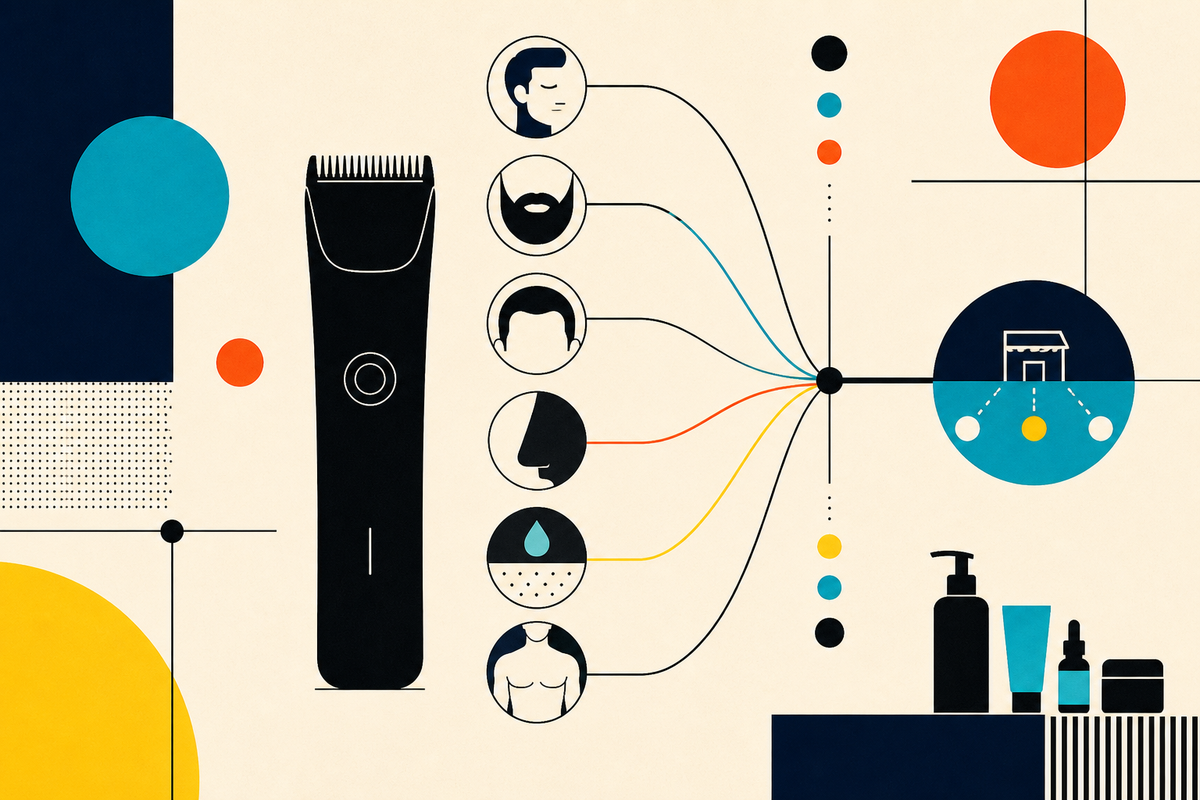
A bathroom shelf, built one zone at a time
The expansion has been methodical. The Weed Whacker moved into nose and ear hair. The Beard Hedger and compact Handyman addressed beards and face shaving. The Dome Shaver Pro went after the scalp. The Chairman Pro added a premium foil shaver. Skin Ultra and an electric Face Buffer pushed the company into daily skincare. Nail kits, body wash, deodorant, cologne, boxers and travel bags filled the spaces between devices.
This solves a second customer problem: the work of assembling a routine. A specialist device is easier to understand when it comes in a named bundle with the relevant wash, balm, blade and bag. The same architecture also helps MANSCAPED. Hardware produces a meaningful first order; replacement blades and consumable formulas create reasons to return; bundles lift basket size; member prices, subscriptions and rewards make replenishment feel automatic.
The customer is not always the person doing the grooming. Gift buyers are important to a brand whose kits arrive boxed, named and ready to explain themselves. Retail extends that audience further: a shopper who would never search for a groin trimmer can discover one while buying electronics, razors or holiday gifts. Meanwhile, the broader face and body range gives existing customers a less intimate reason to recommend the brand. A joke may open the sale, but convenience, packaging and a clear use case make the product easier to put in someone else's hands.
The omnichannel grooming loop
The bars above describe the strategic sequence, not reported revenue shares. It begins with a visible, demonstrable machine and moves toward less glamorous but more frequent purchases. A trimmer may win the customer; deodorant, wash, blades and skincare determine whether the relationship becomes a routine.
Creators made the private problem public
Long before the brand bought a Super Bowl spot, it seemed to be everywhere a young male audience put on headphones. Podcast hosts and YouTube creators could turn the product script into a comic bit, then offer a trackable discount code. That format suited a category requiring explanation. The presenter could acknowledge the awkwardness, describe the use case and give the audience social proof in the same minute.
Sports partnerships performed a similar job at larger scale. UFC, the San Francisco 49ers, hockey clubs, football teams, bowlers, darts and action sports placed the brand inside communities where male audiences already gathered. Pete Davidson joined as a brand partner and shareholder in 2022, lending the company a celebrity persona whose humor matched its own. In 2025, MANSCAPED turned shaving into a mechanic on a custom Fortnite map. By February 2026, discarded hair had become singing puppet monsters in the company's first Super Bowl commercial.
The tactics look unruly, but the distribution logic is consistent: make a private behavior visible in public culture. Each activation buys more than attention. It makes the next retail encounter less strange. A customer who has heard the joke ten times is prepared when the black box appears beside mainstream razors at Walmart.
Find the avoided job
Start with a real need incumbents describe too broadly or too delicately.
Name the routine
Give products memorable language that explains the job and travels by word of mouth.
Build repeat purchase
Surround the hero device with blades, formulas, bundles and membership.
Expand distribution
Use creators for education, retail for convenience and culture for familiarity.
The health message beneath the punch line
A brand this comfortable talking about testicles has a natural opening to discuss testicular health. MANSCAPED's “We Save Balls” platform supports the Testicular Cancer Society with education, awareness and fundraising around self-screening and early detection. The partnership has included special-edition products, athlete campaigns, instructional videos and, in 2026, a celebrity hairball auction for charity.
The fit is unusually close. It does not require the company to bolt a distant cause onto a seasonal campaign. The same attention that brings someone into the grooming routine can prompt awareness of a health change. Humor earns the first look; responsible education has to carry the next sentence.
Growth without the ticker symbol
For a brief period, MANSCAPED appeared headed for public markets. A 2021 agreement with Bright Lights Acquisition Corp. proposed a combination implying a $1 billion enterprise value. Investor materials later reported $297 million in 2021 revenue and guided to $305 million for 2022. In August 2022, the parties terminated the deal, citing unfavorable market conditions.
A canceled transaction is not a current valuation, and old guidance is not current revenue. The more durable evidence came afterward. MANSCAPED remained private, announced a Series B co-led by Banner Ventures and Smash Ventures, kept adding retailers, and built out categories that were barely visible in the original pitch. The company now lists roughly 201 to 500 employees on LinkedIn; supplied business data places the team near 260.
Its culture materials read like an internal answer to the external brand: candid, collaborative and willing to laugh. Five leadership pillars ask employees to unite, lead with empathy, own the work, stay humble and remain nimble. The company has also publicized employee communities and professional-development support. That may sound conventional next to singing hairballs, but consumer brands need operational calm behind theatrical marketing.
The difficult move: from famous niche to default routine
MANSCAPED's advantage is also its constraint. The brand is instantly associated with one body zone. That fame makes customer acquisition easier for the original product and potentially harder for facial skincare, where specialists and mass brands have decades of credibility. Every move upward risks softening the specificity that made the company memorable.
The competition changes by shelf. In hardware, MANSCAPED meets Philips, Braun, Wahl and Panasonic. In shaving subscriptions, it meets Harry's and Dollar Shave Club. In masculine personal care, Dr. Squatch and Beardbrand compete for tone and identity. In online health and wellness, Hims owns a broader relationship with the same customer. Retailers add their own labels and endless lower-priced lookalikes.
The answer cannot be louder comedy alone. It has to be coherent product design, easy routines and repeatable quality across beard, face, scalp and skin. The 2026 Beard Hedger Plus and entry-priced Lawn Mower Go show both sides of the task: deepen adjacent categories while widening access to the original one.
MANSCAPED's real moat may be permission: permission to ask, shop, laugh and begin a routine that used to feel awkward.
That is what other founders can steal. Begin where the customer's discomfort is most specific. Create language that carries the explanation for you. Build a product system around the first solved job. Add new shelves only after the old one has taught people who you are.
MANSCAPED may never escape the joke that introduced it, and perhaps it should not try. The joke is the front door. The harder work is making sure a customer who enters for one careful trim finds enough utility, trust and taste to stay for the rest of the bathroom.
Keep browsing