The apple-fritter cookie was supposed to arrive on Friday. Chip City had been telling its Instagram followers to come in for it: cinnamon spice, glazed doughnut pieces, apple filling, vanilla icing. Instead, on October 2, 2026, customers learned the chain had closed. The invitation had outlived the business.
The story in three bites
- A $70,000 loan helped start a 250-square-foot bakery in Astoria, Queens.
- Centralized dough production and local baking helped turn it into a multistate chain.
- After $17.5 million in announced EHI investment, all remaining shops closed in October 2026.
That ending makes Chip City an unusually useful company to study. Its product had attracted queues, devoted customers and an experienced hospitality investor. Its shops offered something immediately understandable: a very large cookie, served warm. Yet the company ultimately lacked the money to continue operating. To understand the gap, start with the people outside the first door.
01 / THE NEIGHBORHOODAn army of strollers
Peter Phillips and Theodore “Teddy” Gailas were childhood friends before they became cookie entrepreneurs. In 2017, they challenged each other to make a cookie they loved, then opened in Astoria that July. Phillips came from construction and real estate. The initial plan was modest: sell 100 cookies a day.
Gailas later told Goldbelly they surpassed that target within the first hour. The shop initially kept limited hours; Instagram helped customers learn when it would open and what it would bake. Demand persuaded the founders to open full-time and expand. Here was a useful kind of market research: people showing up before the business had worked out how often to serve them.
A local mothers’ Facebook group helped spread the word. Phillips described “an army of strollers” outside. Families became an early audience for a product that could turn an ordinary neighborhood walk into a small occasion. Buying a cookie required neither a reservation nor an explanation.
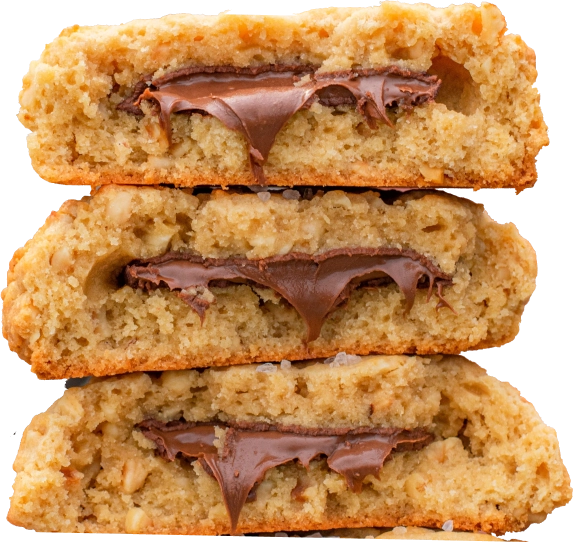
The size mattered to the proposition. Chip City was selling an indulgence substantial enough to photograph, share or bring to someone else. Flavors such as cannoli and baklava borrowed the appeal of other desserts, giving the bakery a wider vocabulary than chocolate versus vanilla. The weekly rotation also created a little planning exercise: which cookie was available, and was this the week to go? For a shopper seeking the same favorite on every visit, that changing selection could be less convenient.
02 / THE OPERATING IDEAThe freezer was the clue
Success first exposed a practical problem. The original shop had one small freezer and needed repeated reloads during the day. A queue outside is flattering. Inside, somebody still has to find enough dough.
“We had just one small freezer and had to do multiple reloads during the day.”
Peter Phillips / Restaurant Business, 2022
Experimentation produced a useful discovery: the cookies baked better from frozen. That meant dough could be made centrally and baked in the shops. By 2024, a Queens commissary supplied roughly 40 locations, including Florida. The production method supported a bigger footprint while preserving the smell and warmth of local baking.
- Make centrallyPrepare dough at the Queens commissary.
- Distribute frozenSupply the store network.
- Bake locallyServe the finished cookie warm.
The stores used electric equipment, simplifying site requirements. Phillips emphasized a short training curve and relatively few moving parts. This was the company’s particular expertise: bringing the appeal of a specialty bakery into an operation designed to repeat. Its competitive territory sat between neighborhood bakers and chains such as Insomnia Cookies and Crumbl.
For customers, the offering extended beyond a counter purchase. There were event packages, corporate gifts and nationwide shipments through Goldbelly. A box could carry the brand into an office or a home far from Queens. These were additional occasions to buy the same core product.
03 / THE EXPANSIONThe price of another door
Phillips initially resisted raising capital. Surviving the pandemic changed his confidence, he told Franchise Times. In October 2022, Enlightened Hospitality Investments, associated with Shake Shack founder Danny Meyer, invested $10 million. Chip City then had 14 locations. In May 2024, EHI supplied another $7.5 million in Series B funding; the announcement counted 38 shops.
The expansion story came with attractive historical economics. At a 2024 conference, the company described typical build costs of $250,000-$300,000, annual unit sales of $750,000-$800,000 and a 25 percent store-level margin. It also projected 100 locations by the end of 2025. Those figures described a company’s performance and ambitions at a particular moment.
A shop margin leaves further questions: central production, headquarters, expansion spending and the cash needed while new stores establish themselves. A successful location can help finance the next one. It cannot make the next neighborhood behave like the first.
04 / THE RETURN VISITA reason to return, a need for cash
The menu offered both familiarity and surprise. In 2024, Gailas described five best sellers alongside four weekly rotating flavors. Chocolate Chip could anchor the visit while a seasonal experiment supplied the excuse. Nostalgic combinations and the Mr. Chip mascot gave the brand material beyond the standard chocolate-chip photograph.
Attention was harder to sustain. Phillips told Square that paid marketing had produced little return. The company emphasized hospitality, simple checkout tools and loyalty rewards instead. Staff could explain the flavors while customers explored the menu. For another retailer, the useful lesson is specific: reduce friction for employees so they have time to help the person at the counter.
By July 2026, Chip City was announcing a new president, Nicolas Baizan, and a focus on revenue and profitability across 39 locations. September brought regional closures. On October 1, employees were told the remaining shops would shut permanently that day. Baizan’s message described weaker spending, evolving preferences and insufficient operating funds. A founder’s severance lawsuit was also underway; its existence does not establish what caused the collapse.
The transferable ideas still deserve attention: test demand locally, simplify production, give customers reasons to return. Each depends on conditions. Frozen distribution needs workable delivery costs. Expansion needs enough repeat purchases to support rent, labor and the wider company. Hospitality needs the budget to keep people behind the counter. The Friday cookie announcement kept a promise of novelty. By then, Chip City could no longer keep the doors open.
For someone copying the model, the order of decisions matters in practice. Chip City found its audience in one neighborhood before it collected institutional checks. The commissary answered a production problem; the rotating menu answered a merchandising problem. Neither automatically answered how many shops a market could support. A founder could copy the discipline of testing recipes and observing purchases, then make a different decision about expansion. Keeping the operation small would still require viable sales and costs, but it would change how much capital the experiment needed.