The lease suggested a mustache comb. Also a pocket hairbrush and a spectacle chain. In 2015, New Stand’s founders were dealing with the Metropolitan Transportation Authority, whose paperwork seemed to imagine a commuter from another century. They wanted to sell useful things to people passing through Union Square. The comedy was already on the shelf.
- Started with commuter essentials, a shop and a media app.
- Moved into workplace hospitality, events, gifts and recognition.
- Standardized physical installations to make expansion less cumbersome.
- Now points visitors to Daycast, a workplace experience agency.
Here is the interesting question behind the business: how much of a person’s opinion of a place is formed by its smallest transactions? Finding a charger. Buying lunch without a detour. Getting a little credit for something well done. New Stand has spent its history changing the setting around that question.
A ten-year lease and a very small shop
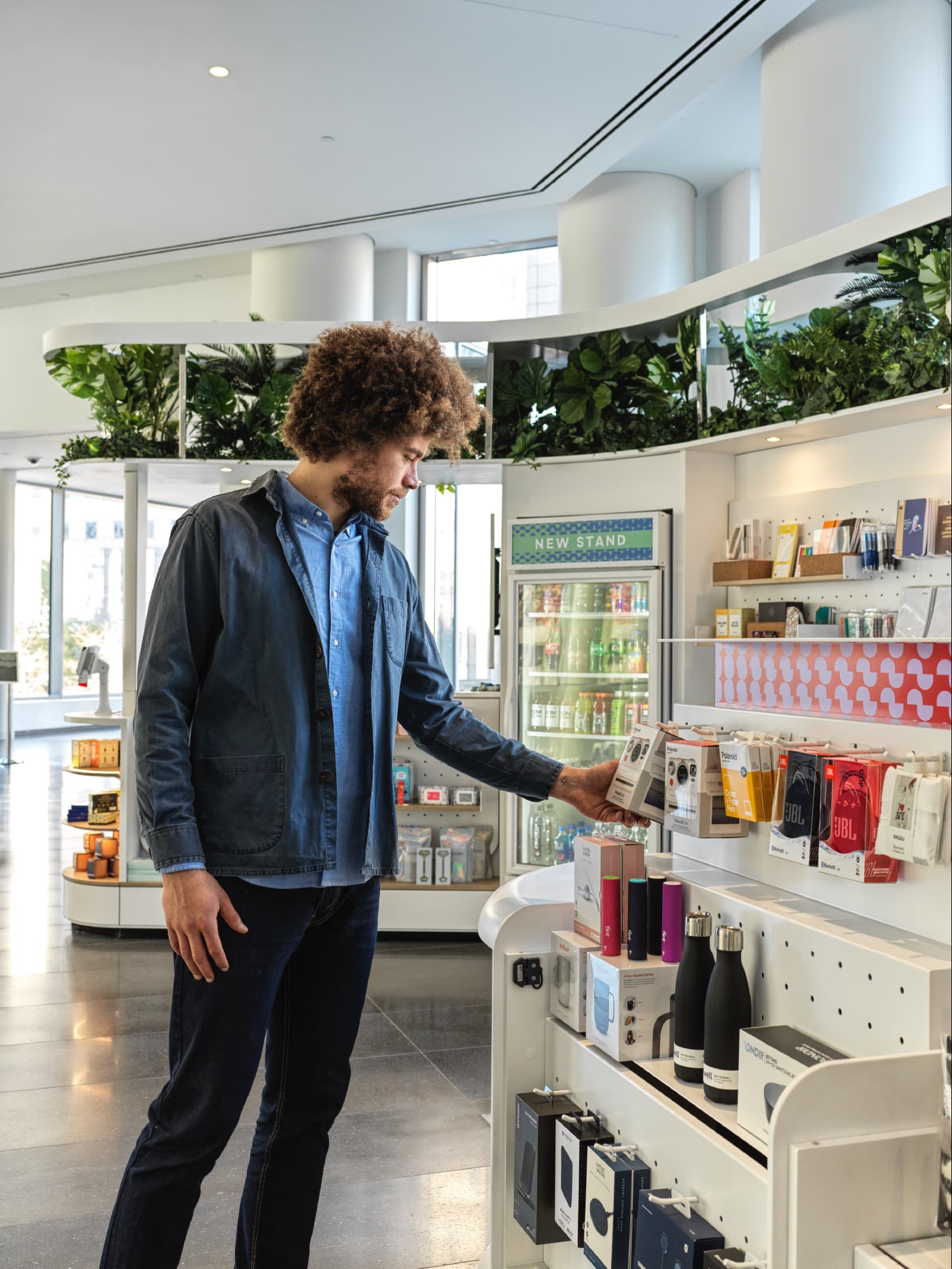
The original idea grew out of a conversation between Lex Kendall and George Alan about New York’s underground retail. Union Square had an available space. They discovered the procurement deadline with roughly two weeks remaining, scrambled to arrange the down payment and signed a ten-year lease. A modest shop came with a remarkably long commitment.
They recruited Andrew Deitchman, a co-founder of advertising agency Mother New York, and David Carson, a co-founder of Heavy.com. The founders brought experience in brands, media, design and hospitality. The shop paired everyday supplies with unexpected objects; the phone app supplied reading, music and a faster way to pay. Convenience could include a little entertainment.
But the name did not dictate the demand. In a 2019 interview, Kendall recalled that the newspapers stocked at launch had failed to sell. Snacks, drinks, health and beauty products and electronics performed better. Customers were quite willing to edit the founders’ idea, using the blunt instrument of a purchase.
The expensive part was doing it twice
A handsome shop is one problem. Producing another, in a different building, is another problem entirely. Kitspace, New Stand’s design and manufacturing partner, says the early reliance on individual custom builds made expansion too slow and costly. That is an unusually useful admission in a business where photographs tend to do the talking.
Across a three-year collaboration, the partners developed standardized, reconfigurable fixtures and workplace modules. Components could be made in batches, stored and transported efficiently, then assembled onsite. Kitspace describes installations taking hours rather than weeks. The aesthetic survived; the process became repeatable. An attractive cupboard still requires a competent supply chain.
- 01Break the design
into reusable parts - 02Manufacture
in batches - 03Ship efficiently
and assemble onsite
Kitspace reports assembly in hours rather than weeks. This is a delivery claim, not a measured return on investment.
The cost lesson is about method rather than a universal price. Standard parts reduce the need to reinvent each location. They also impose discipline: someone must decide which variations matter to a customer and which merely flatter the designer. New Stand’s solution was a system flexible enough to travel.
The customer moved upstairs
By 2021, New Stand was developing its workplace business. Its $40 million Series B, led by Brookfield Property Group, put capital behind that direction. Brookfield had already used the offering. A property owner could see the proposition from both sides: an amenity for people in the building and a reason to value the building itself.
New Stand at Work offered contactless micro-markets stocked with food, drinks and everyday necessities. Dartcor became its first operating partner in June 2021, bringing culinary and hospitality capabilities to New York and Philadelphia markets. The partnership made a practical division of labour: New Stand supplied its retail format and technology; Dartcor supplied fresh food expertise.
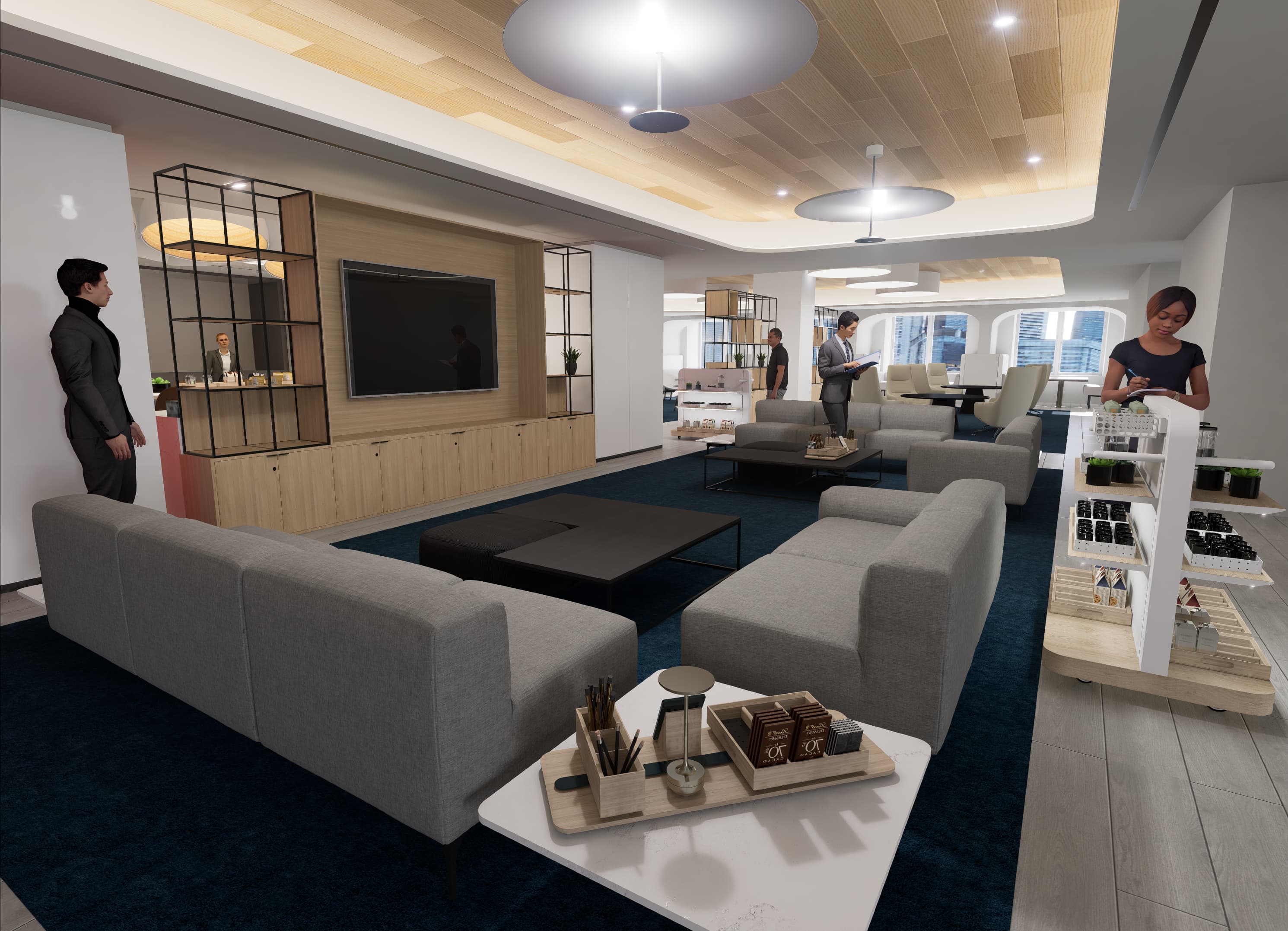
The buyer had changed. A commuter buys an item. An employer buys a service that must suit employees, fit a budget and keep working after launch day. The employee remains the audience, but another person signs the contract. That distinction explains why procurement, replenishment and program management matter as much as curation.
In 2024, Deitchman announced that CBRE would take on operations and service delivery through a partnership with New Stand and Brookfield. New Stand could concentrate on developing engagement programming and tools. That December, CBRE publicly included it in the Host tenant experience partner network. Distribution was becoming someone else’s established specialty.
Coffee acquires a creative brief
The digital side developed too. New Stand Connect’s 2024 app listing describes company messages, peer recognition, event RSVPs, gift redemption, refreshments and employee sentiment surveys. The ambition is to gather everyday culture activities into a convenient destination. An app gives the physical experience a channel between visits.
Its place in the market sits between several familiar suppliers. A pantry operator handles refreshments; an events agency arranges gatherings; a rewards platform distributes recognition. New Stand’s proposition combines these jobs around the employee’s routine. For a workplace team, the attraction is having someone coordinate the pieces.
Today, newstand.com redirects to Daycast. Its public offering brings workplace research, creative programming and provider management together. The work can include experience audits, internal campaigns, hospitality design, coffee and events. Its landlord offering covers amenity retail, food and beverage programs and communications. The agency language makes the planning role explicit.
“We chose Daycast to have a true work experience partner, not just a better snack provider.”
Caeley O’Shea, Warner Music Group
Testimonial published by Daycast
Borrow the habit, then do the homework
The useful lesson for a workplace manager is to begin with observation. Identify a repeated inconvenience, choose a service people will use, make delivery reliable and invite feedback. New Stand’s history suggests that employee experience becomes more manageable when it is treated as recurring work with an owner, rather than an occasional flourish.
The approach needs a budget, a functioning service operation and enough participation to justify the physical offering. An office market requires stocking even when attendance varies. A recognition app requires people to participate. These are practical conditions, not guarantees of happier employees. A beautifully designed perk can still answer a question nobody asked.
That is why the discarded newspaper matters. The company’s most instructive move was listening when a familiar category failed to match actual behaviour. Before ordering the next workplace amenity, try that small exercise: watch the day people are having. The spectacle chain can wait.