On the sixth floor of Carnegie Hall Tower, a doctor’s appointment could become a detour between meetings. Reside Health’s first clinic was planned for 2,500 square feet inside the Manhattan office building. The proposition was pleasingly literal: bring primary care closer to the people who needed it. An elevator would do some of the work usually assigned to a patient’s determination.
- Reside combined primary care, virtual access and wellness services inside New York office buildings.
- Landlord partnerships made one clinic available to people working for different employers.
- A former employee reported all offices closing in 2024, leaving useful ideas and uncomfortable economic questions.
There was a clinical argument underneath the real estate. In a 2022 healthcare report, co-founder Komal Kothari recalled a patient with diabetes whom she treated in medical school. The woman had reached hospital with complications. Kothari saw a problem that began well before the hospital admission: access to timely preventive care.
“Like many Americans, her underlying diagnosis was: lack of access to timely preventative care.”Komal Kothari · DHNY, Q1 2022
A checkup is easy to postpone when it requires a journey, an absence from work and another set of arrangements. Reside proposed to reduce those arrangements. Founded in 2020, it brought together Kothari’s medical background and the company-building experience of AlleyCorp’s Kevin Ryan. Its customer proposition had an address as well as an appointment book.
A building full of potential patients
Office buildings gather people from many businesses behind one front door. Reside treated that concentration as a way to distribute care. The landlord supplied a location and access to tenants; employees gained a nearby practice; employers could offer a useful benefit without creating their own clinic. A building became the unit around which a service could be organized.
That alignment attracted TF Cornerstone at Carnegie Hall Tower and SL Green at 750 Third Avenue. The latter location also served neighboring 485 Lexington Avenue. In March 2022, Silverstein Properties announced a Reside center in the Inspire Workspace at 4 World Trade Center. Primary care was joining the vocabulary of office amenities.
The service combined annual physicals, screenings, sick visits and chronic condition management with mental health and nutrition support. Wellness offerings varied by setting. The World Trade Center announcement included acupuncture, massage and physical therapy. Online booking and virtual care extended access beyond the physical clinic, an essential feature for a service attached to the workplace.
A distribution diagram, not a claim of measured savings.
The room was part of the prescription
Spectorgroup’s Carnegie Hall Tower design borrowed from its musical neighbor. Curved lighting guided patients through the space. Natural textures and soft colors gave the clinic a calmer register than the familiar fluorescent room. The architecture made a modest argument: a place where people discuss uncomfortable things need not look uncomfortable itself.
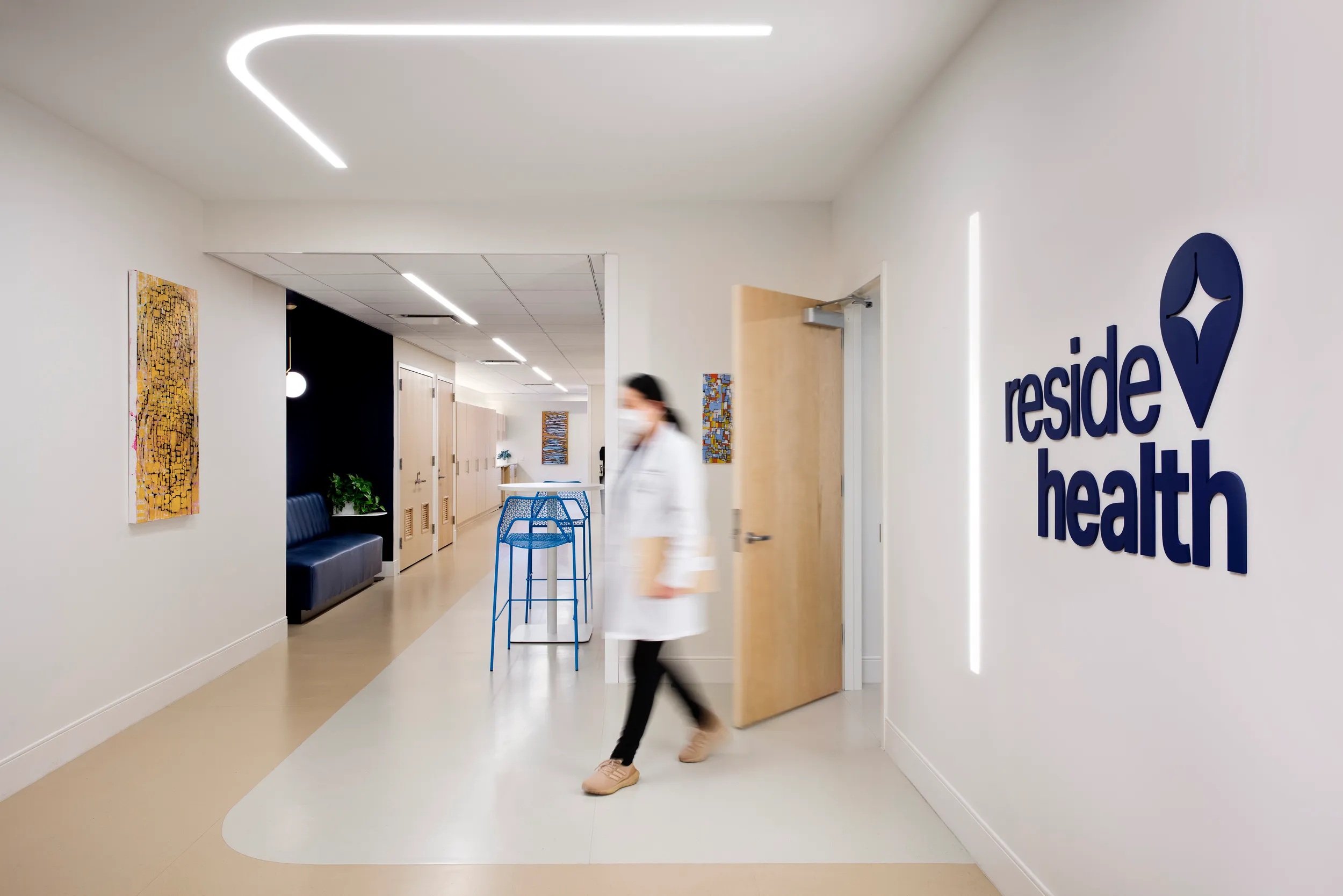
The practical decisions mattered as much as the atmosphere. Rooms could change between examination, office and rest functions. Storage concealed supplies and records. Flexibility meant the space could accommodate different uses without every adjustment demanding another construction project. At 750 Third Avenue, contractor ACC reported completing the clinic in six weeks.
Patients could use the practice for the ordinary, recurring work of healthcare: establishing a relationship with a clinician, arranging preventive visits, bringing in a new concern and following an existing condition. Reside’s recruitment materials described an interdisciplinary team. The appealing room depended on less photogenic work: clinical coordination, support staff and referrals.
The unusual number on the lease
The first clinic’s most instructive feature may have been financial. Commercial Observer reported that TF Cornerstone charged percentage rent, capped below market. Occupancy costs could move with Reside’s business. For a young service operation, that is a meaningful concession: the landlord accepted some variability instead of demanding a conventional fixed office rent.
A compact clinic on the sixth floor, with rent linked to business volume and a below-market cap.
The payment model had several layers. Primary care accepted major insurance, while employers could pay a fixed monthly fee for premium services. Membership-based practices were described in subsequent hiring materials. These layers served different purchasers: patients sought care, employers sought benefits and property owners sought an attractive building. Their interests overlapped without becoming identical.
The market alternatives were familiar: a conventional primary care practice, an urgent care center, membership medicine such as One Medical, or an employer’s dedicated onsite clinic. Reside’s distinguishing choice was to organize access around a multi-tenant building. Its advantage depended on the clinic’s placement, the care team and the commercial relationship working together.
A short ride still has a long cost
The later record makes this a historical experiment. In a LinkedIn account reshared in June 2024, former Reside health coach Carlee Alexander described budget-related layoffs, followed by learning that all offices were closing. A third-party capture of the company website also records a closure notice. The sequence she described puts staff cuts before the office shutdown.
That account establishes an outcome, not a complete explanation. It would be too neat to blame hybrid work, insurance reimbursement or construction spending without evidence connecting them to the decision. A January 2024 contractor announcement had still described a remodel. The public record moved from investment in the physical setting to a reported end of operations.
What survives the experiment
For anyone copying the idea, the sensible starting point is the catchment: how many people are actually nearby, and how often? A tower’s advertised capacity is different from a reliable patient population. Then come staffing, payment collection and the cost of keeping care available. A shorter journey for the patient does not shorten every expense.
Reside left several choices worth examining: pool demand across employers, negotiate rent that shares uncertainty, and design rooms that can change purpose. Each needs enough recurring use to support a clinical team. The elevator remains an elegant answer to distance. The harder achievement is keeping a familiar doctor waiting when its doors open.
Reside’s original web address and public profiles are included as historical links.