LeAnn Darland’s preferred beer presents a small problem for anyone trying to explain her company in one sentence. She likes the clean bitterness of a West Coast IPA. She helped create TALEA, the New York brewery known for fruit-forward beers that welcome people who often find an IPA much too bitter. The distinction matters. A founder can love one thing and still notice that an entire table would rather order something else.
Before the taprooms, before the colorful cans, there was a neighborhood in Coronado, San Diego. Darland was serving in the Navy and living three blocks from Coronado Brewing Company. The brewery offered something she valued after work: friends, a relaxed atmosphere, a place to sit without much ceremony. She became interested in how beer was made. She also became interested in what a brewery could feel like.
Darland grew up in Ohio, studied economics at the United States Naval Academy, and earned a master’s in finance at Johns Hopkins. Her early career took her to Hawaii and San Diego as a signals intelligence officer. A brewery was an unlikely next destination on that itinerary, but the interest stayed with her when she left military service and moved into corporate finance.
The contrast was useful. A brewery could be informal without being careless. It could be a neighborhood institution and a manufacturing operation at the same time. Darland had encountered the social half of that equation as a customer. Eventually, she would become responsible for much of the machinery that allowed the social half to happen.
Eight days away from the spreadsheet
At Google, where she worked for three years, Darland found another model of how an organization could operate. She appreciated the attention paid to employees and the freedom they were given to do their work. Those ideas would travel with her. The subject of the work, however, never held her attention the way beer did.
An eight-day backcountry hike in the Adirondacks gave her room to consider that difference. Around campfires with friends, at about thirty, she began to see a career in beer as something she could pursue. There is a pleasing incongruity here: a finance professional needed several days away from ordinary office life to decide what deserved her working life.
She started homebrewing while earning her MBA at Berkeley’s Haas School of Business. That combination placed the experiment on two tracks. There was the practical pleasure of making a drink, and there was the question of whether enough people would want to buy it. A successful batch could answer the first question. It could hardly settle the second.
Darland’s next move was Hopsy, a beer e-commerce startup that brought her to New York. There she met Tara Hankinson, another homebrewer whose background included The New York Times and a family steeped in wine and hospitality. Their experiences differed, but their irritation with the beer market was shared. They liked beer. They wanted a business that treated more people as plausible customers.
- 01U.S. NavySignals intelligence
- 02GoogleCorporate finance
- 03HopsyBeer e-commerce
- 04TALEAFounder & operator
A partner, then a name
Hankinson supplied a perspective shaped by hospitality; Darland brought finance and operations. In 2018, the two found enough common ground to begin building a company together. Within three months of meeting, they formed the LLC that became TALEA. The name combined their first names, Tara and LeAnn. It was a practical answer to a problem that had already consumed time and money in trademark searches.
Naming a company is an excellent way to discover how many apparently original thoughts have already occurred to somebody else. Their solution put both founders into the word on the can. More usefully, it let them get on with the work. By April 2019, TALEA had released its first beer.
They began selling to bars, restaurants, and retailers around New York. Early progress was measurable. An August 2019 interview recorded more than 100 barrels sold in under three months, placements in every Whole Foods across the city, and more than 85 accounts. The founders were testing their proposition in places where buyers had plenty of other beer to choose from.
Darland also carried an older ambition into this new business. As a child, she had imagined working on Wall Street. When a television interview took her onto the floor of the New York Stock Exchange, she arrived as a beer entrepreneur. The setting survived; the job description had changed rather dramatically. Finance had brought her somewhere she once wanted to go, by a route she had not anticipated.
The customers beyond her own glass
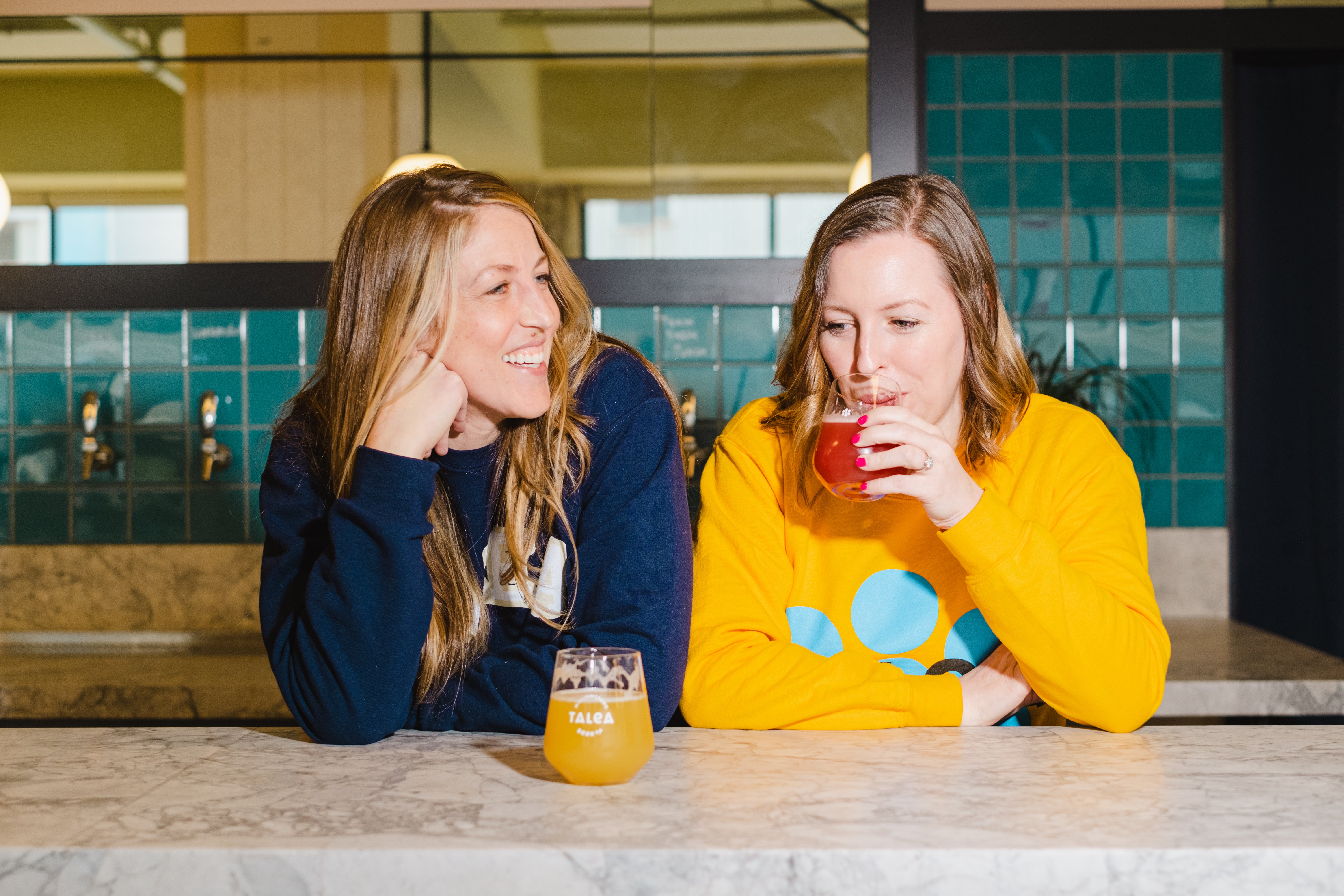
The opportunity was visible in ordinary social plans. When friends visited Darland in San Francisco, they wanted to go to wineries. She thought about a brewery that her friends and mother would enjoy visiting to dress up and celebrate. The appeal extended beyond what was in the glass. People were choosing an outing, a setting, and the company they would keep.
TALEA’s approach took those preferences seriously. Low bitterness and familiar fruit flavors gave people a route into beer without requiring them to acquire Darland’s own taste for hops. The founders also wanted packaging and rooms that felt welcoming. Someone who usually ordered wine or hard seltzer could approach a beer with a useful reference point instead of a vocabulary examination.
By 2024, the founders described their audience as roughly 70 percent women. That is their reported customer mix, rather than a universal rule about who likes which drink. Their beers still had to work for established beer drinkers. The aim was to bring different preferences to the same table and give each person something worth ordering.
Color, texture, and comfortable chairs became part of that invitation. So did a varied program of events, including singles nights and pop-culture trivia. The choices suggest an understanding of hospitality that starts before the first sip. A room can make trying something unfamiliar feel ordinary. It can also make returning feel like a sensible way to spend an evening.
“My favorite style was, and still is, very hoppy West Coast IPAs.”
LeAnn Darland
The work behind the welcome
Darland’s responsibilities put her close to the less photogenic parts of that promise. She manages brewing, production scheduling, wholesale, and back-office work, while Hankinson leads hospitality and marketing. The bright room depends on an industrial timetable. A beer has to be brewed, packaged, and delivered before anybody can casually decide to have another.
In 2023, Darland described a year organized around doubling production, wholesale volume, and the taproom footprint. That required relying on key staff and making internal project management more efficient. The challenge was familiar to anyone who has built a business by handling its details personally: growth creates more details than one person can reasonably handle.
Her finance background gives those decisions a concrete shape. Taproom sales and wholesale require different investments. The equipment a company needs depends on what it expects to produce and how it expects to sell it. Darland has discussed planning for those alternatives and led startup-finance workshops. The questions are considerably more demanding than whether a label looks good on a shelf.
Recognition has increasingly reflected that operational work. Darland and Hankinson received a StarChefs Rising Star Concept Award in 2023. Darland’s Inc. honors include 2024 and 2026; the latter recognized her oversight of the production of 2.5 million beers at the Brooklyn facility. It is a number that gives the appealingly casual taprooms a rather different scale.
beers produced at the Brooklyn facility under Darland’s oversight, recognized in her 2026 Inc. honor.
Six rooms, one brewery
The Williamsburg brewery and taproom opened in March 2021. Cobble Hill followed in 2022, then Bryant Park and the West Village in 2023. Penn District expanded the map again. In September 2026, TALEA opened its sixth taproom, on the Upper West Side, in the former St. James Gate space at Amsterdam Avenue and West 81st Street.
The Upper West Side had been a target for years. Its arrival brings another version of the all-day room Darland first appreciated in San Diego: coffee, beer, other drinks, and food, with reasons to visit at different hours. A mezzanine offers space for laptops. Large windows face the neighborhood. The business now has more addresses, but the underlying attraction remains a place to spend time.
Production stays in Williamsburg. TALEA’s website lists more than 1,300 retailers, bars, and restaurants across New York State carrying its beer. The taprooms and wholesale business therefore ask different things of the same company. One must make a visit appealing; the other must make a can useful far from the room where the brand first made sense.
That arrangement keeps Darland’s earlier careers in view. The customer sees a welcoming table. Somewhere behind it are production forecasts, staffing choices, orders, and deliveries. Her work connects the feeling she remembers from Coronado with the practical requirements of making that feeling available across a growing New York business.
- First beer released
- Williamsburg brewery opens
- Cobble Hill
- Bryant Park & West Village
- Upper West Side joins the six-location map
An unexpected order from George Washington
In 2026, an unusual collaboration made the distance from Darland’s first brewery visits especially entertaining. The New York Public Library asked TALEA to recreate a beer recipe George Washington had written in a 1757 notebook. A library approached a brewery to turn an archival object into a drink. New York occasionally makes excellent use of its neighbors.
The project produced two beers. One recreated Washington’s molasses-based “small beer” for the library. The other, Liberty Lager, used the recipe as inspiration for a contemporary amber lager. Brewmaster Eric Brown worked on the historical version. The separate lager gave modern drinkers another way into the story, without asking them to adopt an eighteenth-century palate.
The distinction fits TALEA’s broader approach: take the underlying interest seriously, then consider who will actually enjoy the result. A historical recreation and a beer for present-day customers can serve different purposes. There is room for both, provided somebody remembers which question each is answering.
Darland’s own preferences remain refreshingly uncomplicated. She likes burgers, including Shake Shack and Five Guys, and has room in her affections for both Papa John’s and L’Industrie. A founder concerned with widening beer’s audience has little reason to police somebody else’s dinner. Her taste for bitter IPAs has endured through all the fruit-forward brewing around her.
TALEA began with two women noticing customers the industry was overlooking. Darland’s contribution has been to help turn that observation into something people can repeatedly use: a stocked shelf, a finished beer, a room with an available chair. The invitation is easy to understand. Keeping it available is the work.