She left The New York Times to homebrew, got turned down by 400 venture capitalists who wanted a pink beer, and built the brewery they refused to fund.
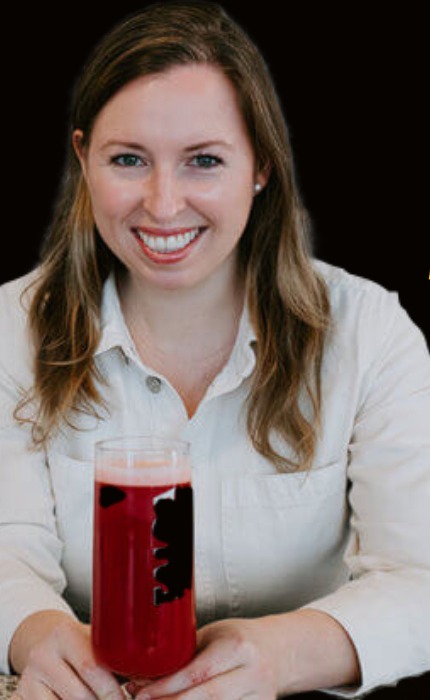
She is holding a red one - probably the Raspberry Crush Gose, the beer she names as her favorite. The black backdrop, the white shirt, the glass of something the color of a fruit stand: this is a woman who thinks about how beer looks as much as how it tastes.
Tara Hankinson runs the brand, the marketing, and the taprooms at TALEA Beer Co., which means she spends her days on a question most breweries never bother to ask: what would beer look like if it were built for the people craft beer spent forty years ignoring. The answer, at TALEA, is fruit-forward beers with names like Sun Up and Raspberry Crush Gose, packaging you would not be embarrassed to bring to a dinner party, and taprooms - five of them now, from Williamsburg to Bryant Park to the Penn District - that were each designed by a female architect. That last detail is not decoration. It is the thesis.
TALEA is, by the count that matters to the people who track these things, New York City's first woman-owned production brewery. It sells beer in more than 1,300 stores across the state, including the Whole Foods and Trader Joe's shelves where a lot of people buy their first craft beer without meaning to. Hankinson is co-CEO alongside LeAnn Darland, a structure that sounds like a governance problem waiting to happen and has instead been the whole point since the beginning: two people, two jobs, one shared irritation with an industry that kept selling to the same room.
The irritation is worth quoting directly, because Hankinson does not soften it. "A lot of craft beer has been made by craft beer lovers for craft beer lovers, selling to the same echo chamber," she has said. Her fix is not to make the beer worse or the marketing louder. It is to make the whole experience feel like somewhere you would actually want to spend an afternoon: "as creative as the best restaurants in New York City, as friendly as the staff at a kid's store and as beautiful of a space as the coolest coffee shops."
The division of labor with Darland is clean enough that it explains a lot about how TALEA works. Darland, a U.S. Navy veteran who found craft beer in San Diego, handles the brewing and operations side. Hankinson takes the brand, the marketing, and the taprooms - which is to say she owns the part of the business a customer actually touches. Two co-CEOs is the kind of arrangement that gets founders lectured about accountability, and TALEA has simply run it as a feature: the company that describes itself as woman-owned and, by some accounts, veteran-owned is run by two people who split the job down a seam that maps to their actual expertise rather than their titles.
You can see the strategy most clearly in the rooms. The Williamsburg flagship came first, in a former warehouse; every taproom after it was designed by a female architect, with the deliberate goal of building spaces that read as inclusive rather than clubby. There are, in TALEA's telling, thoughtful touches you would not find at a typical brewery. The point is not that beer needs to be gentler. It is that the room around the beer is a product decision, and most breweries had been making it badly for decades.
White men in their 60's totally have their finger on the pulse of what's trending in Williamsburg.
Our strategy is to make approachable beers in fun packaging that's very digestible, and convert people into beer lovers.
Seeing all these people believe in us brings me to tears.
Hankinson did not arrive at beer the way most brewery founders do. She grew up around the beverage business - parents in wine importing and restaurant management - and got an MBA at NYU Stern after an undergraduate business degree from Bucknell. During business school she took wine classes and worked at Wolffer Estate Vineyard on Long Island. What she took from the vineyards was not the wine. It was the hospitality, the sense that a place could be built around making you feel welcome. "There was nothing like that in the beer space," she has said. So she started homebrewing.
The resume in between is the kind that makes the eventual pivot look reckless: management consulting at PwC, a marketing job at The New York Times. Then she took a role at Hopsy, a beer e-commerce startup, where she met LeAnn Darland. Within roughly three months of meeting, the two of them had filed the LLC that would become TALEA. Both left steady jobs in 2019 to do it - the sort of choice that reads as either brave or foolish depending entirely on whether it works, and only later gets sorted into the first category.
What the two of them shared, working side by side at Hopsy, was a specific and repeated exasperation with the way craft beer talked to women. Not a vague sense that the industry could do better - a daily, granular annoyance at the packaging, the marketing, the assumption baked into nearly every product on the shelf. Both wanted an inclusive, approachable beer company that could reach a wider market than the one craft beer kept selling to. The homebrewing, the wine background, the marketing chops from a career spent making things appealing to people: it all pointed in the same direction, and they moved fast once they saw it.
The one she remembers.
Fruit-forward, on brand.
Florence Fabricant on TALEA's easy-drinking beers.
The fundraising story is the one Hankinson tells most, and it is genuinely instructive about what conviction costs. TALEA pitched roughly 400 venture capitalists. Most passed. A recurring piece of feedback was that the founders should make a "pink beer" - a product literally colored and marketed for women. They declined, on the grounds that the entire premise was wrong: the goal was not to segregate women into a novelty aisle but to make beer that anyone might want and that happened to be made by women. Eventually they raised over $2 million, most of it from around 116 investors - friends, family, angels, people writing checks with a $25,000 minimum. Later they closed a Series A.
Before any of the taprooms existed, TALEA's beer was brewed under contract at Torch & Crown in the Bronx. The flagship Sun Up IPA launched in April 2019, before the company had a building of its own. In the earliest days the founders sold beer off a loading dock behind a handwritten sign that said, more or less, knock for beer. One Saturday of knocking brought in about a thousand dollars. The flagship brewery and taproom finally opened in Williamsburg in March 2021 - not, it should be noted, an easy month to open anything in New York.
There was nothing like that in the beer space.
Rejected repeatedly, often with the suggestion to make a "pink beer." She refused, and raised the money from small investors instead.
A distinction that carried real marketing weight and real skepticism from investors.
Williamsburg, Cobble Hill, West Village, Bryant Park, and the Penn District.
Across New York State, including Whole Foods and Trader Joe's.
The look of the room is treated as a product decision, not an afterthought.
Named to the 250 list, and later the 500.
Grown from a Bronx contract brew and a loading-dock sign.
The stated ambition is expansion - more taprooms across New York and beyond - powered by a Series A and the same premise that got 400 no's. TALEA's growth math depends on converting people who currently reach for wine or seltzer into people who reach for beer, one approachable, fruit-forward can at a time. The bet, in Hankinson's telling, is that craft beer's future belongs to whoever is willing to stop selling to the echo chamber and start building rooms that other people want to walk into.
There is something clarifying about a business whose entire strategy can be stated as a sentence a rejected VC would have found unfundable: make beer for the people who do not already love beer. Everything TALEA does follows from it. The fruit-forward flavors are a way in for someone whose reference point is rose. The fun packaging is a way to get picked up off a Trader Joe's shelf by a shopper who was not looking for an IPA. The taprooms, designed by women, are a way to make the third place - the room that is neither home nor work - feel like it was built with a wider set of people in mind. And the co-CEO structure is a way to keep the beer honest and the brand ambitious at the same time. It is a lot of moving parts in service of a very simple refusal: TALEA was not going to make the pink beer.
Tara Hankinson is the co-founder and co-CEO of TALEA Beer Co., New York City's first woman-owned production brewery. After leaving jobs at PwC, The New York Times and a beer e-commerce startup, she and co-founder LeAnn Darland launched TALEA in 2019 to make craft beer approachable for the people it had long ignored. She runs the brand, marketing and a growing chain of design-forward taprooms across Manhattan and Brooklyn, with beer stocked in more than 1,300 retailers.
Last updated: