Company Profile ◆ Food & Beverage ◆ New York
Manhattan Hadn't Brewed Its Own Beer Since 1995. Two Guys With Confiscated Fake IDs Fixed That.
A finance trader and his oldest friend spent a decade trying to brew beer in the one New York borough that had given up on breweries. Then they opened during a pandemic - and had to reinvent the whole thing in a week.
For twenty-five years, you could not buy a beer that was actually made in Manhattan. Breweries had fled to Brooklyn, Queens, and points upstate, chased out by rent, real estate, and the plain arithmetic of stacking fermentation tanks in the most expensive dirt in America. The borough that once had breweries on nearly every avenue had, by the late 1990s, exactly zero. Then two childhood friends decided that was a problem worth spending a decade to solve.
Torch & Crown Brewing Company opened at 12 Vandam Street in SoHo in October 2020 - which, if you are keeping a calendar, is roughly the worst month in living memory to open a bar in New York City. It was the first production brewery to operate in Manhattan since 1995, and for its entire run it was the only one. That fact alone would make it interesting. What makes it a story is everything the founders had to do to keep the doors open once they got them open.
01The origin nobody would put in a pitch deck
John Dantzler and Joe Correia grew up in the New York area and did not, they'll tell you, always plan to open a brewery. The turning point in the company's own telling is almost too good: at 16, both had their fake IDs confiscated at a bar in the East Village. Cut off from buying beer the easy way, they started making it - an illicit homebrew hobby that turned serious, collected some competition trophies, and became the thing they kept circling back to after college.
The idea took formal shape around 2008. The company itself was founded in 2018. That gap - a decade of conceptualizing before incorporating, then two more years before the taps ran - is the part founders should study. This was not a fast bet. Dantzler spent years as a vice president and trader in macro credit derivatives at Barclays before trading a Bloomberg terminal for a brewhouse. The patience that looks romantic in hindsight was, at the time, mostly just the long, unglamorous work of figuring out how to fit a factory inside Manhattan.
02What they actually built
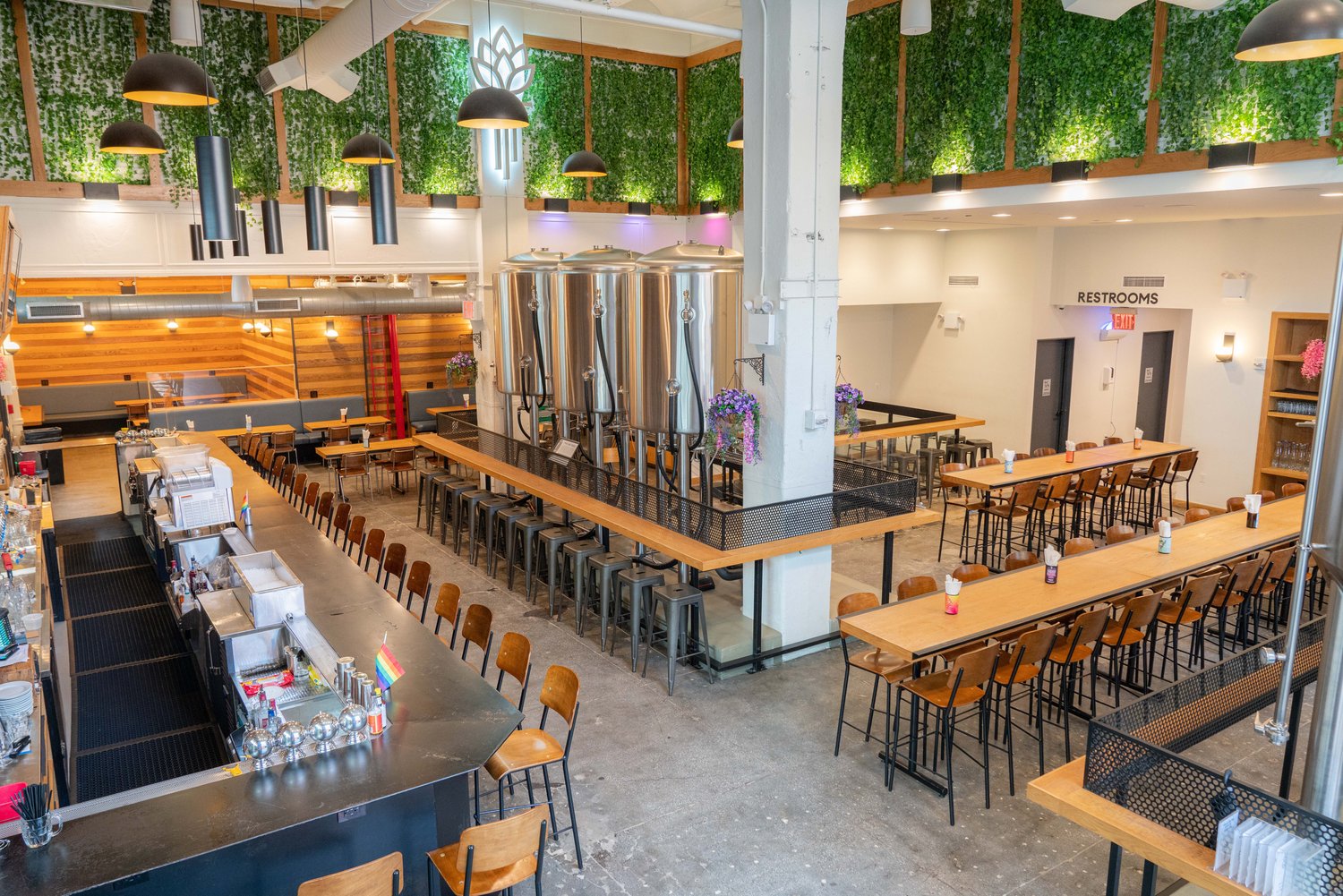
The answer to "why did everyone else leave Manhattan" is space, and Torch & Crown's answer to that was to go big and go vertical. The SoHo home base runs about 9,000 square feet across multiple levels, with soaring ceilings, ivy on the walls, an 18-tap blackened-steel bar, brite tanks on the main floor, and seating for roughly 250 people inside plus another 180 in a heated outdoor area. It was engineered to be three businesses at once: a working production brewery, a full restaurant pouring its own beer alongside New York State wine and cocktails, and an event venue built to host parties from five people to five hundred.
The beer itself spanned the three families a modern taproom needs: ales, lagers, and sours. The house lineup that regulars came to know included the Tenement Pilsner, a workmanlike American lager called Dive Beer, and a double IPA with the very New York name Power Lunch. This was not a one-style vanity project. The point was range - something for the after-work pint, something for the beer nerd, something to take home.
03The opening that immediately went wrong
Here is the part worth copying. Torch & Crown's grand opening landed in the middle of a pandemic that had shut down exactly the on-premise, sit-at-the-bar experience the whole space was designed around. A lesser operation would have waited, or folded. Instead the team built a direct-to-consumer beer-delivery business almost overnight - standing up an e-commerce store from scratch to sell fresh beer straight to New Yorkers' apartments, rotating staff on shifts to keep operating safely, and keeping payroll going through the worst of it.
Treat the emergency channel as a real product. Delivery started as survival, but Torch & Crown kept it after reopening. The lesson isn't "build a website in a week." It's that a distribution channel forced on you by a crisis can outlast the crisis if you decide to invest in it instead of retiring it.
It worked well enough that the company committed to keeping home delivery running alongside the taproom once the city reopened. The technology stack under the hood was unglamorous and effective - a Shopify storefront, print-on-demand for merch, an email list - the same kit a thousand small consumer brands use, pointed at the very specific problem of getting cold beer across Manhattan.
04The business model, in plain terms
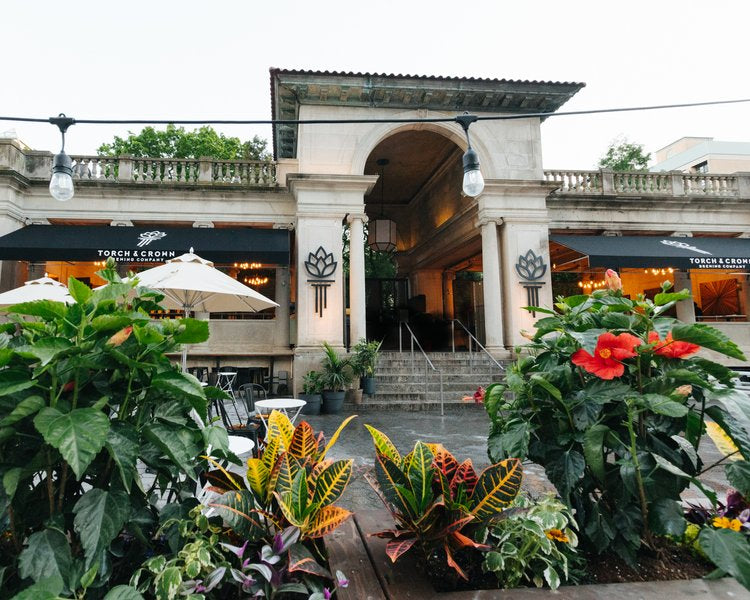
Strip away the ivy and Torch & Crown ran four revenue lines off one brewhouse. On-premise sales at the SoHo taproom and the seasonal Union Square beer garden. Direct-to-consumer delivery through its own store. Wholesale to city bars and retailers. And private events, which turned that big, unusual room into money on nights it might otherwise sit half full. Any one of those alone is a hard business in Manhattan. Bundling them is how you justify the rent on a factory in SoHo.
Being the only brewery in Manhattan was both the whole marketing story and a real constraint. It gave Torch & Crown a claim no competitor could copy - Brooklyn Brewery, Other Half, Threes, Grimm, and the rest all pour excellent beer, but none of it is made on the island. It also meant carrying Manhattan-sized costs against a small brewer's output: roughly 5,000 barrels a year, against national craft brands that ship many times that.
05Knowing when to stop going it alone
In September 2025, Torch & Crown merged with Aslin Beer Co., an Alexandria, Virginia brewer and one of the largest taproom breweries in the country, to form a combined group called Driven Collective. The pitch was to put "production, distribution, hospitality, and brand under one roof" and give both labels better reach in their home markets of New York and Washington, D.C. Under the new structure, Aslin's larger Alexandria plant would brew flagships and seasonals for both brands, while the SoHo brewpub kept turning out its own one-offs.
The leadership map tells you how the deal was weighted. Aslin chief executive Andrew Kelley became CEO of Driven Collective; John Dantzler moved into the chief financial officer seat. For a founder, handing over the top title is not the failure narrative it's sometimes read as - it's a bet that a bigger, shared platform beats a smaller solo one. It also fits a company that had already shown, twice, that it would rather change shape than break.
06Where it fits - and where it wouldn't work
Torch & Crown sits at the intersection of consumer packaged goods and hospitality, which is a polite way of saying it had to be good at two hard businesses at once. Its edge was never being the cheapest or the biggest. It was being the local one, in the one place locality seemed impossible, with a story - teenage homebrewers, a decade of planning, a former derivatives trader chasing a beer instead of a bond - that a marketing team couldn't have invented if it tried.
The model leans hard on dense foot traffic, a novelty-of-place hook, and an operator willing to run three businesses under one roof. Drop it in a cheaper market and the "only brewery in Manhattan" magic evaporates; the rent that made the story possible is the same rent that keeps the margins thin. It's a strategy for a specific address, not a template you can stamp anywhere.
By 2026, the SoHo taproom's own listings show it closed as brewing consolidated into Driven Collective - the tanks that ended Manhattan's 25-year drought went quiet again, at least at that address. But the through-line of the whole company holds: a decade of patience to open, a week of improvisation to survive, and the judgment, at the end, to scale by joining rather than straining alone. For a small brewery that only ever wanted to make beer where people actually lived, that's a fairly complete arc.