The most revealing customer at Tom’s Watch Bar is the one who will not leave. Conventional restaurant math treats that person as a small disaster: another hour in the seat, no fresh table, no new entrée. Tom’s treats the same person as the product. Give a fan a clean sightline, the right game, a cold drink and a room that reacts at once, and a stubborn table becomes a four-quarter occasion.
That inversion explains more than the wall-to-wall televisions. It explains the fast kitchens, the handheld ordering, the giant rooms, the stadium-adjacent leases, the official team relationships and even the 40-ounce, two-handed beer stein. Tom’s Watch Bar is technically a restaurant chain. Operationally, it is a scheduled live-entertainment business that happens to collect its tickets through wings, prime rib dips and premium tequila.
The accident hiding inside the diner
The company did not begin with a sports-bar manifesto. Tom Ryan, Rick Schaden and their partners launched Tom’s Urban in the 2010s as an upscale, all-day diner for busy casino and entertainment locations. Their résumés were unusually loaded for a young restaurant brand. Ryan had worked on Pizza Hut stuffed crust and the McDonald’s McGriddle. Rick Schaden had run Quiznos. Together they had helped create Smashburger.
The first version was broad because broad looked safe. Breakfast, lunch, dinner, cocktails, tourists, locals - an urban restaurant for everyone. Then the Los Angeles unit near the arena now called Crypto.com Arena started giving management a different answer. As the team added televisions, traffic rose. One Monday evening, when the dining room normally would have emptied, a football game kept it half full. Away games drew people too. Sports unrelated to the arena worked. A generic diner had accidentally found a more specific reason to exist.
“If we’re going to go toward sports, let’s go fully after sports.”Brooks Schaden, co-founder and co-CEO
In 2019, Tom’s Urban became Tom’s Watch Bar. The name change was the inexpensive part. The company began programming games rather than merely turning them on. It published schedules ahead of time, spread different events across scores of screens and treated fantasy players, bettors, alumni clubs, international-soccer fans, women’s-sports audiences and UFC crowds as primary customers. The promise was not “we probably have the local game.” It was certainty.
The costly part is making “yes” reliable
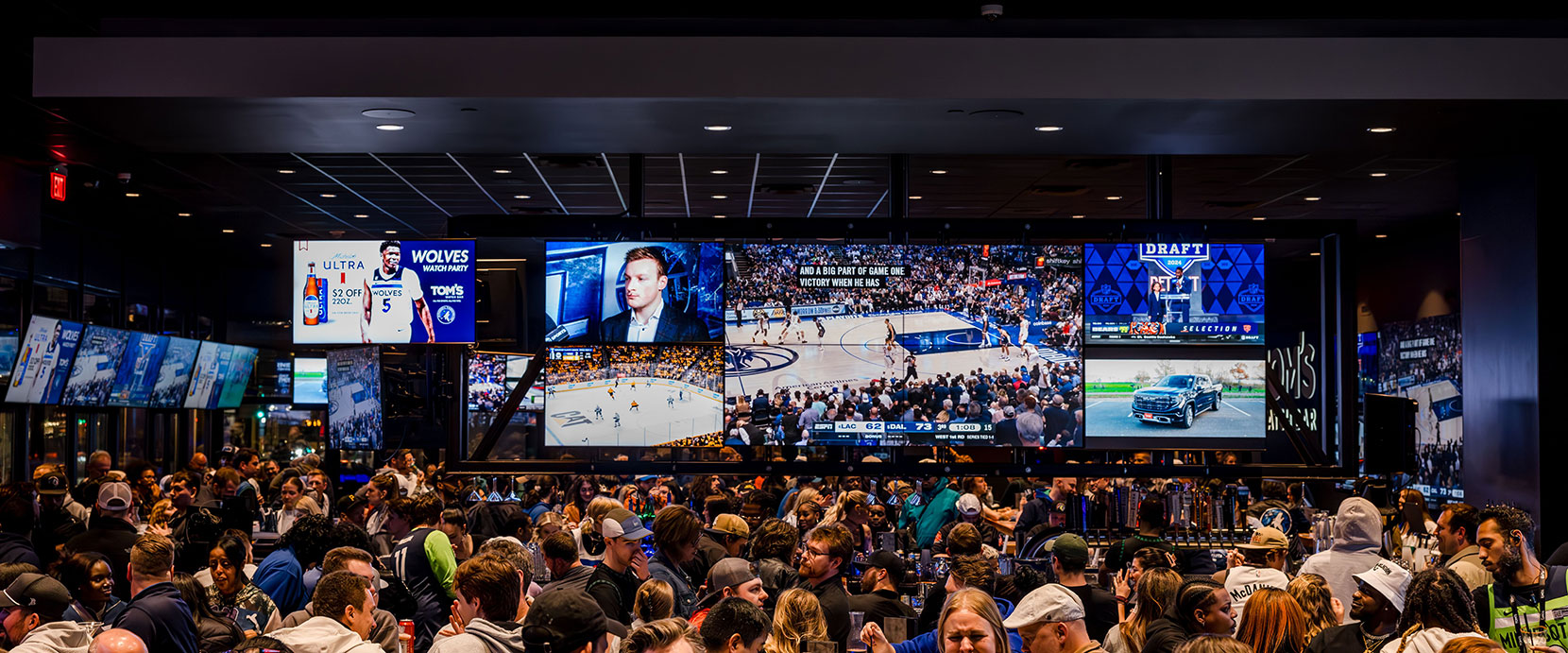
More screens are easy to copy. Reliability is not. Sports rights are scattered across broadcast, cable, streaming and pay-per-view services. A location must know which customer wants which contest, where to place it and which audio feed matters. The Indianapolis venue opened with 135 displays in roughly 10,000 square feet. Across the chain, a central “stadium” screen provides the visual anchor while secondary screens protect the promise that almost every seat works.
Then service has to behave like the clock matters. Servers use handheld tablets and stay close to their stations. Management has said drinks can arrive in around a minute and hot food in about eight. That is not simply a hospitality flourish. A fan will forgive an ordinary chicken wing before forgiving the touchdown missed while hunting for a bartender.
The menu is calibrated between sticky-floor nostalgia and expense-account theater. There are wings, burgers and nachos, but also ahi tuna, Mediterranean bowls, a prime rib dip, craft cocktails and zero-proof drinks. Alcohol has accounted for roughly half of sales. Long stays change the check: company leaders have said a guest may order one and a half dishes and four or five drinks, rather than the one dish and one or two drinks typical of a shorter restaurant visit.
A $30 million real-estate thesis
The pandemic struck one year after the rebrand, closing the rooms just as Tom’s had decided what they were for. Management used the idle period to work on development. Soft restaurant real estate created openings. In September 2022, Sagard Credit Partners supplied $30 million in growth financing; SIF Partners, the Denver-area family office that owns the company, had provided the initial equity. Eight venues were then under construction.
The money amplified a particular site strategy. Tom’s seeks what its executives call “gravities of traffic”: arenas, stadiums, convention centers, casinos and entertainment districts. By September 2025, 15 of 18 units were adjacent to a stadium or arena. The company avoids going inside the venues, where opening hours depend too heavily on ticketed events. Next door, it can collect the crowd before the game, after it, during an away game and when a concert or convention rolls through.
The game-day whiplash - reported Denver sales
This is a powerful model with a nasty pulse. The Denver restaurant has reportedly swung from about $2,000 on a quiet night to roughly $200,000 around baseball’s opening day. Forecasting labor, food and beer against that curve is more like event production than casual dining. Attractive suburban demographics can still fail if the street goes silent by 7:30. A giant screen cannot manufacture foot traffic outside the calendar.
The teams are landlords, marketers and cast members
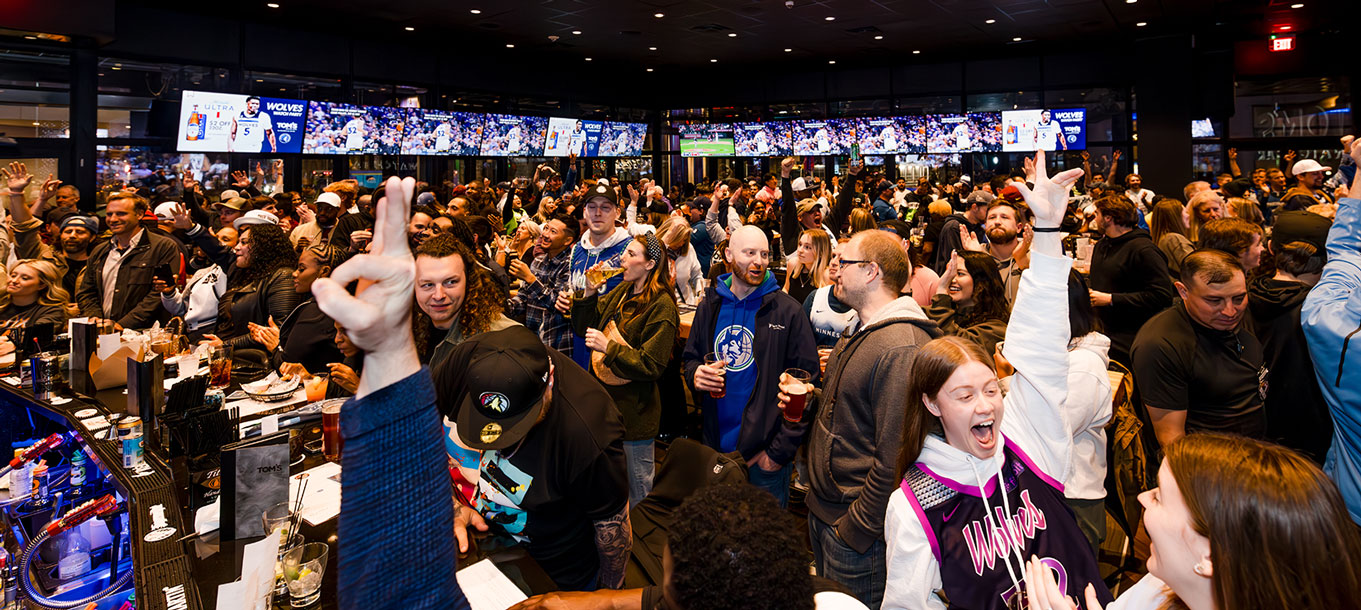
Tom’s has relationships with sports organizations and venue owners in Los Angeles, Denver, Cincinnati, Milwaukee, Sacramento and Seattle. The Los Angeles Kings call the nearby Tom’s their official pregame and postgame spot. At watch parties, teams can supply mascots, cheer squads, announcers, giveaways and, most importantly, access to fan communication channels. A message from a team lands with credibility a restaurant coupon cannot buy.
The exchange works both ways. A team needs its expensive district to feel alive when the club is traveling. Tom’s gives away games a home, extends the game-day visit and captures people who could not secure a ticket. The restaurant gets an official-feeling gathering with lower customer-acquisition costs. National relationships with UFC and Flecha Azul Tequila add more programmed events and promotion.
Store leadership follows a similarly aligned structure. Instead of conventional general managers, Tom’s uses operating partners who hold a piece of their location and manage its profit and loss. The idea borrows from the managing-partner culture Shannon McNiel encountered at Texas Roadhouse: make the person closest to the room think like an owner. The company credits the model with retention and operational discipline, although public employee reviews remain mixed - a useful reminder that ownership language at the top does not guarantee a uniform shift on the floor.
The reported sales jump around 2025 “Love Island” watch events. The discovery: communal fandom does not require a scoreboard.
What changed their mind, twice
The first change came from Monday Night Football: screens were not decoration but demand. The second came from a dating show. In 2025, Tom’s hosted “Love Island” viewing events and reported that sales around the finale surged nearly 900 percent. Fans cheered and cried in rooms designed for buzzer-beaters. The machinery worked because the underlying job was the same - gather people who care about a scheduled live moment.
That makes Tom’s more interesting than its “sports bar” label. It sits between casual dining, live media and experience entertainment. Buffalo Wild Wings, Twin Peaks, Walk-On’s and the local corner bar are obvious alternatives. So are a stadium seat and a phone. Tom’s response to the phone is not a better stream. It is synchronized emotion, delivered with fries.
The parts worth stealing
Watch the accidental peak
When a weird day outperforms, ask which behavior changed. The Los Angeles Monday crowd was research hiding in the register.
Publish the promise
A two-week game calendar turns “maybe” into a plan. Certainty can differentiate a familiar product more cheaply than novelty.
Design around dwell time
If customers want to linger, align service, menu and economics with the stay instead of fighting it.
Borrow distribution
Choose partners whose audiences already trust them. Team channels and official watch parties beat generic restaurant advertising.
Follow the calendar
Locate near recurring reasons to gather, then plan labor and inventory for the violent peaks those reasons create.
Do not copy the giant room first. The model struggles where evening foot traffic dies, sports interest is thin, rights are unavailable, service cannot keep pace or rent assumes every night is opening day. Long dwell times only work when repeat drink and food orders support them. Team partnerships only work when both sides actively distribute the event. A 100-screen bar with no programming discipline is simply expensive wallpaper.
Tom’s reported average venue sales above $6 million in 2025, with restaurant-level margins over 25 percent and a company run rate above $100 million. The company site listed 18 markets in August 2026. Those numbers do not prove every future location will travel. They do show what happened when experienced operators listened to the room: they stopped asking how quickly a customer might leave and built a company around why the customer came.