At a Miller's Ale House on a busy night, the television screens are everywhere, but they are not always the center of attention. One table is studying a playoff game. Another is negotiating whether to split mozzarella sticks. A family has found the kids' menu. Someone at the bar is collecting a takeout order. This mixed scene is the point. Miller's is a sports bar engineered so that nobody in the group has to be much of a sports fan.
That distinction has carried the company a long way from Jupiter, Florida, where Jack and Claire Miller opened the first Ale House in 1988. The original promise was plain: a local place open to all walks of life, with fresh food, fair prices and an easygoing room. The company is now based in Orlando. Its official locator lists 112 restaurants across the United States, and its public company profile counts more than 9,000 team members.
Miller's sits in the crowded overlap between sports bar, neighborhood tavern and family casual dining. Buffalo Wild Wings may be the obvious national comparison, but Miller's menu reaches toward the territory of Chili's, Applebee's and the big steak-and-seafood chains too. That overlap is not an identity crisis. It is the operating thesis.
The customer base follows from that hybrid. There are committed fans arriving before kickoff, but also parents looking for a low-friction meal, coworkers extending lunch into a drink, travelers who recognize the sign and regulars who prefer a bar seat to a dining room. Large groups matter because the format can absorb them, and catering carries the same familiar food into meetings and celebrations. Miller's is selling less to a demographic than to an occasion: the moment when people want to be together without planning something elaborate.
A menu designed to defeat the veto
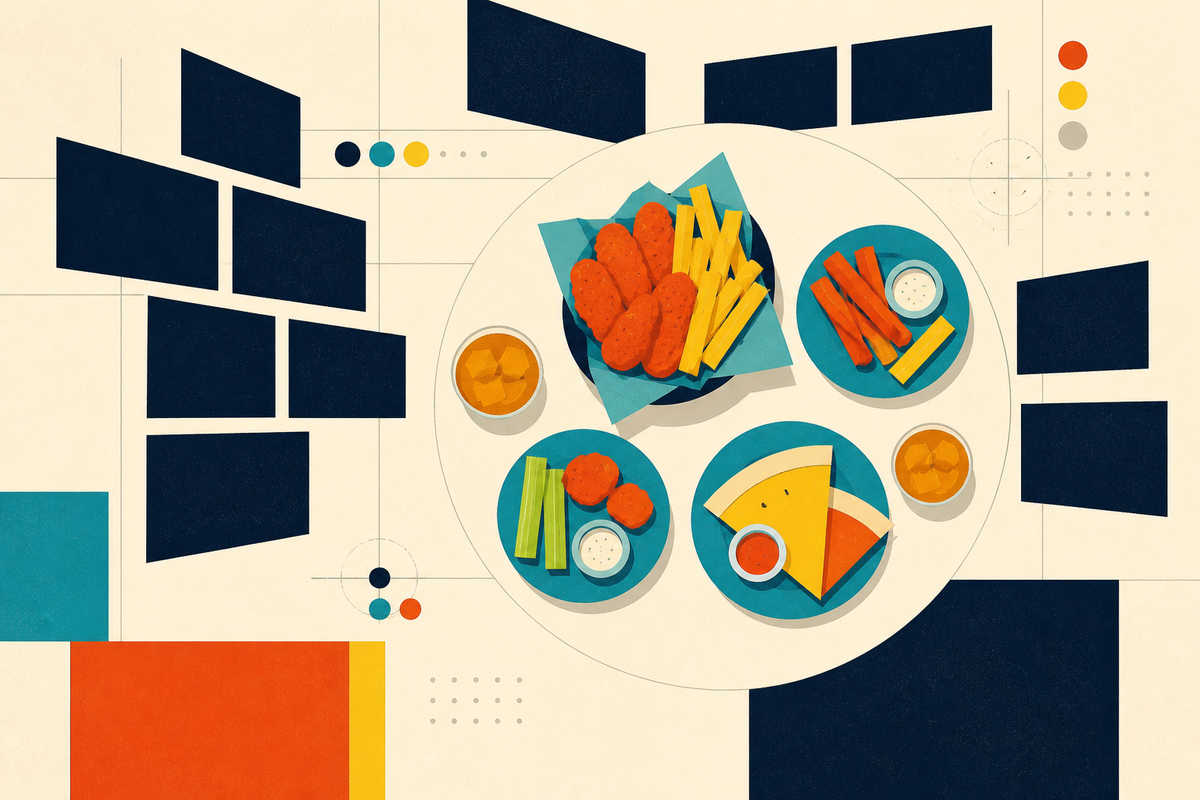
Restaurant decisions are often made by groups, and groups are collections of small objections. One person wants wings. One wants salmon. One is watching the bill. One wants a cocktail and one needs something a child will actually eat. Miller's answers with abundance: burgers, steaks, seafood, pasta, salads, sandwiches, soups, shareable starters and desserts, plus weekday specials and a full bar.
The menu is less a chef's narrow argument than a peace treaty. It solves a familiar consumer problem: where can several people with different appetites watch an event, eat a full meal and avoid a formal occasion? In business terms, that variety lets the same dining room work across lunch, happy hour, family dinner, late-night drinks and game-day traffic.
One kitchen, four reasons to visit
The range would be forgettable without a product people can name. Miller's has Zingers, its hand-breaded boneless chicken tenders, and the gloriously literal Zinger Mountain Melt: Zingers laid over fries with melted cheese, bacon and scallions. It is food built for a table with several forks, an indulgent photograph and a story that requires no culinary translation.
“The menu is a peace treaty for a table full of vetoes.”YesPress analysis
The neighborhood feeling is carefully repeated
Every chain faces a peculiar design problem. Scale rewards consistency, but diners like the idea that their gathering place belongs to them. Miller's calls each restaurant “Our House,” uses a come-as-you-are message and positions staff as hosts of a local room. The sports help. A national football broadcast is shared infrastructure, while the people cheering for the local team supply the local character for free.
The company says its mission is to connect people through exceptional experiences, producing loyalty, profitability and growth. Its six public values are more operational than poetic: integrity and respect, people first, ownership of guest loyalty, a drive for excellence, mutual accountability and community engagement. They describe a service business in which thousands of small interactions must feel personal even when the recipes and systems are standardized.
Value is the second part of that familiarity. Large portions, weekday deals and recognizable ingredients reduce the risk of trying the place. Miller's does not need to convince a guest to understand a new cuisine. It needs to deliver a steak, salad, burger or plate of Zingers reliably enough that the group returns. In a casual-dining market squeezed by higher labor and food costs, that balance is hard: the plate must look generous without destroying the unit economics.
A restaurant floor with a digital back room
The visible business is simple. Restaurants sell food and alcoholic drinks, with the bar lifting the economics of a visit. The less visible business extends each kitchen through online ordering, pickup, delivery, catering, party boxes and gift cards. A mobile app and e-club help Miller's reach guests before the next game or weekday deal. Catering repackages existing production into buffet trays and individual boxes for offices, birthdays, family gatherings and casual receptions.
Behind those channels is the unromantic work of purchasing the same ingredients, protecting quality and seeing problems before 112 managers discover them separately. Miller's began using ArrowStream's foodservice supply-chain platform in 2022 and renewed the partnership in December 2025. The companies say the system automates manual workflows and gives Miller's better visibility across suppliers and distributors. Doug Jackson, the chain's chief supply chain officer, said the platform added depth to his organization and helped it operate more efficiently.
That is where Miller's expertise lives: not in inventing a new food category, but in coordinating a complicated, high-volume social experience. It must schedule games across screens, turn a long menu through one kitchen, serve both a quick lunch and a lingering table, manage alcohol responsibly and preserve value while food prices move. The customer sees the cold beer. The operator sees forecasting, line checks, table turns and distributor data.
Ownership changed; the proposition stayed recognizable
Roark Capital acquired Miller's in July 2013 from Jack Miller and SKM Equity Fund III. At the time, there were 65 units and roughly $300 million in system-wide sales. The price was not disclosed. Roark, which has owned and backed numerous restaurant brands, described Miller's as a differentiated consumer business with a loyal following and a strong value proposition.
The intervening growth to 112 listed locations is meaningful, but it is not the rocket-ship story of a drive-through concept. Full-service restaurants carry larger buildings, more labor and more operational complexity. A new Miller's needs a market with enough families, workers and sports traffic to keep all those seats useful beyond one kickoff window. Its competitive edge is therefore cumulative: broad appeal, alcohol sales, recognizable signatures, sports infrastructure and an atmosphere casual enough for repeat use.
It also competes with the living room. Every large game is available on a household screen, and delivery can bring wings without the drive. The restaurant has to offer what the couch cannot: simultaneous games, a crowd's reaction, no cleanup, different meals from one kitchen and the mild theater of strangers caring about the same final seconds. Online ordering is not merely a hedge against that competition. It lets Miller's serve the household when staying home wins, using the same brand and much of the same menu.
Where Miller's fits now
Miller's occupies the practical middle of American dining. It is more meal-oriented than a neighborhood bar, less specialized than a wing chain, less theatrical than an arcade restaurant and usually more casual than a steakhouse. Local taverns can feel more distinctive. Focused chains can run simpler kitchens. Miller's accepts those tradeoffs to become the place a mixed group can agree on.
Recent marketing has leaned into that social identity. The company has promoted local hockey viewing parties, a “Draft Stories” video series with brewers and short-form comedy built around sports-debate culture. Its summer 2026 menu added a choose-three appetizer sampler. Each move makes the same argument at a different scale: assemble what you like, sit with your people and let the screens supply a little extra electricity.
The formula is not mysterious, which may be why it has lasted. Miller's does not demand that dinner become an event. It makes room for several small events to happen at once: a goal, a birthday, a workday ending, a child finally choosing dinner. The televisions are easy to count. The more durable product is permission for everyone at the table to want something different.