The pitch behind Punch Bowl Social has always been almost suspiciously simple. Put a real kitchen, a serious cocktail bar, and a room full of games in the same building, and people will stay. Not for the 55 minutes a normal restaurant gets between the greeting and the check, but for hours - through dinner, a second round, a few frames of bowling, one regrettable karaoke number, and a plate of late-night fries. The company sells dwell time. Everything else is decor.
That decor happens to be very good. Since opening its first venue in Denver's Baker neighborhood in 2012, Punch Bowl Social has built big, photogenic rooms stuffed with bowling lanes, vintage arcade cabinets, darts, ping-pong, shuffleboard and private karaoke - and wrapped them around a from-scratch food program. The result helped define a category American operators now call "eatertainment," a clumsy word for a genuine idea: that the night out and the meal out no longer have to be separate errands.
The more interesting story is what happened after the concept worked. Punch Bowl Social grew, took a nine-figure check from an unlikely partner, then walked straight into the one event its entire business model could not survive - a year when gathering itself was illegal. What it did next is why it is still worth writing about.
The ConceptA restaurant that happens to bowl
It is tempting to file Punch Bowl Social next to the arcade bars and axe-throwing joints, but the company has always insisted on the order of its own name: food first, then the play. The kitchens are scratch kitchens - gastro-diner fare, weekend brunch, late-night snacks - and the bar runs a high-volume craft cocktail and craft beer program with a daily happy hour that starts at 3 p.m. and puts sips and bites on the menu from around $5.
The games are the hook that gets a group in the door. The kitchen is the reason a group comes back. That distinction sounds like marketing until you look at the failure mode of the category: a room full of activities with mediocre food is a one-visit novelty. Punch Bowl Social's bet was that the food had to be good enough to stand on its own, so that the bowling became a bonus rather than the entire proposition.
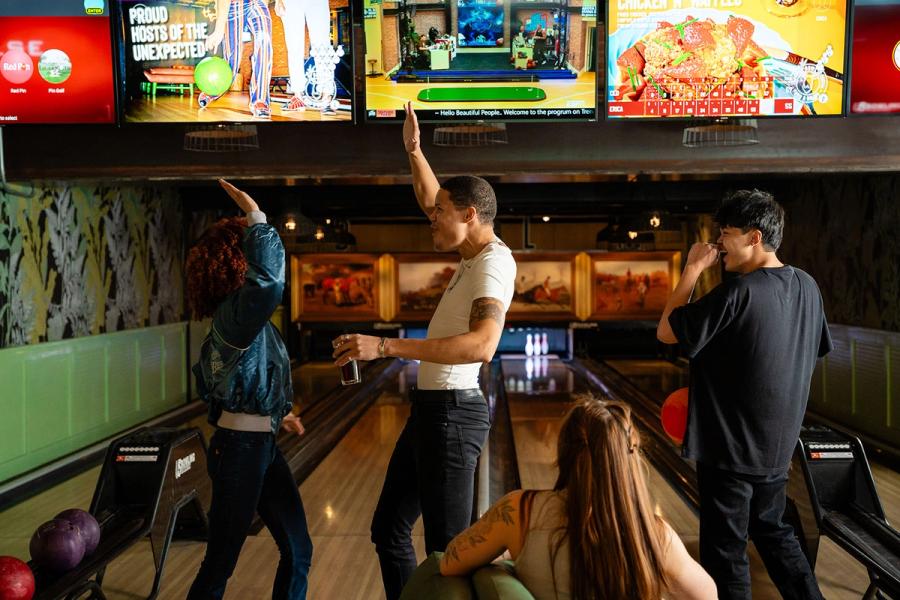
What can you actually do inside one? More than a menu can hold, which is the idea. A typical night can move from the bar to a lane to a dartboard to a private karaoke room without anyone leaving the building.
The games get a group through the door. The kitchen is why the group comes back.The eatertainment thesis, in one line
The CustomerWho books a room full of games
Punch Bowl Social's core guest is the group that has run out of ideas. The problem it quietly solves is the most common failure of adult socializing: everyone shows up, the food arrives, the food disappears, and then there is nothing to do but ask for the check. A venue with a dozen activities turns "what should we do?" into a solved question before anyone arrives.
That makes the company's most valuable customer the one booking on someone else's behalf - the office manager planning a team outing, the friend organizing a birthday, the couple hosting a rehearsal dinner that needs to survive three hours of small talk. Corporate outings, private parties, holiday parties and full venue buyouts are a distinct line of business, run on dedicated event menus and food-and-drink packages. During the day, the same rooms flip to a more family-friendly crowd. At night, they skew toward the millennial group hang the brand was designed around.
The WhiplashA $140M year and a Chapter 11 year
By 2019 the concept had scaled to close to 20 locations and roughly $119 million in annual sales. That July, it drew an investor most restaurant startups never see coming: Cracker Barrel, the highway comfort-food institution, put $140 million into the business at an enterprise value of about $185 million. It was a bet by an aging brand on a younger one - a way to buy exposure to the millennial night out.
The timing turned out to be almost cruelly precise. Within months, the pandemic closed all of Punch Bowl Social's locations and forced the layoff of nearly its entire workforce. A business built on packing people into a shared room lost the one thing it required. Cracker Barrel, facing its own pressures, walked away from further investment in early 2020 to protect its core business. Founder Robert Thompson resigned. That December, Punch Bowl Social filed for Chapter 11 bankruptcy.
The numbers tell the story better than any adjective. A business valued at $185 million in one summer was sold for about $32 million a year and a half later, when CrowdOut Capital acquired it out of bankruptcy in 2021. The concept did not fail. The circumstances did.
A business valued at $185 million in one summer sold for about $32 million a year later. The concept did not fail. The circumstances did.2019 to 2021, in two prices
The ComebackFrom the bought to the buyer
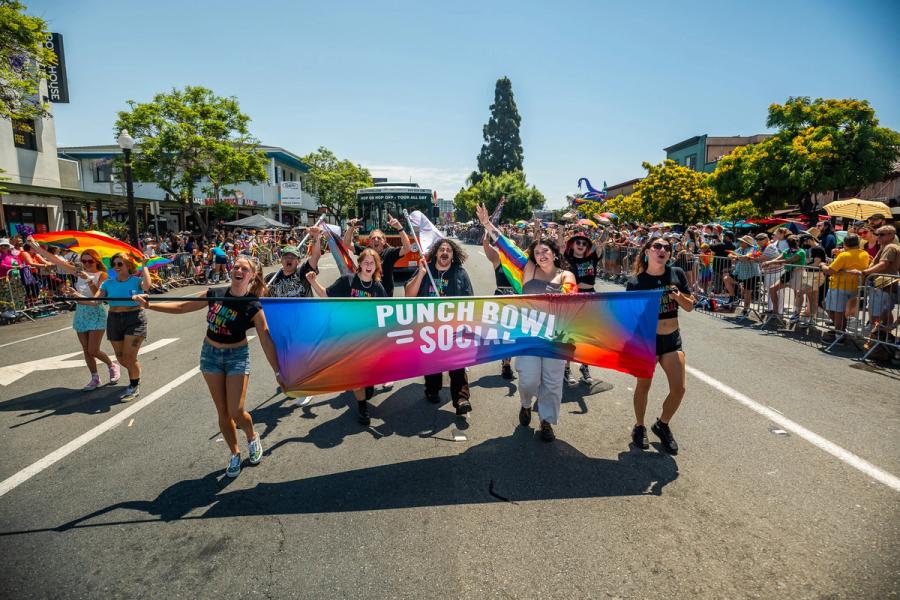
Most bankruptcy stories end at the sale. This one gets more interesting afterward. Under new ownership, Punch Bowl Social reopened venues city by city - Denver's South Broadway room among them - rather than trying to relight the entire national footprint at once. Then it started doing something a recently bankrupt company rarely does: buying other people's concepts.
In 2024 it acquired Voicebox Karaoke, a two-location Portland operator, and Sweet Tooth Hotel in Dallas, and opened a new venue in Columbus, Ohio. Then came the move that closed the loop. In 2025, Punch Bowl Social - partnered with Silverview Capital Partners and its existing investors - acquired Pinstripes, a bowling-and-bocce rival, out of its own Chapter 11 bankruptcy. Pinstripes continues to run its U.S. locations as a standalone brand. The company that had been carried out of bankruptcy court a few years earlier was now the one doing the carrying.
There is a lesson in that sequence for anyone watching experiential retail. The clearest sign that a category has staying power is not that its winners keep growing - it is that its wreckage gets bought rather than abandoned. Eatertainment did not die in the pandemic. It consolidated.
The FieldWhere it sits on the board
Punch Bowl Social shares a neighborhood with Dave & Buster's, Bowlero, Topgolf, Puttshack and a wave of smaller arcade-bar operators like Pins Mechanical and 16-Bit. Most of those rivals lead with a single hero activity - screens, lanes, golf bays, mini-golf. Punch Bowl Social's differentiator is the spread: no single game carries the room, and the food is treated as a headline rather than a concession stand. It is less an arcade with snacks than a restaurant that happens to own a lot of games.
That breadth is also the risk. Big rooms with many activities mean expensive buildouts and heavy fixed costs - exactly the profile that made 2020 so brutal. The company's business model runs on food and beverage sales, per-hour and packaged game play, private events and buyouts, gift cards and programmed nights like music bingo and silent disco engineered to fill mid-week seats. It works when the rooms are full. When they are not, the square footage bites back. The founder himself, Robert Thompson, moved on to build new concepts - Camp Pickle and Jaguar Bolera - reportedly backed by more than $200 million, proof that the category still attracts serious capital.
The Bottom LineWhy it still stands
Strip away the bowling shoes and the arcade tokens and Punch Bowl Social is a bet on a durable human preference: that people would rather do something together than sit across a table and watch the food run out. That bet has now survived a boom, a pandemic that closed every door, a bankruptcy, and a change of owners. It came out the other side still opening rooms, still running a scratch kitchen, and - improbably - shopping for rivals to add to the collection.
Denver-born and recession-tested, the company is a useful case study in the real economics of experiential retail, which are far less tidy than the pitch decks suggest. The concept was never the fragile part. The building full of people was. And in 2026, the buildings are open again.