Before Ahmass Fakahany had a restaurant group, he had his father's guests. His father, an Exxon executive, entertained clients at home, and the younger Fakahany helped serve them. There was food, conversation and the small choreography of making an evening work. Long before he managed a balance sheet, he was learning what happens on the other side of a dining table.
He would eventually become co-president and chief operating officer of Merrill Lynch. Then he would build Altamarea Group, whose restaurants include Marea, Ai Fiori and 53. The tempting version of this story involves a financier discovering pleasure after years among spreadsheets. His interest in hospitality, however, preceded the spreadsheets. The dinner party came first.
“I was constantly serving in my own home,” he recalled. It is a useful opening scene for someone whose later business would depend on remembering that guests have come out for an evening, rather than a demonstration of how efficiently a company can operate.
A business education with a dining room attached
Fakahany was born in Cairo and grew up in Switzerland and England. He moved from London to the United States at 17 to attend university. Boston University awarded him his undergraduate business degree in 1979, summa cum laude; an MBA at Columbia followed. His education crossed borders before his career required it.
At Merrill Lynch, which he joined in 1987, his assignments included chief financial officer for Asia, chief operating officer for global markets and investment banking, group chief financial officer and vice chairman. These were jobs in which the view extended well beyond a single office, a single market or a particularly demanding customer.
The bank announced his retirement in January 2008, effective February 1. He was 49. It was a consequential moment to leave a Wall Street leadership position, with Merrill already in difficulty and the financial crisis still unfolding. His restaurant career would begin against that background, rather than in the agreeable weather of an uninterrupted boom.
- 1979Boston University graduate
- 1987Joins Merrill Lynch
- 2008Leaves the bank
- 2009Marea opens in New York
- 2022Chairs BU's board
- 2025Marea reaches Beverly Hills
His route into the business had already acquired a human connection. At Fiamma in SoHo, where Fakahany held business events, chef Michael White took an interest in the financial markets. Fakahany had an interest in food. A conversation could therefore proceed in either direction without either participant having to pretend.
Fakahany prepared business speeches in the private events space; White listened, and the two discussed markets and meals. Their complementary interests became the basis of a working relationship. A chef curious about business and a business executive curious about restaurants had found something more useful than a mutually agreeable dinner.
The uncomfortable timing of a good idea
The early experiments were in New Jersey. Fakahany described the initial ambition as manageable: offer the kind of food associated with New York in an affluent New Jersey town. Then came the larger wager, Marea on Central Park South in 2009, when opening an ambitious restaurant required a particular tolerance for ominous economic news.
He remembered the discomfort vividly: spending felt magnified by the circumstances. His reasoning rested on New Yorkers continuing to go out to eat even when they curtailed other extravagances. Dinner offered a smaller escape. That was a specific commercial judgment about a city's habits, made while much else looked uncertain.
Marea's coastal Italian cooking gave the venture a clear identity. In 2010, it received the James Beard Foundation's Best New Restaurant award. The timing matters: the restaurant opened in 2009, and the award followed the next year. A wager had become a business with public recognition and an address people remembered.
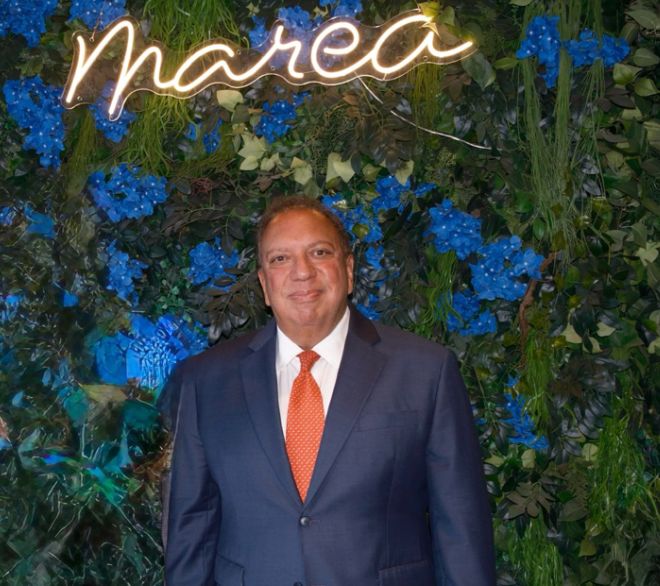
The names were related. Marea means tide; Altamarea means high tide. Fakahany and White had considered the names for the restaurant before choosing Marea and using Altamarea for the broader group. In retrospect, the distinction is handy: one name belongs on a dining-room door, the other can accommodate several doors.
As the portfolio developed, the proposition widened beyond one formal evening. Ai Fiori, Osteria Morini and Nicoletta offered different settings and occasions. The customer who came for a celebration might also want pasta on an ordinary night. A restaurant company could follow that person through more than one kind of appetite.
Fakahany has a less comfortable word to accompany passion: paranoia. His advice is to assume something can go wrong. For an owner, enthusiasm has to coexist with checking the details, listening to customers and preparing for trouble. It is a demanding combination. The person imagining a memorable evening must also consider all the ordinary things capable of spoiling it. The confidence required to open a restaurant leaves plenty of work for vigilance once the doors are open.
The romance of knowing when to reorder vodka
Ask what finance contributed and the answer can become wonderfully unromantic. Fakahany has explained procurement through vodka: a group can model the drinks a bottle should produce, monitor inventory and coordinate purchasing. A supplier gains a clearer picture of demand; the restaurants gain a better position from which to buy.
There is no reason for the guest to contemplate any of this. The bottle should be available, the drink should arrive, and the price should make sense. The practical ambition is to improve the machinery behind the bar without making an evening feel like a tour of the machinery. Romance has a receiving department.
The same attention reaches the menu, though consistency does not require identical plates everywhere. Fakahany has described different portions and preferences in New Jersey, Washington and New York. A shared company can accommodate a local appetite. Treating every city as a slightly misplaced Manhattan would be an expensive failure of observation.
His account of good management also makes room for careers. In 2013, he talked about chefs and general managers wanting to understand the business and have more responsibility. Keeping talented employees meant offering development across properties. A company with several restaurants could give someone another opportunity without requiring a resignation.
By 2018, he was describing retention as the foundation for consistent food, service and recognition of returning guests. The idea has a pleasingly ordinary logic. A restaurant can record your preferences, but someone still has to greet you. People who remain long enough to know the room become part of what customers return for.
“You have to really like people.”
Ahmass Fakahany, 2026
His interests extend to the conditions around the meal: lighting, music, how an evening changes pace. In his account, these details increasingly belonged alongside the food in creating loyalty. A table is occupied for hours. The company has to think about those hours as an experience, including the parts no menu can describe.
Several doors, and some that closed
Expansion did not produce an uninterrupted sequence of openings. Costata and The Butterfly closed in 2015. Early in 2016, Fakahany spoke about slowing expansion and concentrating on the existing restaurants. The record includes the less photogenic work of consolidation, alongside the launches that give a growing group its public momentum.
White later left Altamarea. The partnership belongs to the group's origin story, while the continuing business has involved other culinary leaders. Keeping those chapters separate makes the trajectory more revealing: the enterprise that grew from a particular relationship had to develop a life beyond it.
There were other changes of scene. The original SoHo Osteria Morini, opened in 2010, closed in 2024, with relocation plans announced. Restaurant names can appear permanent on a portfolio page while the rooms, teams and circumstances underneath them change. Running a group requires decisions about the doors to keep as well as the doors to open.
In 2022, Altamarea opened 53, a contemporary Asian restaurant beside the Museum of Modern Art. Its relationship with Petzel Gallery brought a changing art selection into the dining experience. For Fakahany, whose career had included Asia, this was another departure from the assumption that the group's future must always resemble its Italian beginnings.
A seat at a rather different table
Boston University also brought him back in a different capacity. He joined its Board of Trustees in 2016 and became chair in September 2022. The undergraduate arriving from London had become responsible, with fellow trustees, for the institution's direction. It is a return journey measured in responsibilities rather than miles.
When his selection was announced, outgoing chair Kenneth Feld emphasized his organization, demeanor and respect for other people's ideas. The selection process identified an ability to build consensus. These are quieter credentials than opening a restaurant across from Central Park, but they explain another side of his work: helping a room reach a decision.
In Beverly Hills, Marea opened in January 2025 with PJ Calapa as executive chef. Its early weeks coincided with the Los Angeles fires. The restaurant offered complimentary takeaway meals to first responders from January 10. A new dining room was finding its place in a city under extraordinary strain.
By March 2026, Fakahany was discussing a group spanning more than 25 restaurants and a broader role developing concepts with partners. His emphasis remained on understanding diners, sharing resources across the business and using technology without letting it take over the encounter. The scale had changed; the attention required at a table remained stubbornly personal.
There is a cheerful coda to all this. Asked which restaurant he could eat at for 30 days straight, Fakahany chose Hillstone. The founder associated with Marea and Ai Fiori could appreciate a reliable meal elsewhere. After the awards, the new rooms and the financial models, even a restaurateur has to decide where he would like dinner tomorrow.
More conversations, more tables
- Altamarea Group
- Marea
- Boston University biography
- LinkedIn · Altamarea Group
- Instagram · Altamarea Group
- Facebook · Altamarea Group
- 2013 conversation · The Caterer
- Restaurant operations · Nation’s Restaurant News
- 2026 conversation · Fine Dining Lovers
- Marea in Beverly Hills · Observer
- Bloomberg video · linked in Eater’s 2010 coverage
- Wikipedia
Social accounts above belong to Altamarea Group. The Bloomberg video is linked from 2010 coverage.