In 1997, Kevin Boehm stopped for lunch at a Wendy’s in Carlinville, Illinois. He was driving from Springfield to St. Louis with his chef friend Scott Alderson. A woman greeted them at the entrance. The cashier took the chicken sandwich seriously. The dining room was immaculate. Then the greeter came to their table and refilled their water from a pitcher. Boehm began to wonder what, exactly, was happening.
The restaurant had the familiar menu and the familiar building. Its manager had somehow persuaded people to treat those ordinary surroundings as a place worth caring about. Boehm asked to meet him, offered a compliment and learned that the location had won the chain’s Golden Wendy’s award. He left impressed, and irritated with himself. He was running a restaurant of his own. Why was this fast-food team making such a convincing case for hospitality?
Decades later, Boehm is co-founder and co-CEO of BOKA Restaurant Group. He and Rob Katz won the 2019 James Beard Award for Outstanding Restaurateur. Their restaurants include Girl & the Goat, Momotaro and Swift & Sons. Yet the lunch he keeps retelling happened beside a highway, over a sandwich. It is a useful detail about his taste in teachers. A person with a pitcher can hold his attention as effectively as a person with a medal.
Six tables, and a very long apprenticeship
Boehm grew up in Springfield, Illinois, and announced at ten that he wanted a restaurant. His childhood viewing supplied some improbable career guidance: Jack Tripper cooked on Three’s Company, and Rick owned a bar on Magnum P.I. The pleasures of hosting looked attractive before he knew the vocabulary of the trade. The ambition arrived early; the practical knowledge would take considerably longer.
He attended the University of Illinois for two nonconsecutive years, then left for the Florida Panhandle. The first restaurant job did not arrive on demand. He spent six months working at an amusement park before an embellished résumé helped him get a captain’s position at Beach House Restaurant. There is a gap between deciding to become a restaurateur and being trusted to look after dinner. His early career lived in that gap.
In 1993, the savings became a six-table restaurant in Seaside, Florida. Indigo Wine Bar followed in the same town in 1995. Later came restaurants in Springfield and Nashville. By thirty, he had opened and sold four places. These were small-business experiences with actual customers, actual bills and actual consequences. Each opening gave the next ambition something firmer to stand on.
- 1993Six tables in Seaside
- 2002Partnership with Rob Katz
- 2003Boka opens in Chicago
- 2019Outstanding Restaurateur
- 2025The Bottomless Cup published
A coffee appointment gets out of hand
Chicago was the destination Boehm had been circling. Katz, who had owned bars and nightclubs, wanted to move into restaurants. Friends introduced them. At Nookies on North Wells, a coffee meeting expected to last fifteen minutes became four hours. It is an origin story with an appropriately hospitable flaw: neither guest seemed especially eager to leave. They decided to open one restaurant together.
Boka opened in Lincoln Park in 2003, after a long search for a site. The partners borrowed $450,000 from friends. They wanted contemporary American cooking in a room that occupied the space between formal fine dining and very casual eating. They advertised for a chef in the Chicago Reader. The names that would later make their group recognizable were still ahead of them.
Their backgrounds could also be heard and seen in the room. Katz liked the lights lower and the music louder; Boehm leaned toward fine dining. In the early months, one would adjust the atmosphere and the other would adjust it back. A dimmer switch is an unusually candid business document. It records the negotiation without pretending either partner began with the complete answer.
The restaurant changed as the chefs changed. Giuseppe Tentori joined in 2007, bringing expectations that pushed the owners to improve their own work. Boka received its first Michelin star in 2010. Lee Wolen later took the kitchen forward. The name stayed above the door, while the cooking continued to develop. That distinction helps explain why Boehm’s career is better understood through partnerships than through a list of properties.
Fifteen cards in a manager’s hand
Boehm’s interest in service has produced some wonderfully concrete management ideas. His “Full Deck” training system uses fifteen cards, each representing a skill. A manager earns the cards as the skills are mastered. Running the pass and understanding a profit-and-loss statement belong in the same education. A title alone cannot tell you whether someone is ready for the problems that arrive halfway through dinner.
The cards make learning visible. They also turn a promotion into something that can be discussed without fog. Which responsibilities can this person handle? Which need practice? For a young employee, those questions are more useful than being told to show leadership. Leadership can sound like a personality one must acquire. A skill can be learned, demonstrated and recognized.
His own experiments have sometimes involved letting customers organize a small pleasure for themselves. At one restaurant, he put a chalkboard beside the bar: write down a bottle from the wine list, find two more people willing to join in, and he would open it. The arrangement made a bottle into an occasion. A room of separate tables briefly gained a common project.
“Big sales mask inefficiency.”
Kevin Boehm, on restaurant operations
For all the appeal of these flourishes, he keeps returning to basic operations. A restaurant can have good food, an attractive room and attentive service, yet still fail the guest if the temperature is uncomfortable. Success can conceal weak systems. Boehm’s warning about sales is particularly pointed in a business where a crowded room is so easily mistaken for evidence that everything behind it works.
The steakhouse gets a nameplate
Swift & Sons offered a different test. Chicago already knew what a steakhouse was supposed to be. Boehm and Katz took a 10,000-square-foot space in the old meatpacking district and worked with AvroKO on a room that could acknowledge those expectations while making its own choices. The question was where convention could bend without making dinner feel unfamiliar.
Some of the answers were physical. The room had generous lanes for tableside carts. Some were personal: regulars received brass nameplates, and a concierge checked reservations for opportunities to make an evening special. These details cost thought as well as money. A nameplate works because someone has remembered a name. Without that act of attention, it is merely another piece of metal.
The connection to Carlinville is easy to see. At both restaurants, a guest encounters an extra gesture within a familiar format. One offers water, another a personalized table. The prices differ considerably. The managerial question remains whether the people serving dinner have noticed the people eating it. Boehm’s fascination with that question gives continuity to rooms with very different menus.
Two medals, several distinct dining rooms
In May 2019, Boehm and Katz received the James Beard Foundation’s Outstanding Restaurateur award. The award recognized the partners behind a group that included Boka, Girl & the Goat and Momotaro. Restaurant ownership is shared work, and the photograph from that evening happens to make the point rather nicely: Boehm and Katz flank chef Daniel Boulud, smiling, with medals in hand.
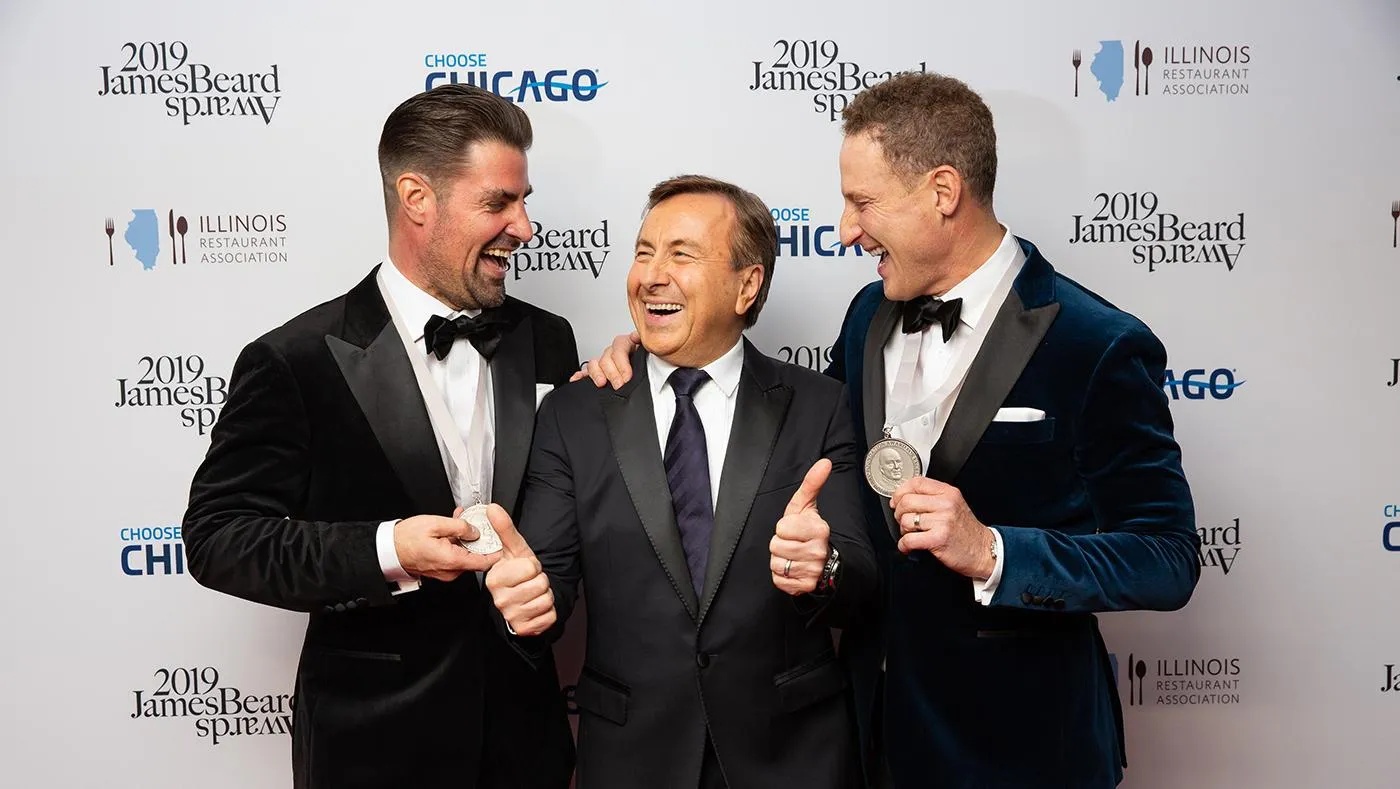
The group’s current chef partnerships include Stephanie Izard, Chris Pandel, Lee Wolen, Gene Kato, Michael Solomonov, Christina Tosi and Brian Lockwood. Each brings a culinary identity. For Boehm, expansion consequently means a fresh set of decisions about a chef, a room and an experience. A recognizable company can sit behind restaurants that do not all ask their guests to want the same dinner.
He and Katz have also maintained a friendship alongside the company. In a 2012 conversation, the partners joked that their disagreements concerned fantasy football. Boehm named the Cubs among his enduring attachments and imagined a dream conversation with John Lennon and Paul McCartney. The restaurateur who studies how a room feels is also a fan with a very ambitious seating plan.
Writing his own closing check
In November 2025, Abrams Press published The Bottomless Cup: A Memoir of Secrets, Restaurants, and Forgiveness. Its subject is the life surrounding the openings: partners, guests, critics, family and the cost of ambition. Boehm had already written for publications including Esquire, McSweeney’s and Fast Company. A memoir gave him room to stay with a story after the usual restaurant anecdote would have ended.
He found the writing unexpectedly familiar. The time at the desk was something he looked forward to. That pleasure is a revealing addition to a career organized around busy rooms and public occasions. Writing allows the host to choose a different pace. The reader can linger; nobody needs the table back for the next reservation.
A book dinner at Indigo in Springfield brought the new work back to an old address. Boehm read, signed copies and met friends and former patrons. He stood with the restaurant’s current owners, Mike and Samah Novel. Selling a restaurant can end the ownership without ending the connection. Returning with a book makes that continuing relationship visible in an especially pleasant way.
The next opening still has to work
The recent chapter includes Gingie, developed with chef Brian Lockwood in Chicago. A kitchen fire closed it just three days after its March 2026 debut; in August, the group announced its return. Even after awards and decades of openings, a restaurant can demand a second opening almost immediately. Experience gives an operator resources to respond. It does not grant control over every evening.
Boehm’s career offers many possible starting points: six tables in Florida, a four-hour coffee, an award ceremony, a memoir. The water pitcher remains the most revealing. It caught him paying attention to another person’s work, and it gave him a story he could hand to his own teams. Dinner ends. The memory of being looked after can keep finding new tables.