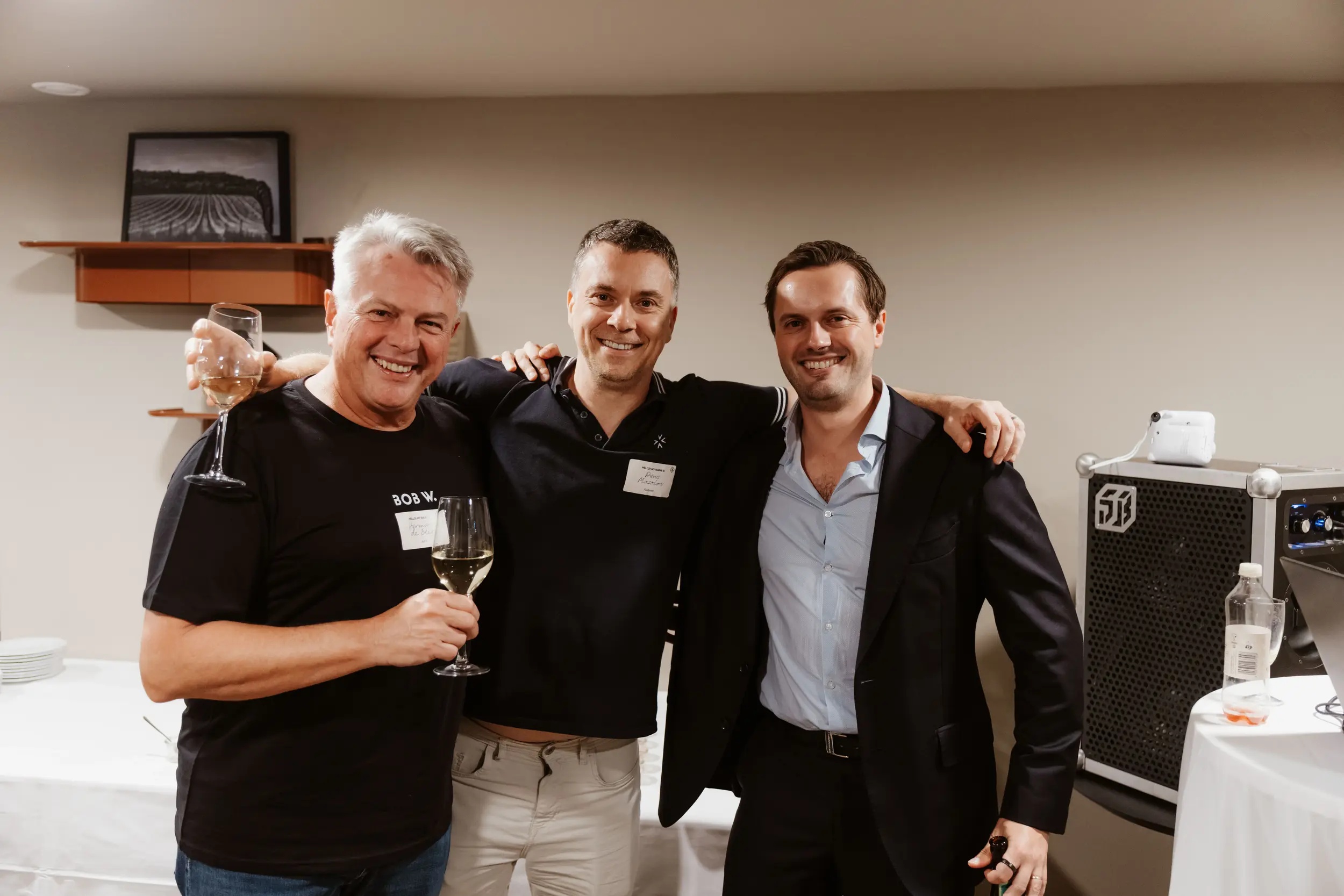
Niko Karstikko was 14 when he found himself managing the front desk of an eight-room bed-and-breakfast. He landed the summer job almost by accident. He loved it. Then he spent much of his early career doing other things, which is a surprisingly elaborate way to discover that your first job had already given you a clue.
Banking came later. So did a technology company, frequent travel and the business he now runs with Sebastian Emberger. Bob W, founded in Helsinki in 2018, combines serviced apartments with hotel standards and an operating system built around technology. Karstikko remembers the little bed-and-breakfast as his favourite summer job. In his telling, recognising that affection took roughly 17 years.
There is something pleasingly inconvenient about this beginning. The hospitality founder did have hospitality experience, but it was tucked away in adolescence rather than polished into a grand career plan. Eight rooms give a front-desk worker a manageable cast of characters. A guest can be a person with a particular arrival time and a particular question. Multiply the rooms and the cities, and keeping that sense of attention becomes an organisational problem.
That is the problem running through Karstikko's career today. Bob W sells a stay, with all the physical obligations the word implies: a clean room, access that works, somewhere to put your things. The software has to earn its place by making those obligations easier to fulfil. An elegant booking screen receives little gratitude when the guest is still outside with a suitcase.
A corporate career, with an escape route
Karstikko grew up in central Helsinki, attended an English school, and moved to London during his school years because of his parents' work. University took him to the United States; further studies took him to Paris. His bachelor's degree is in International Business and Finance from the University of South Carolina. The future host had become accustomed to being the visitor.
Both parents were entrepreneurs. Watching the uncertainty of their working lives initially pushed him towards a corporate career. His earlier employers included Metso, NetJets and Barclays. He describes structured organisations as useful schooling in getting organised, even while the fit felt awkward. His route out included applying to an entrepreneurship master's programme at Aalto University. Studies offered a respectable explanation for trying a business.
It is an unusually candid career manoeuvre. The familiar founder biography tends to tidy every turn into destiny. Karstikko's version leaves room for the practical cover story: if the venture faltered, he could explain that he was studying. Ambition and an exit route occupied the same plan. Anyone who has ever renamed a risky decision a professional development opportunity will recognise the technique.
In 2012, he and Trevor Ferguson founded SportSetter, a discovery and booking business for sports activities. The pair had met through university in South Carolina. The business was eventually sold in 2016. That first company supplied experience of building a product, finding customers and raising money. It also gave Karstikko a more colourful fundraising memory than most people would care to budget for.
The pitch after the poker game
In 2014, with SportSetter short of cash, Karstikko went to Helsinki's Slush conference hoping to find investors. The meetings he wanted did not materialise. On his way home, a colleague persuaded him to return for a poker tournament organised by venture firm OpenOcean. Its guest list mixed founders and investors. Karstikko won.
The prize was 3.1415 bitcoins, a numerical joke with a useful financial consequence. But the larger opportunity came when he was invited to speak. “No, I wanna pitch,” he replied. His three-minute explanation of SportSetter produced 15 meetings. He later credited those contacts with helping him close an investment round the following year. He used the bitcoin winnings for expenses while waiting for funding.
The episode is amusing because the pitch survived the evening more successfully than the planned fundraising did. A conference had disappointed him; its after-hours card game put an audience in front of him. Winning bought attention. He still had to decide what to do with it. He chose to talk about the company while the room had a reason to listen.
A poker story makes a dangerous business manual and a very good anecdote. Karstikko's useful move was the unglamorous part that followed: converting a roomful of possible contacts into meetings, then working through a slow funding process. The tournament was a hinge in the story, rather than a substitute for the work. By 2016, SportSetter had been acquired by The Orange Company.
“No, I wanna pitch.”Niko Karstikko, after winning the OpenOcean poker tournament
Seven apartments and a cupboard of soap
Alongside his startup, Karstikko had begun hosting on Airbnb in 2012. Travel left his own apartment empty, so he rented it out. The side business expanded to as many as seven apartments, including investment properties belonging to him and his brother. After selling SportSetter, he travelled in Asia and worked out how the rentals could run remotely.
The requirements were decidedly domestic: chat-based service, a dependable cleaning checklist, enough soap in the cupboard to last six months. Those details contain the seed of Bob W. Hospitality has many occasions for grand language, but a cupboard stocked properly is a stronger argument than a mission statement when the guest needs soap.
Being a host showed him what could go wrong behind the scenes. Being a traveller showed him how much uncertainty remained in front of them. He liked the experience of living locally, yet found himself choosing hotels. Could he trust a host, the photographs, the key collection? Familiar hotel standards made the decision easier. Apartments offered everyday utility that a conventional room often lacked.
He and Emberger built Bob W around that overlap. The name abbreviates “Best of Both Worlds.” Kitchens, laundry facilities and room to settle in belong to the apartment side of the bargain; professional standards and dependable service belong to the hotel side. The guest should not have to become an amateur detective to establish whether the accommodation will work.
That arrangement also permits different reasons for staying. A holiday, a work assignment and a relocation require different lengths of visit, but they can share an address. In an October 2025 interview, Karstikko described an average stay of about four nights and operations across 19 cities in 11 European countries. A spare-apartment sideline had become a business spanning borders.
Dependable service
Consistent experience
Everyday utility
Flexible length of stay
A host made of systems, a company made of people
Bob is also the brand's imagined host. The friendly name puts a conversational face on a collection of processes: bookings, access, cleaning, payments and support. Karstikko's job is to make those processes cohere. The charm of an apartment is difficult to enjoy while sorting out the machinery required to enter it.
By January 2026, he was discussing a model with one-seventh the employees of a comparable hotel, at comparable average daily room rates. That is his operating comparison, rather than a universal staffing rule. In the same conversation, he described the financial discipline required when fundraising conditions changed in 2022. Bob W had to become profitable without assuming another funding round would arrive.
Emberger receives substantial credit in that account, alongside the management team. The partnership matters because a hospitality company has to reconcile two temperaments: someone must imagine a better experience, and someone must make the economics and operations hold together. Doors, leases and cleaning schedules have a useful habit of bringing airy ideas back to earth.
Karstikko has also made employee ownership part of that company story. In late 2022, Bob W formalised stock options for every full-time colleague. When he discussed the arrangement in 2023, it covered more than 100 people across eight countries. The reasoning was straightforward: the people doing the work should participate in the upside.
That decision adds a human dimension to an organisation often described through automation. Guests experience the company through its rooms and replies. Employees experience it through their work and their stake in the outcome. Reducing repetitive tasks does not settle every question about running a business. Ownership is one answer Karstikko and Emberger chose for the people building theirs.
The employee count he reported relative to a comparable hotel, at comparable average daily room rates.
The room still has to belong somewhere
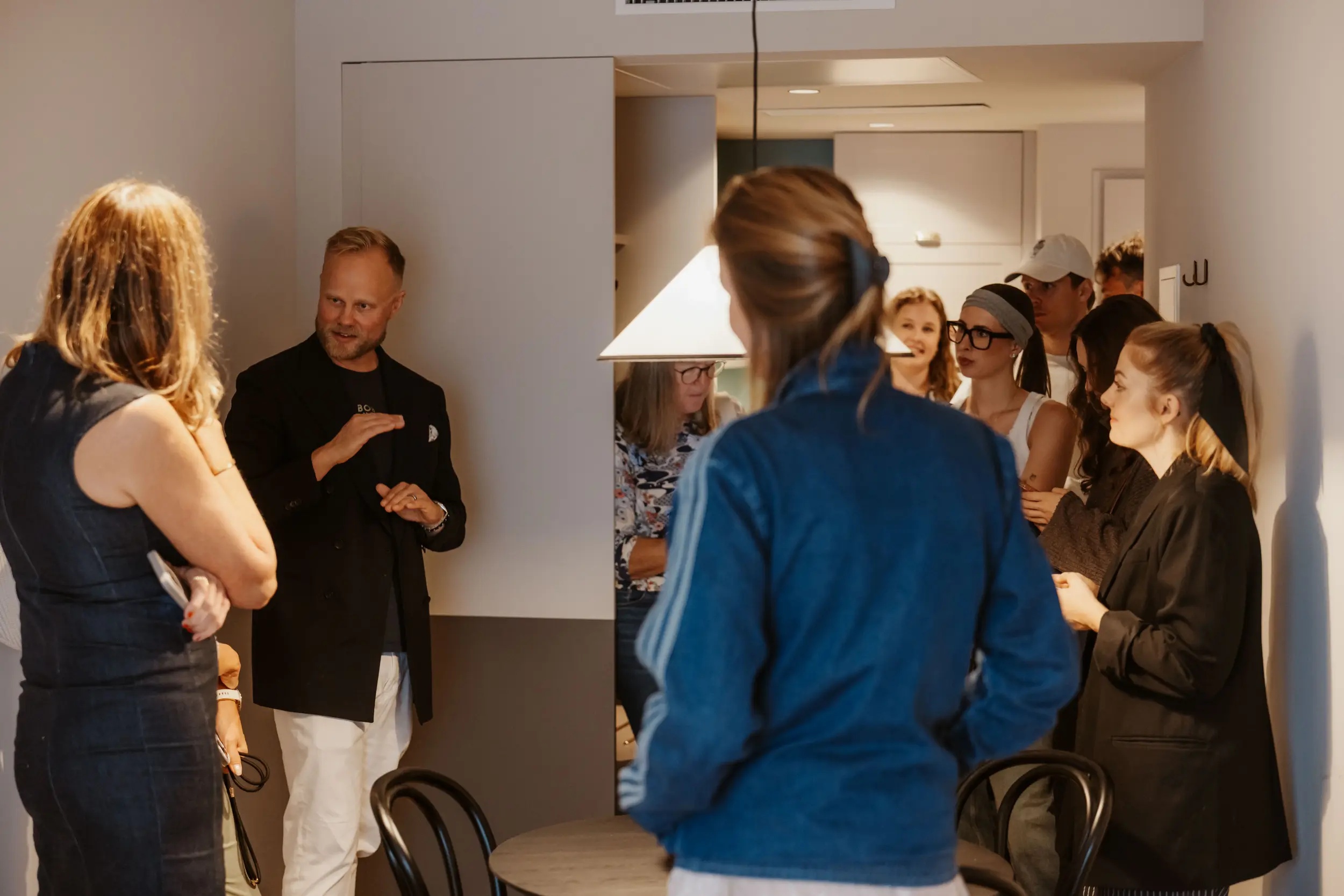
Expansion introduces another test: can a consistent experience still feel attached to a particular neighbourhood? On 10 September 2026, Karstikko led a media morning at the opening of Bob W Vienna Döbling, the company's first Austrian property. The evening brought together landlords, investors, partners, neighbours and friends. A business built around digital access had plenty of people in the room.
Ceramicist Yvonne Rausch showed her work, including mugs made for the building. Photographer Gregor Hofbauer attended. Food came from Rita bringt's, wine from Schachenhofer in the Wachau, and music from DJ Dorian. These are specific contributions to a place. A mug can be standard equipment and still have a maker nearby.
The environmental argument is similarly more interesting when it becomes specific. Karstikko has advocated reporting emissions per guest night. Discussing Bob W's 2023 result of 29 kilograms of carbon-dioxide equivalent per guest night, he acknowledged how much work remained. “No point in sugar coating it,” he wrote. Publishing a number invites scrutiny in a way that a pleasant green adjective seldom does.
The scale of the next buildings raises the stakes. An October 2026 announcement outlined 285 studios in a former office building near Berlin's Alexanderplatz, each with a kitchen. A September announcement described 160 units planned for Rotterdam's Weenahuis, targeting summer 2027. These are announced projects, with the practical work of conversion and opening ahead.
Karstikko's ambition remains a dependable hospitality experience for every guest, with a lower environmental footprint. It is a large ambition assembled from rather small tests. Does the key work? Is the answer useful? Can you make breakfast? Does the room give you enough independence to get on with the trip you came for?
The 14-year-old at the bed-and-breakfast could meet the guest across a desk. The chief executive now has to arrange that feeling across buildings, teams and software. Between those jobs sit a corporate detour, a card game and seven apartments. The common thread is a host's obligation to make someone else's arrival go well. For all the technology involved, that remains a wonderfully ordinary thing to want.