A group holiday has a curious architectural problem. Everybody travels together, then the hotel sends everybody to separate rooms. The conversation resumes in a corridor, a lobby, or somebody’s room, where the bed suddenly becomes a sofa. Domio built its proposition around that missing place to gather. The living room was the point.
- The idea: apartment space with a recognizable hospitality brand.
- The customer: families, friends and colleagues traveling together.
- The catch: nightly bookings supported much longer property commitments.
Founded in New York in 2016 by Jay Roberts and Adrian Lam, Domio furnished urban accommodation and sold stays. It sat between the conventional hotel and the independent vacation rental: more domestic than the first, more standardized than the second. Its appeal was easy to understand. Its eventual financial distress requires a little more patience.
The missing room
In a 2018 PhocusWire interview, the company described friends occupying three or four rooms, sometimes in different neighborhoods. Family reunions presented the same difficulty. Accommodation could provide beds without providing togetherness. Domio treated the group as the customer, rather than multiplying an individual traveler by five.
A kitchen changed the possibilities. Breakfast became something people could make together; an evening could continue without buying another round downstairs. Multiple bedrooms offered privacy while a common room kept the group intact. These were ordinary household arrangements, repackaged for people away from home.
The economics were part of the attraction. Historical company marketing claimed savings of about 25 percent against comparable hotel accommodation. That was a relative claim, dependent on the comparison, rather than a universal nightly tariff. For a group, the sensible calculation was the whole accommodation bill divided among travelers, with meals and usable space considered alongside beds.
“Comfort of a home. Confidence of a hotel.”Domio’s brand promise
A hotel you could inhabit
The New Orleans property on Baronne Street made the proposition visible in 2019. It had kitchens, shared living areas, a gym and a rooftop pool. A guest could spend the morning making coffee and the afternoon swimming without feeling obliged to choose between an apartment and a hotel.
The smaller decisions were revealing. Casper supplied mattresses, Snowe supplied kitchenware, and Zeel offered on-demand massages. A speech-enabled concierge called Roxy connected guests with the front desk and local recommendations. Through Society6, visitors could buy textiles and artwork they had encountered in their rooms. The room was also a modest showroom.
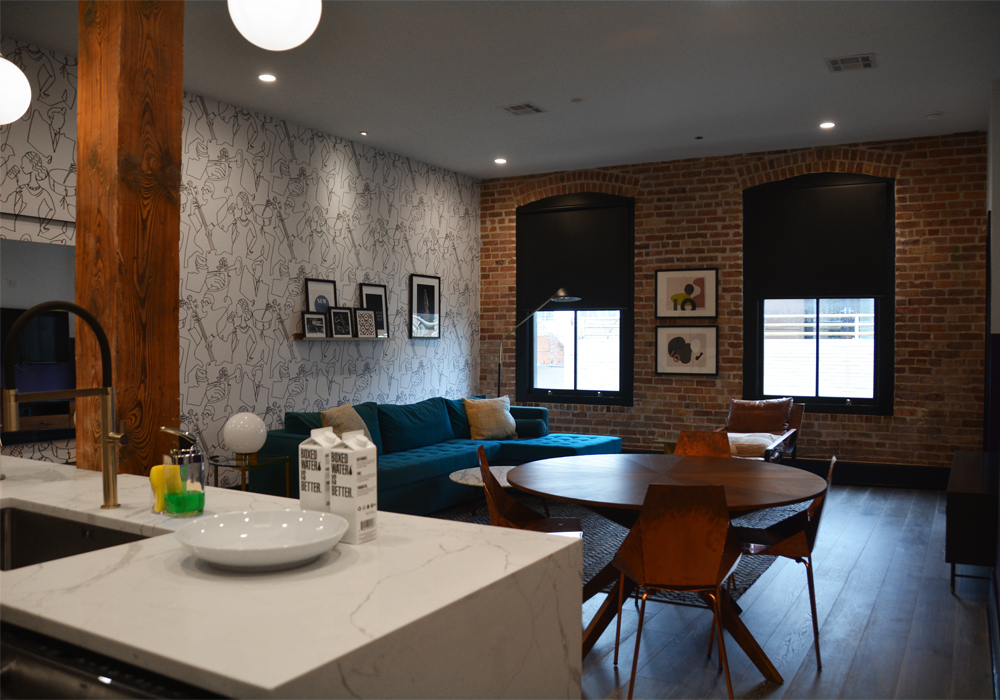
Domio’s designers gave locations their own visual vocabulary. In New Orleans, illustrated wallpaper drew on local character. Design chief Olivia Hnatyshin had worked in television production, where quick transformations were part of the job. Hospitality Design described her earlier experience producing magazine-ready kitchens in days. That background helps explain an operation which needed attractive rooms ready quickly.
The distinction from an open rental marketplace was control. Domio took responsibility for the accommodation it operated, including its interiors and guest experience. Conventional hotels remained an alternative; serviced-apartment operators such as Sonder occupied nearby territory. Domio’s particular emphasis was the group and the shared space that made traveling together worthwhile.

The rent behind the room
Control came with a bill. Domio leased properties, furnished them and rented them to travelers. It could avoid buying a building while still committing to payments on it. Calling that arrangement asset-light described ownership better than it described the operator’s obligations.
Money arrived in several forms. In 2018, Domio announced a $12 million Series A and a separate $50 million property joint venture with Upper90. The venture was intended to support apartment-hotel leasing and operation. It should not be mistaken for another ordinary equity round.
Equal amounts. Different obligations.
In December 2019, Domio announced financing comprising $50 million in equity and $50 million in debt. GGV Capital led the equity round; Upper90 led the debt financing. The company reported a presence in 12 US markets and ambitions beyond the country. The funding was intended to support more properties and recruitment.
The underlying arithmetic remained stubbornly physical. Each occupied apartment generated stay revenue; every apartment required preparation and upkeep. Rent, housekeeping, staff and booking costs stood between sales and profit. More space could delight a customer while making an empty unit expensive for its operator.
Commit to space→FURNISH
Spend before arrival→HOST
Earn by the stay
Interpretation: the customer’s commitment is shorter than the operator’s.
The channel closes
The pandemic made those commitments harder to carry. But the 2020 story also involved distribution and trust. In August, Airbnb suspended Domio’s associated host accounts and listings while investigating historical activity. Business Travel News reported that the company could no longer accept new reservations through that platform during the investigation.
That was a distinct failure with a clear date: one booking channel stopped working. Reports had alleged misleading host identities and questionable rental practices. In September, Roberts and Lam resigned. Airbnb subsequently reinstated the listings. Leadership changed, but restoring access did not settle the company’s finances.
- AUG Airbnb suspends listings
- SEP Founders leave; listings return
- NOV Creditor process begins
By November, reporting described failed efforts to raise another $10 million and layoffs affecting most staff. Domio entered an assignment for the benefit of creditors, a process for handling assets outside formal bankruptcy. Initial reports framed it as a shutdown. Interim CEO Jim Mrha countered that properties were still serving guests during financial restructuring.
That distinction matters. Insolvency can begin while a guest is still checking in. The historical record supports a company in serious financial distress; it does not require every door to have closed on the same afternoon. An occupied room and a solvent operator are different facts.
Copy the gathering place
Domio leaves a useful customer insight: design for what people do together. A kitchen, a table and a dependable service standard can matter more to a group than another decorative flourish. Readers planning trips can use that test when comparing accommodation, even when considering another operator.
For founders, the conditions are stricter. The approach needs lawful inventory, dependable booking channels and sufficient demand to cover property commitments. It becomes harder when travel collapses, a platform withdraws access, or fresh capital disappears. Domio understood the social life of a holiday. Its story asks whether the financial life of the room can survive the guest’s absence.