The holiday starts with a small administrative crisis. A flight in one tab. A hotel in another. A train timetable that seems to assume you already live there. Trip.com Group has built its business around this gap between wanting to go somewhere and getting every reservation to agree. The scenery belongs to other people. Much of the paperwork can belong to Trip.
That proposition produced RMB62.4 billion in net revenue in 2025, about US$8.9 billion. The company sells access to travel through several brands, including Ctrip, Trip.com, Qunar and Skyscanner. Its ambition reaches beyond the moment of payment: inspire the trip, help assemble it, sell its components and answer when something goes wrong. There is money in making a complicated journey feel manageable.
There is also power. In July 2026, Chinese competition authorities imposed a substantial penalty on the group over its treatment of business partners. The decision complicates the cheerful story told by the booking screen. A platform that makes suppliers easier to find can also acquire considerable influence over how they sell.
Four names on the departure board
Start with a distinction that the branding does little to help: Trip.com is a booking service; Trip.com Group is the parent company. Ctrip is its established China-focused brand. Qunar also serves the Chinese travel market. Trip.com addresses international travelers, while Skyscanner compares options across travel providers. A person browsing several familiar travel sites may be encountering different members of the same family.
The products overlap, but the customer’s intention varies. Someone using a booking app may already know the destination and dates. Someone searching Skyscanner may still be working out whether the airfare makes the whole idea possible. Holding both kinds of business gives the group contact with travelers at different stages of a decision. That is a useful position even before anyone buys a ticket.
The alternatives include Booking.com, Agoda, Expedia, regional agencies and booking directly with hotels or airlines. Trip.com Group’s distinguishing combination is its Chinese travel business, international booking operation and ownership of Skyscanner. It sits between suppliers and travelers, with corporate travel services adding employers and travel managers to the customer list. Tourism organizations have another use for it: getting a destination in front of people considering a holiday.
The £1.4 billion shortcut abroad
James Liang, Neil Shen, Min Fan and Qi Ji founded Ctrip in 1999. It listed on Nasdaq in 2003. The group eventually took its current name in 2019 and added a Hong Kong listing in 2021. Those milestones describe a company that outgrew the identity of a single Chinese booking service.
The international expansion involved buying reach. In 2016, Ctrip acquired Skyscanner for approximately £1.4 billion, including about £1.2 billion in cash and the remainder in shares. The deal brought an established travel-search business based in Edinburgh. Building an app is one undertaking; persuading people in unfamiliar markets to start their holiday planning there is another. Acquisition provided an existing audience and brand.

Partnerships could cross competitive lines, too. In August 2014, the Priceline Group agreed to invest US$500 million through a convertible bond while expanding a commercial relationship with Ctrip. Their agreement widened access to each other’s accommodation inventories. The practical lesson is less romantic than conquering a market: sometimes the fastest way to offer customers more choice is to work with a business that also competes for their money.
The booking button has a payroll
Trip.com Group earns commissions and service fees from travel transactions, alongside revenue from tours, corporate travel, advertising and related activities. Gross booking value and company revenue are different measures. A hotel reservation may carry a substantial price, but the platform does not ordinarily keep the entire amount. Its job is to make enough transactions useful enough to support the machinery behind them.
In 2025, accommodation reservations accounted for 42% of revenue and transportation ticketing for 36%. Tours and corporate travel supplied smaller portions. Product development cost RMB15.1 billion; sales and marketing cost RMB14.9 billion. Each represented about 24% of net revenue. The numbers puncture the appealing idea that a travel marketplace is simply a website collecting fees.
Two expense lines. Together, approximately 48% of annual net revenue.
The workforce makes the same point. At the end of 2025, the group reported 43,574 employees, including 16,718 in customer service centers. Software can show a reservation. A traveler whose plans unravel needs a resolution. Supplier management, technical support and customer service are part of the product, even when the customer never sees the people doing them.
For users, the attraction is having several pieces of a journey available through a common interface. For suppliers, it is distribution. Those interests can align: a hotel wants an occupied room and a traveler wants somewhere suitable to sleep. They can also diverge over commission, visibility and control of the customer relationship. The marketplace has to manage that argument every day.
When nobody could take the trip
The pandemic exposed the dependency underneath the software. In 2020, net revenue fell 49% to RMB18.3 billion. Accommodation and transportation revenues both suffered steep declines. The failure was basic: a booking business needed people to be able and willing to travel. A more attractive interface could not reopen a border.
Trip.com Group changed how it sold. Its BOSS Live broadcasts began in March 2020, with Liang appearing as a presenter. A company chairman promoting hotel offers on camera is an unusually literal example of management getting closer to the customer. The company reported US$56 million in gross merchandise value from an October livestream marathon. That was sales activity, not revenue retained by the group.
The format gave travel businesses a way to put offers and destinations back in front of audiences. The lesson is conditional: selling future travel depends on confidence that the trip can eventually happen. A broadcast cannot substitute for that confidence. Nor does a headline sales number, by itself, establish whether the promotion made money.
The itinerary moves into the app
TripGenie, introduced in July 2023 as an enhanced AI assistant inside the Trip.com app, brings another part of the journey into the company’s orbit. Users can describe what they want, receive itinerary suggestions and follow links into relevant app results. The launch demonstrated text and voice interaction, saved itineraries and visual travel planning.
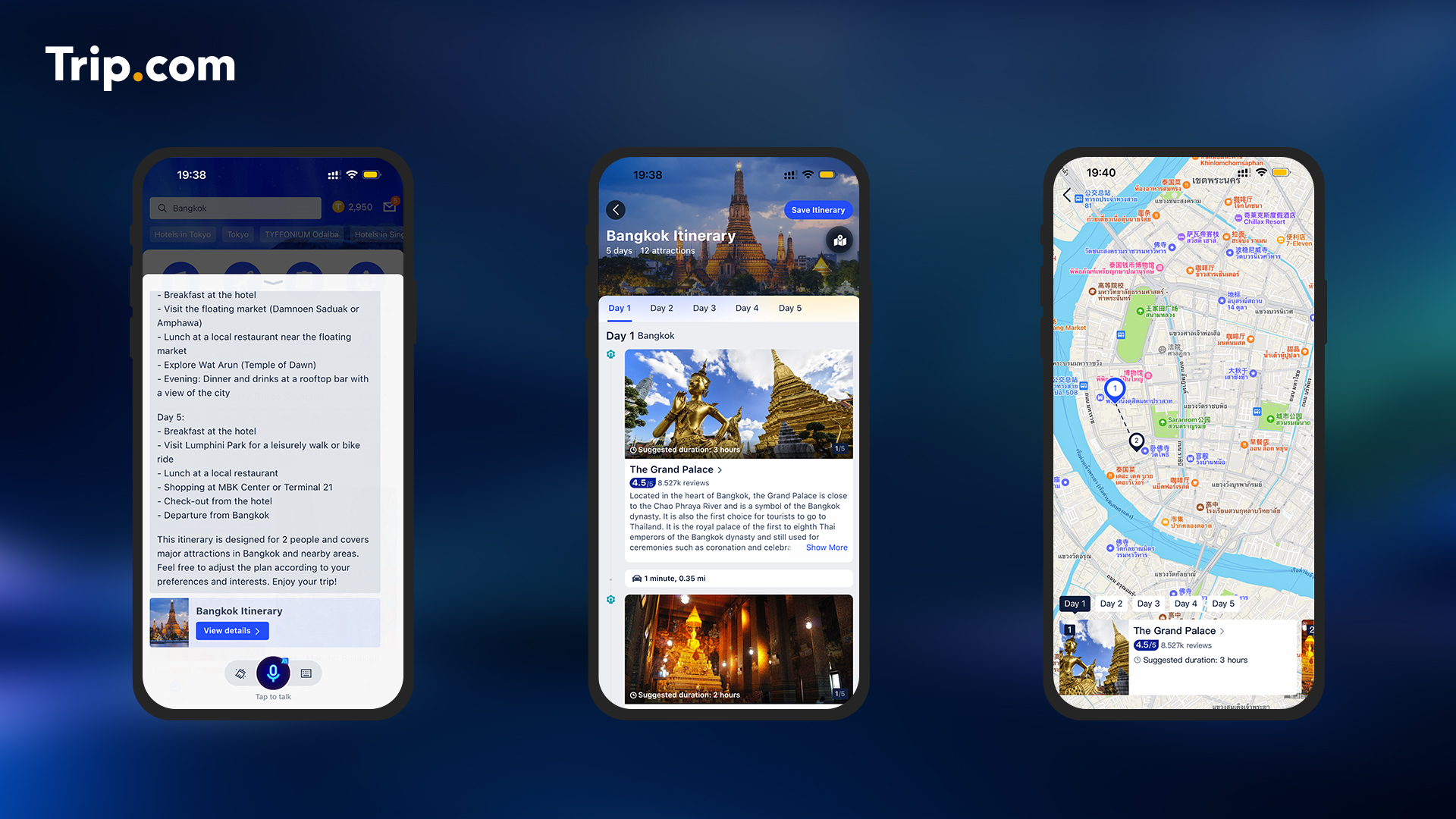
The commercial logic is straightforward. Planning creates opportunities to introduce bookable products. The useful feature is the connection between a suggestion and the next action: a place to stay, an attraction to investigate, a reservation to make. An eloquent paragraph about Bangkok has limited value if the traveler must reconstruct the entire plan elsewhere.
Destination partnerships extend the same idea beyond the app. Singapore Tourism Board renewed its agreement with the group for three years in 2024, with campaigns across eight markets and collaboration involving customized premium travel. The destination gains distribution; the platform gains material and offers to market. A tourism board’s promotional ambitions can become a traveler’s next search.
The experiment that changed managers’ minds
Inside the company, another decision received a more disciplined test. A randomized trial covering 1,612 employees in 2021-2022 compared five office days with the option to work from home on Wednesdays and Fridays. Quit rates fell from 7.2% to 4.8%, without damage to measured performance. The results appeared in Nature in 2024.
Managers’ average prediction about hybrid work’s productivity effect moved from negative 2.6% before the experiment to positive 1% afterward. Those were beliefs, not measured productivity gains. Management estimated that replacing a departing employee cost about US$20,000 in recruitment and training. The group announced a broader hybrid policy in February 2022.
The transferable practice is to record expectations, run a comparison and measure outcomes that matter. This study concerned graduate employees in particular divisions, with three shared office days. It does not settle every question about fully remote work, frontline jobs or new recruits. The conditions belong with the result.
“To pursue the perfect trip for a better world.”Trip.com Group’s stated mission
A bill for the power behind the platform
On July 25, 2026, China’s market regulator imposed a RMB3.521 billion fine and confiscated RMB1.658 billion in gains. It also ordered refunds of RMB122 million in hotel security deposits. The company’s filing described findings concerning exclusive arrangements and unreasonable transaction terms imposed through a dominant market position. Trip.com Group accepted the decision and committed to corrective measures.
The distinction matters for anyone trying to copy its business. More inventory and easier booking can make a service attractive. Restrictions that obstruct suppliers’ other routes to market raise a different question. The regulatory decision shows that the way a platform obtains its commercial advantage matters alongside the convenience it offers travelers.
The next financial checkpoint was still ahead at publication. On September 2, the group scheduled second-quarter and first-half 2026 results for September 15. Its earlier second-quarter guidance called for 3%-8% revenue growth, citing economic pressures and operational adjustments. That forecast should not be mistaken for a reported result.
Trip.com Group’s next chapter will be judged in contracts and completed journeys as much as in download counts. Its central proposition remains easy to understand: take some of the administrative burden out of going somewhere. The harder task is doing that profitably while giving the hotels, airlines and travelers on either side of the screen good reasons to keep coming back.