A company can negotiate a handsome hotel discount and still pay the ordinary rate. All it takes is an employee who finds the approved booking tool annoying. The contract sits in procurement. The reservation happens somewhere else. Everybody has done their job, and the saving has quietly left the building.
This is the problem that makes Deem interesting. Corporate travel software has several audiences with incompatible wishes: finance wants visibility, travel managers want compliance, and the person catching the plane wants to finish booking before the next meeting. Deem tries to put those interests on the same screen. Its wager is that convenience can do some of the work usually assigned to enforcement.
- Cloud and mobile software for booking and managing business trips.
- Company policies and negotiated rates built into the shopping experience.
- Safety information, accessibility features and carbon estimates alongside travel choices.
- Owned by Juniper Group since June 2026, with Travelport remaining a partner.
The discount needs a doorway
Consider the mechanics described in Deem’s Travel Edge case study. The travel management company negotiates with suppliers on a client’s behalf, then loads the resulting rates into the booking platform. The discount becomes something a traveler can select. A purchasing agreement, previously an achievement in somebody’s inbox, becomes an option in somebody else’s search results.
Travel Edge’s stated ambition was to cut customers’ travel budgets by 15%. That figure was a target, rather than a documented result. The distinction matters. The case describes improved policy enforcement and reminders about unused tickets, but it does not establish that every client achieved the intended reduction. A number can be perfectly true and still be answering the wrong question.
The same account names Trace3, a customer that had tried two other booking platforms unsuccessfully. Travel Edge describes dissatisfaction and a feeling of being ignored. The replacement involved both software and attention from the agency. The useful reading is that a booking tool lives inside a service relationship. Better screens cannot take all the credit when better support arrives with them.
“Deem has the people to support their technology.”Adam Danyleko, CEO, Elite Travel Management
Elite’s separate account supplies a more concrete implementation detail: an agreement signed in January, a desired March 1 launch, and deliverables met on schedule. It also describes customers booking on their phones. These are vendor-published customer stories, but they point to something buyers can investigate: how quickly a configured tool becomes an ordinary part of working life.
Fifteen doors were fourteen too many
Deem’s anonymized global technology customer offers a larger version of the same puzzle. The enterprise had more than 100,000 employees and 15 separate travel sites. It wanted one site for employee and non-employee travel, while keeping the localized rules, content and branding its program required. Its longstanding vendor could not meet its stated customization, security and innovation requirements.
Deem describes rebuilding the program’s architecture with the customer, adding traveler segmentation, pre-trip approval and configurable messaging. The customer’s information security specialists completed an assessment within 30 days. This is an account of a particular deployment, not a promise that another organization will complete its review on the same timetable.
The intriguing part is the combination of consolidation and difference. One site still had to accommodate different travelers, permissions and local conditions. The design problem was to organize the complexity so the person booking a hotel did not have to administer it. That is a recognizable enterprise software skill, and travel gives it unusually visible consequences.
The interface has to do the persuading
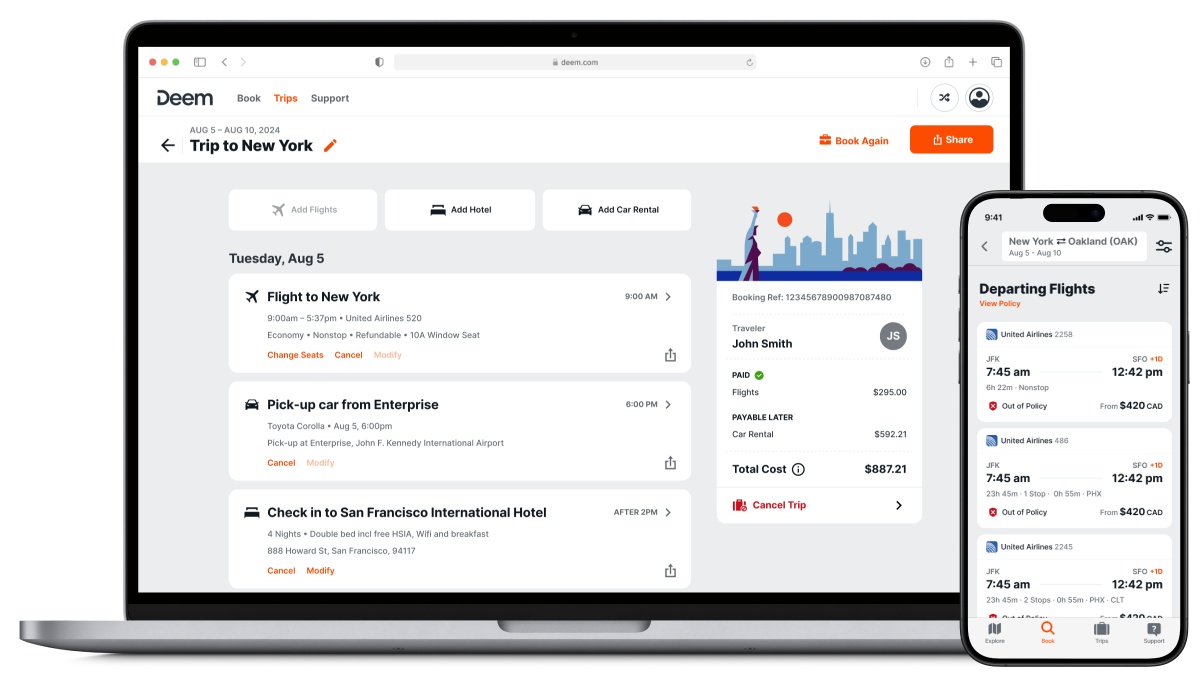
Deem’s current platform brings flights, hotels, cars and rail into a shared booking experience. It supports traditional travel distribution content and New Distribution Capability, or NDC, content. Travelers can assemble trip components in different orders, with a shopping-cart hold of up to 48 hours. Changes recalculate fare conditions, taxes and penalties, while available ticket credit appears in the booking flow.
Its competition includes corporate booking tools such as SAP Concur, Cytric and Serko. Deem’s positioning emphasizes a configurable traveler interface and connections to existing travel infrastructure. For a buyer, the meaningful comparison is the actual itinerary: which fares appear, which credits can be reused, which changes can be completed, and what happens when an agent must intervene.
Accessibility supplies a particularly practical test. Deem describes screen-reader support, adjustable text and navigation using keyboards or other input devices. A traveler who cannot operate the booking interface needs another route to make the reservation. Accessibility therefore belongs in the operational discussion, alongside policy and content, rather than being left to a decorative statement of values.
The company’s careers materials put the traveler at the center of its stated culture and emphasize collaboration. Those are employer claims. The product provides a more useful place to examine them: does the interface let different people complete the same necessary task?
The hotel has a neighborhood; the flight has a footprint
Deem also brings information into choices that would otherwise be made mostly on price and schedule. Travel SafetyCheck provides hotel-location and neighborhood summaries covering categories such as nighttime safety, theft and LGBTQ+ safety. Such information can inform a decision; a neighborhood score cannot guarantee what will happen to a traveler.
EcoCheck, introduced in 2022 with Thrust Carbon, displays emissions information for flights, hotels and rental cars during booking. The notable design decision is the timing. An estimate shown while two flights are still competing for attention can affect the purchase. An estimate discovered after the trip belongs to the reporting department.
Different considerations, presented around the same booking choice. A conceptual view of Deem’s approach.
The lesson is available to anyone designing a purchasing process: place the relevant information beside the choice it can change. It depends on useful data and practical alternatives. Carbon estimates do not demonstrate that emissions fell, and a traveler with one workable departure time may have little room to act on them.
Ground transportation extends that thinking beyond the plane ticket. Deem announced its Uber for Business collaboration in March 2022, describing ride booking and suggestions informed by flight details, locations and company policy. The airport transfer is a small part of the budget, but an awkward gap in an itinerary. Connecting it makes the trip feel more like one undertaking.
A long journey to a narrower promise
Founder Patrick Grady began the business in 1999 as Gazoo Corporation. Through later names, including Rearden Commerce, the ambition grew into a broad commerce network and personal assistant. In a 2013 interview, he admitted: “I was so ahead of my time and I really thought I had it figured out.” The early vision required infrastructure and integrations that took years to assemble.
The historical ambition was expensive. Deem announced $50 million in expansion capital in July 2014, led by Hony Capital, for network growth, international expansion and acquisitions. That is one disclosed financing, not a complete accounting of the cost of building today’s travel product.
Ownership subsequently moved through businesses with different reasons to value travel technology. Enterprise Holdings announced its acquisition in 2019. Travelport bought Deem in March 2023, seeking closer integration between corporate booking and travel content, including NDC. In June 2026, Juniper Group acquired it from Travelport, with Deem retaining its leadership and brand. The relationship with Travelport continues.
Deem now operates within Juniper’s portfolio of specialized software businesses, under the wider Constellation Software organization. Its commercial model is B2B software supplied to corporations and through travel management companies, with implementation and integration part of the relationship. Buyers should evaluate a configured proposal and agency arrangements when calculating cost, rather than treating the app as an isolated purchase.
Let the traveler finish
There is one small episode that neatly captures Deem’s approach. Its newer travel platform launched as Etta in 2021. In July 2023, the company renamed it Deem because customers already called it that. The users had simplified the naming system before the company did.
The broader proposition has the same direction of travel: meet people where their habits already are, then make the approved route easier to complete. Deem’s 2026 overview reports 1.1 million trips booked annually and $0.7 billion in annual travel spending. Those are company-reported activity measures, not revenue or proof of savings.
For someone choosing travel software, the copyable lesson is pleasantly concrete. Test a real booking, a real change and a real unused ticket. Include travelers who use assistive technology. Check that negotiated content is available and that agency support connects to the workflow. A corporate policy earns its keep when an employee can follow it and get on with the trip.