Corporate travel has always had a peculiar way of making expensive people do cheap clerical work. A consultant bills by the hour, then spends 15 minutes toggling between a consumer search site, a company policy, a Slack thread and an online booking tool designed during the age of beige cubicles. SkyLink looked at that relay race and made a pointed product decision: the booking should happen where the conversation already was.
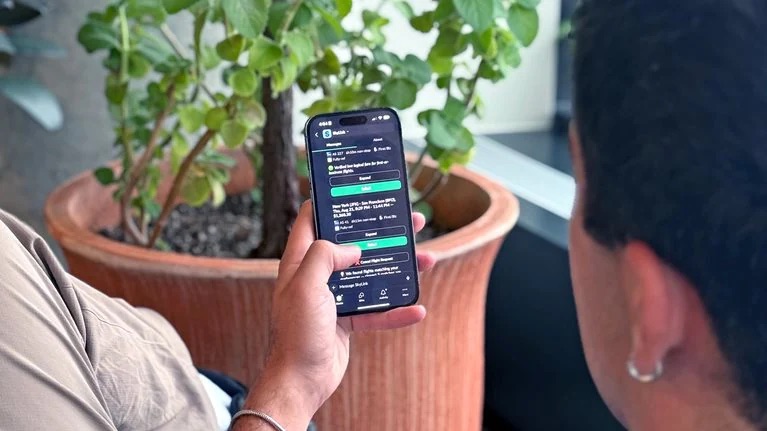
The company, founded in 2021 by Atyab Bhatti and Kush Maheshwari, built an AI travel agent inside Slack and Microsoft Teams. A traveler can ask for an evening flight to London, specify a meeting location, add a hotel, apply a project code and confirm an itinerary without opening a separate booking site. Underneath the chat, SkyLink connects to travel management companies, global distribution systems, direct supplier feeds, traveler profiles and corporate policies. The interface feels new. The plumbing is deliberately familiar.
That distinction explains both what SkyLink did and why it mattered. This was not a general chatbot making holiday suggestions. It was an orchestration layer for a controlled enterprise purchase. It had to know who could fly business class, which hotel rate a company had negotiated, what loyalty mattered to the traveler, which charge code paid for the trip and when to stop improvising and call a human.
The product was a shortlist, not a search result
SkyLink's sharpest choice may have been what it refused to show. In the McKinsey deployment, each air search returned three itineraries. Not 30. Not an endless spreadsheet of departure times and fare families. Three options, ranked against the traveler's current request, booking history, loyalty profile and the firm's priorities. The lowest logical fare was marked. An international one-way could trigger a roundtrip suggestion. A flight without a room could trigger a hotel prompt.
The company called its ranking logic Trip Rank. The name is less interesting than the job: translate a messy sentence into a small set of choices a smart, impatient employee might actually accept. SkyLink said 85 percent of McKinsey users chose one of the first three options. That is the quiet victory. A conversational interface is only fast when the answer is good enough to end the search.

The 99-second relay
“Chicago to London Tuesday night, hotel near the office.” Natural language captures intent before filters dilute it.
Policy, history, loyalty, preferred suppliers and live inventory compress the market into three choices.
The traveler picks, adds codes and books. If the path breaks, the request moves to an agent or traditional tool.
What failed first: the fantasy of total automation
The first hard lesson was not that language models could not chat. It was that corporate travel contains decades of exceptions. In McKinsey's rollout, some ideas imagined at the start were not feasible with the available technology. The North American pilot initially pulled only Sabre content. SkyLink did not connect directly into Concur's booking path. Complex requests still required agency expertise. None of this made a tidy “AI replaces everything” slide.
So the team built around the limits. If SkyLink could not complete a booking, it off-ramped the traveler to a traditional platform or an American Express Global Business Travel agent. The handoff was not an apology tucked into the error message. It was part of the operating model. Bhatti called agents the backbone of the industry, an unusually useful sentence in a category fond of announcing their extinction.
“There certainly were times that what we envisioned from the outset wasn't feasible with the technology in place. But we've worked around those pretty well.”Jamie Stewart, McKinsey travel and events technology
What changed minds was consumer behavior. Two years earlier, booking a flight in Slack could feel reckless. After millions of workers learned to ask ChatGPT for complicated answers, conversation became a credible interface for a transaction. SkyLink still needed procurement, security review and AI governance, but it no longer had to explain why a text box could be useful.
The real customer had three heads
SkyLink sold to enterprises with substantial travel programs, but the product had to satisfy three constituencies at once. Travelers wanted speed and relevant choices. Finance and procurement wanted lower logical fares, policy compliance and cleaner data. Travel management companies wanted bookings that preserved supplier economics and reduced repetitive service work without severing the agency relationship.
This is where the company differed from a new online booking tool with a prettier skin. SkyLink sat above the content and service layer, claiming to be TMC-, GDS- and booking-tool agnostic. Its website advertised integrations across Amadeus, Travelport, Sabre, NDC, GDS, Slack, Teams and email. The business model was enterprise software sold directly to large programs and through TMC partnerships; contract pricing was not published.
The BCD Travel partnership in July 2025 made the distribution thesis concrete. SkyLink plugged into BCD's Travel Commerce Platform, while BCD bookings remained standardized and supported by BCD agents. Large North American customers could get the conversational front end without abandoning the content, reporting and service operation already under contract. This is less dramatic than demolition. It is also how enterprise software gets adopted.
McKinsey did not buy a box. It helped build one
Bhatti had once worked at McKinsey, but that did not fling open the door. The founders needed an internal champion who understood the travel program and could translate an AI experiment into the language of procurement and finance. They found that person in Jamie Stewart, McKinsey's director of travel and events technology.
The pilot began in October 2024. SkyLink, McKinsey and Amex GBT worked through content flow, security, privacy, ranking and the exact language of policy prompts. They tuned how many options appeared and which carriers took priority. They added session warnings for multitasking users, recurring-trip duplication and market-specific details such as Eurostar choices in Britain. A North American launch followed in April 2025.
The outcome was measurable beyond speed. McKinsey reported 96 percent satisfaction, a 35 percent shift toward attaching hotels and a 40 percent shift toward international roundtrip fares among SkyLink users. Those figures came from the flagship partner and should be read in that context, not projected onto every customer. But they show why the product survived enterprise scrutiny: it changed purchasing behavior while making the traveler happier.
From a college idea to Amadeus
Bhatti and Maheshwari first kicked around the idea in 2016, while at the University of Illinois Urbana-Champaign. It began as a consumer concept, but traditional machine learning was too slow and expensive to produce the experience they imagined. By 2021, language models were improving and corporate travel offered a sharper problem: high-frequency users, explicit policies, measurable spend and partners with distribution.
Y Combinator backed SkyLink in its Winter 2022 batch. The company won the judges' award at Business Travel News' 2024 Innovation Faceoff, where the product was called “true conversational commerce.” By 2025, McKinsey and Sony were publicly named customers, BCD was a partner, PhocusWire had put SkyLink on its Hot 25 list for 2026, and BTN named Bhatti one of its 25 most influential people of the year.
Amadeus acquired SkyLink on February 25, 2026. The purchase price was not disclosed. Amadeus later reported €50.5 million of cash flow for M&A in the first half of 2026, mainly related to SkyLink, but that line is not a confirmed valuation. What Amadeus said it bought was clearer: proprietary AI architecture and a multilayer orchestration engine, already responsible for tens of thousands of bookings, that could extend from corporate travel into airlines, airports and hospitality.
The acquisition logic: SkyLink had the conversational layer and enterprise proof. Amadeus had APIs, systems of record, reach across more than 190 markets and transaction volume. The bet is that a useful interface becomes more valuable when attached to global execution.
What a builder can steal
The copyable move is not “add a chatbot.” It is to enter the workflow one step before a purchase, while intent is still being expressed. SkyLink met travelers in Slack and Teams, then used the systems below to execute. It narrowed choice instead of celebrating abundance. It made policy a timely suggestion instead of a PDF. It preserved a human fallback. And it measured not just time saved but behavior changed.
There is also a lesson in focus. SkyLink said it resisted solving every adjacent travel problem and concentrated on booking and management. That restraint matters because the product depended on trust. A clever visa answer is nice; a correctly ticketed flight, charged to the right project and serviced during disruption is the business.
Copy this
Own a high-friction interface, integrate with the incumbent rails, return fewer decisions, design the escalation path first and attach the pilot to finance-grade metrics.
It breaks when
Inventory is incomplete, policies are not machine-readable, identity and profile data are weak, servicing partners cannot take a handoff, or users cannot trust why options were ranked.
The conditions where the playbook fails are as revealing as the win. A chat layer cannot conjure missing fares, reconcile a broken traveler profile or service a stranded passenger without reliable connections. A small company without a sophisticated travel program may not save enough time or money to justify integration. A regulated enterprise that cannot approve the data flow will never reach the delightful demo. And a model that presents confident but wrong options will spend trust faster than it saves minutes.
SkyLink's achievement was not making corporate travel simple. Corporate travel remains a snarl of contracts, inventory, policy, duty of care and human exceptions. The company made that complexity briefly disappear for the traveler, then made sure it was still there for the people responsible for control. That is a narrower claim than “AI reinvented travel.” It is also the sort of product truth an acquirer can put to work.