Robert Rosenstein has spent years helping people get closer to a hotel room. He would also like the final few feet to be less annoying. Speaking about artificial intelligence in 2024, Agoda’s co-founder offered a complaint that required no technical vocabulary: “I just hate checking into a hotel. It’s miserable.” After all the searching, comparing and booking, there is still the business of actually getting a key.
It is a useful place to begin with Rosenstein. Travel technology invites extravagant promises. He keeps returning to the machinery underneath: payments, distribution, the local detail that makes an offer usable. A beautiful itinerary can generate applause. A transaction that works can get somebody upstairs. His career offers a long examination of the distance between those two accomplishments.
There is a tempting beach scene at the beginning of Agoda’s story, involving Phuket, beer and inspiration. Rosenstein has repeatedly punctured it. The romance has survived rather better than his patience for it. The business grew from a friendship, an investment and a sustained argument about serving Asian travelers. Apparently, even a tropical origin story must eventually report for work.
01 Before the hotel room, the browser
Rosenstein’s encounters with the internet predated Agoda by years. In 1989, while working at General Dynamics Space Systems, he saw a network used to exchange scientific and military information. It did not immediately announce itself to him as the future of commerce. The more consequential discovery came at Dow Jones in 1993, where he was working on business audio and video services.
Updating software meant visiting clients and reinstalling it. Exploring ways around that inconvenience drew his team into internet technologies and early browsers. Here was a practical irritation with a much larger possibility inside it: could connected systems change how information reached people? He later left to build websites and advise businesses on commercial opportunities online.
That sequence makes his later impatience with hotel check-in easier to understand. His interest in technology had already developed around an awkward delivery problem. The attraction was the possibility of changing the work itself. A browser was exciting partly because of all the journeys it might spare somebody else.
02 A friendship acquires a booking engine
Michael Kenny brought a different history. While Rosenstein had been working in digital media and e-commerce, Kenny was building travel businesses in Thailand. Their friendship supplied a bridge between the two. They began working together before the Agoda name appeared, bringing an existing travel operation and experience of the web into the same conversation.
Agoda formally launched in 2005. Its intended audience mattered: travelers in Asia, buying travel from a company built with their markets in mind. That was a different proposition from simply helping Western visitors arrange an Asian holiday. Geography was doing more than providing the scenery. It shaped whose booking problem the founders wanted to solve.
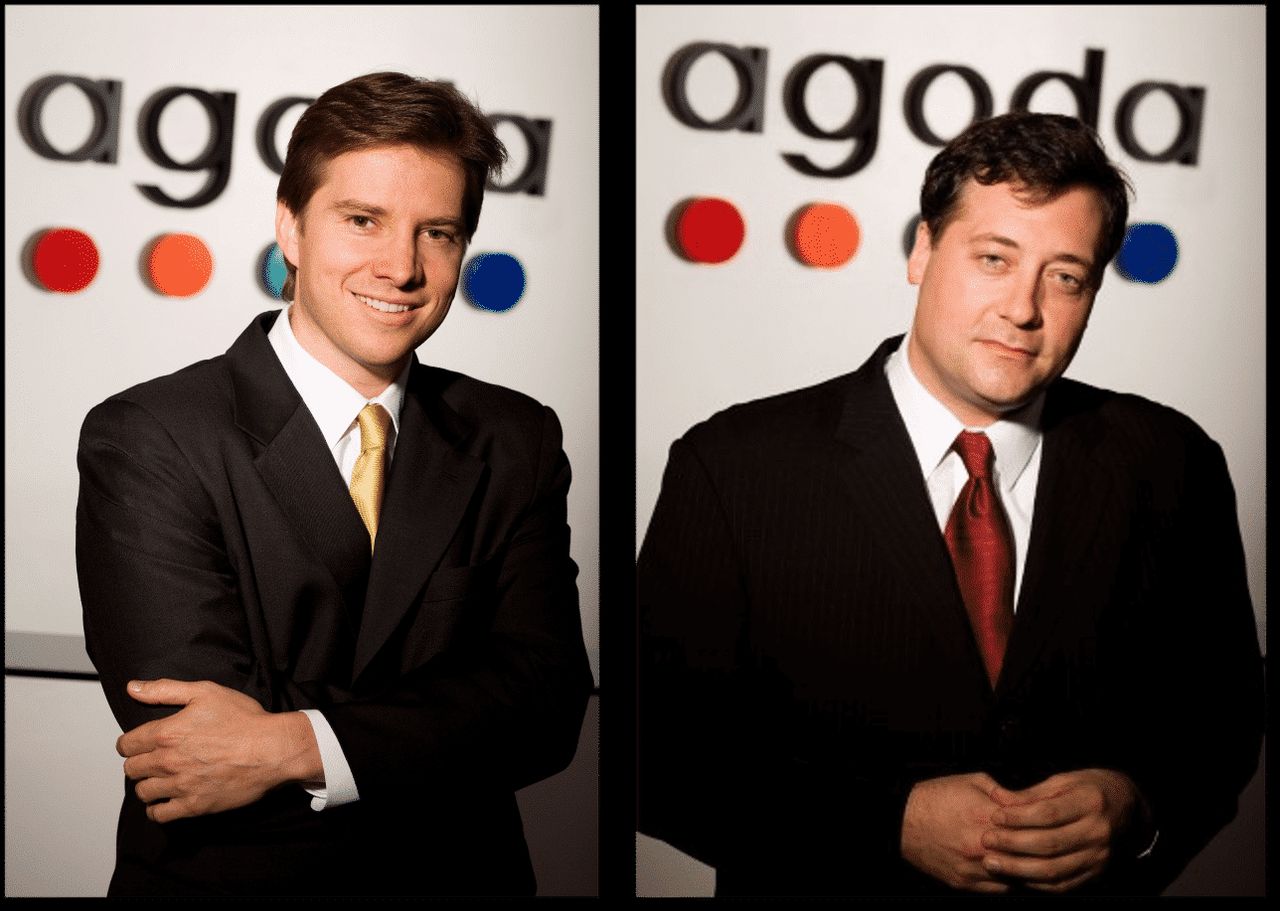
Even the name resisted an ornamental explanation. Agoda has no hidden translation waiting to be revealed. The founders wanted a distinctive name, liked having “GO” in the middle, and researched their choice. The result sounds as though it ought to have an etymology. Its credentials were commercial.
The move toward Asian consumers also required the uncomfortable business of abandoning an earlier brand. Another change replaced a dependence on wholesale hotel inventory with direct hotel relationships. Both decisions involved accepting disruption in the present for a business the founders thought would work better later. Reinvention had a bill attached.
03 The exit that kept him busy
Priceline acquired Agoda in 2007, two years after the brand’s launch. Seen from a distance, the dates can resemble a tidy entrepreneurial sprint. Rosenstein’s recollection is less tidy. He has described concern about the financial outlook and the prospect of larger travel companies pushing into Asia. Joining a bigger group offered a way to compete with more support.
Autonomy was central to the attraction. In a later conversation, he explained the choice with unusual directness: “We picked the company that we thought would interfere the least with us.” Independence inside a parent company sounds like a contradiction until one considers how much work a travel business has to do before it can afford independence outside one.
He became CEO in 2010 and stayed in that role until 2018. The sale had left him with years of operating decisions to make. It also placed those decisions within a public company, where accounting, security and reporting required new habits. A founder could preserve a culture while having to learn a considerably more demanding administrative vocabulary.
The transition to chairman took effect in June 2018, when John Brown succeeded him as CEO. Rosenstein also became an adviser to Booking Holdings chief executive Glenn Fogel. His relationship with the company continued through a change in the kind of responsibility he carried.
04 Hiring someone who can disagree
Rosenstein’s account of leadership repeatedly comes back to other people. He enjoyed working with new employees, joining hotel conversations and helping teams solve operating problems. “My heart has always been with operations,” he said while running Agoda. There is something revealing about a CEO locating his favorite work among contractors, developers and prospective recruits.
He advised founders to sacrifice some of their own economics to bring in the right colleagues and partners. The qualities he valued combined intelligence and competitiveness with humility and ethics. It is an exacting combination. The person must care about winning and remain capable of hearing why their own proposal might lose.
A consequential addition came through the 2014 acquisition of the Israeli advertising technology company Qlika, whose team joined Agoda. Omri Morgenshtern, Idan Zalzberg and Ittai Chorev became important leaders in the business. Morgenshtern would become CEO in 2022. Recruiting, in this account, includes recognizing that an acquired team can change what the acquiring company knows how to do.
“The thing I’m proudest of is the culture.”
Robert Rosenstein, Agoda’s 20th anniversary conversation, 2025
His anniversary reflections emphasized a community that uses evidence, debates and solves problems together. That description gives culture a job. It has to help a company reach better decisions when its people disagree. Keeping the argument useful may be one of the less photogenic achievements in a founder’s working life.
05 No medal for behaving yourself
There is a drier side to Rosenstein’s management philosophy. In 2014, discussing ethical leadership, he rejected the idea that employees should receive special recognition merely for being ethical. Continued employment was the reward. Honesty, by this reasoning, belongs in the price of admission.
He described ethics as part of recruitment, reviews and leadership training, with managers expected to take responsibility rather than passing the subject entirely to human resources. Employees were encouraged to ask about uncertain situations. The system he outlined made room for questions and set firm consequences for substantial violations.
These were his stated standards, rather than a claim that a large business could float above every difficult choice. He acknowledged the pressure that competition puts on judgment and argued for accepting a weaker short-term result when necessary. The interesting detail is the willingness to describe a cost. Principles are much easier to advertise when nobody asks what happens to the quarter.
06 Asia refuses to be one market
Rosenstein’s attachment to Thailand began with a backpacking visit in 1991. He and his wife gradually moved to Bangkok in the early 2000s, and their son was born in Thailand in 2010. For years, building Agoda and making a home there were connected parts of his life.
He is now based in Washington, DC, and continues to travel to Asia. The distance has not flattened his view of the region. At the 2024 Phocuswright conference, he stressed how much individual markets differ, including in payment preferences and meal arrangements. A broad regional ambition still requires attention to very particular bookings.
A booking, examined closely
- Find the roomInventory and distribution
- Make it usableLocal preferences and payments
- Get the keyTransactions and check-in
Three recurring concerns in his interviews - an editorial reading, not a company process chart.
His observations about competition have a similar resistance to easy categories. In 2018, he warned about companies becoming accustomed to spending heavily for market share. He also urged established businesses to remain competitive and humble. Success could leave a company exposed if it stopped paying attention.
That discussion extended beyond the booking platform. He acknowledged that travel’s effects on communities and the environment had often disappointed, and supported closer cooperation between businesses and public authorities. A company can make travel easier while the places receiving travelers face harder questions. His view allowed room for both realities.
07 An investor returns to the awkward bits
Artificial intelligence has given Rosenstein another reason to examine the economics beneath a promising demonstration. In September 2024, he worried that larger companies’ engineering budgets would let them capture benefits that smaller businesses could struggle to afford. Speed and ingenuity would still have to contend with the cost of building and deploying systems.
He also urged entrepreneurs to conserve capital and design for international expansion early. Those are arguments shaped by having operated through different funding environments. A market can reward breadth for a while; the expense of maintaining it does not disappear when investors become less enthusiastic.
His involvement in travel continues through investment. In January 2026, he participated in HeyMax’s $11 million Series A, led by Peak XV Partners. The Singapore company works on the fragmented business of earning and redeeming travel rewards across merchants, payment cards, airlines and hotels. It is another area where an appealing consumer promise depends on numerous systems cooperating.
The pattern is consistent enough to be recognizable without turning it into a personal slogan. Rosenstein follows the point where enthusiasm encounters the work required to deliver it. The hotel lobby remains a fitting example. After the interface, the acquisition, the organizational chart and the itinerary, a traveler is still waiting for somebody to make the next step easy.