In July 2005, Priceline bought a hotel-reservation company in Amsterdam for approximately $133 million. Bookings B.V. had about 130 employees. Its top six executives put some of their proceeds back into the business. The announcement mentioned something else: reviews came from guests who had actually stayed at the hotels. This was a company selling a little more confidence about an unfamiliar place.
Priceline had become famous for asking customers to name their own price. Buying Bookings helped take it toward a different proposition: choose the hotel, see the terms, make the reservation. Thirteen years later, the parent adopted the Booking Holdings name. The acquired business had helped redraw the family portrait.
- Booking owns several front doors to travel, including Booking.com, Priceline, Agoda, KAYAK and OpenTable.
- Its 2025 gross bookings reached $186.1 billion; revenue was $26.9 billion. They measure different things.
- Its next experiment, Vayo, tackles the work that remains after you book.
A room has a deadline
Start with the hotelier. Tonight’s unsold room cannot be sold tomorrow as tonight’s room. The opportunity disappears. A platform that delivers a guest before that deadline has something useful to sell.
Now consider the traveler: unfamiliar neighborhoods, inconsistent descriptions, cancellation conditions, a price that might look different at checkout. Booking.com puts accommodation options, availability and guest reviews into a searchable marketplace. Hotels gain distribution; travelers gain a way to compare. Neither side needs to become an expert in the other’s world.
The original Priceline idea took a detour. Its separately owned licensee, WebHouse Club, applied bidding to groceries and gasoline, then announced its closure in 2000. Funding had dried up. Manufacturers resisted subsidizing discounts. Travel’s peculiar inventory economics did not simply transfer to the supermarket. A clever mechanism still needed suppliers willing to make the numbers work.
The customer wanted to know the name
Glenn Fogel, who became group CEO in 2017, later described the shift plainly: “We noticed that people wanted to book their own hotel knowing what hotel they’re going to get.” For a traveler, mystery can be an inconvenience even when it comes with a discount.
Priceline acquired Active Hotels in 2004 and Bookings B.V. in 2005. The latter deal retained the management team. The executives’ reinvestment gave them a continuing stake in the outcome. One practical lesson emerges: an acquisition can buy judgment and relationships as well as software. Replacing those people immediately would risk losing part of what made the purchase attractive.
“We noticed that people wanted to book their own hotel knowing what hotel they’re going to get.”Glenn Fogel · TIME · May 2025
Five front doors, different errands
Booking Holdings is a portfolio, rather than one travel website. Booking.com anchors accommodation. Agoda offers stays, flights and activities with a strong Asian presence. Priceline attracts deal seekers with hotels, flights, packages and other travel products. KAYAK compares offers across travel providers. OpenTable handles restaurant discovery and reservations, while selling technology to restaurants.
That gives the company several positions along the itinerary. Its customers include holidaymakers and business travelers, but also the hotel, rental firm, restaurant and activity operator seeking bookings. An independent property needs access to distant guests. A restaurant needs a useful reservation book. Their problems overlap without being identical.
Expedia Group offers a competing travel portfolio. Airbnb competes for accommodation, especially homes. Trip.com Group is another international alternative; Google helps determine where travel searches begin. Hotels and airlines also sell directly. Booking’s advantage lies in distribution, local supplier relationships and the accumulated work of making reservations function across markets.
Agoda03FIND A DEALPriceline04DINEOpenTable
A portfolio map, not a required booking sequence.
The bill behind the booking
The group earns agency commissions when it facilitates reservations. In merchant transactions it facilitates payment and recognizes transaction revenue after amounts owed to travel providers, with other payment and ancillary revenue. Advertising and other services add income. A traveler’s hotel bill is therefore not all Booking’s revenue.
In 2025, $186.1 billion in gross bookings produced $26.9 billion in reported revenue. Marketing expense was $8.2 billion. Those figures explain why owning a recognizable brand does not remove the cost of finding the next customer. Search advertising, affiliates, metasearch and social channels remain part of the machinery.
Bars share a dollar scale. Revenue includes several streams; the ratio is not a universal hotel commission.
Keep the failures in the notebook
Booking.com’s researchers described a practical discipline in a 2017 paper: decentralized experiments, a shared record of successes and failures, and safeguards around data quality. Teams could own tests while learning from one another. The useful part to copy is the memory. A failed experiment that stays in one person’s head is available to be repeated by the next team.
This method needs reliable measurement and enough observations. A low-traffic business cannot assume that a tiny difference is a verdict. Nor can a conversion test decide whether a marketplace’s rules are fair. Europe’s Digital Markets Act prohibits Booking.com from imposing parity restrictions in its scope: accommodation partners can offer different prices elsewhere. Travelers have a practical reason to check a hotel’s own offer.
The reservation is only the beginning
Fogel’s longer ambition is the “connected trip.” A flight delay should not leave the traveler manually repairing every downstream arrangement. The hard part is coordinating services whose systems and responsibilities differ.

On October 14, 2026, Booking announced Vayo, a new travel agent in private beta. It brings travel confirmations together from a user’s inbox and watches the trip for changes. Booking plans to invest $100 million, subject to product progress and market conditions. Direct booking, a native app and companion planning were described as future additions, rather than completed features.
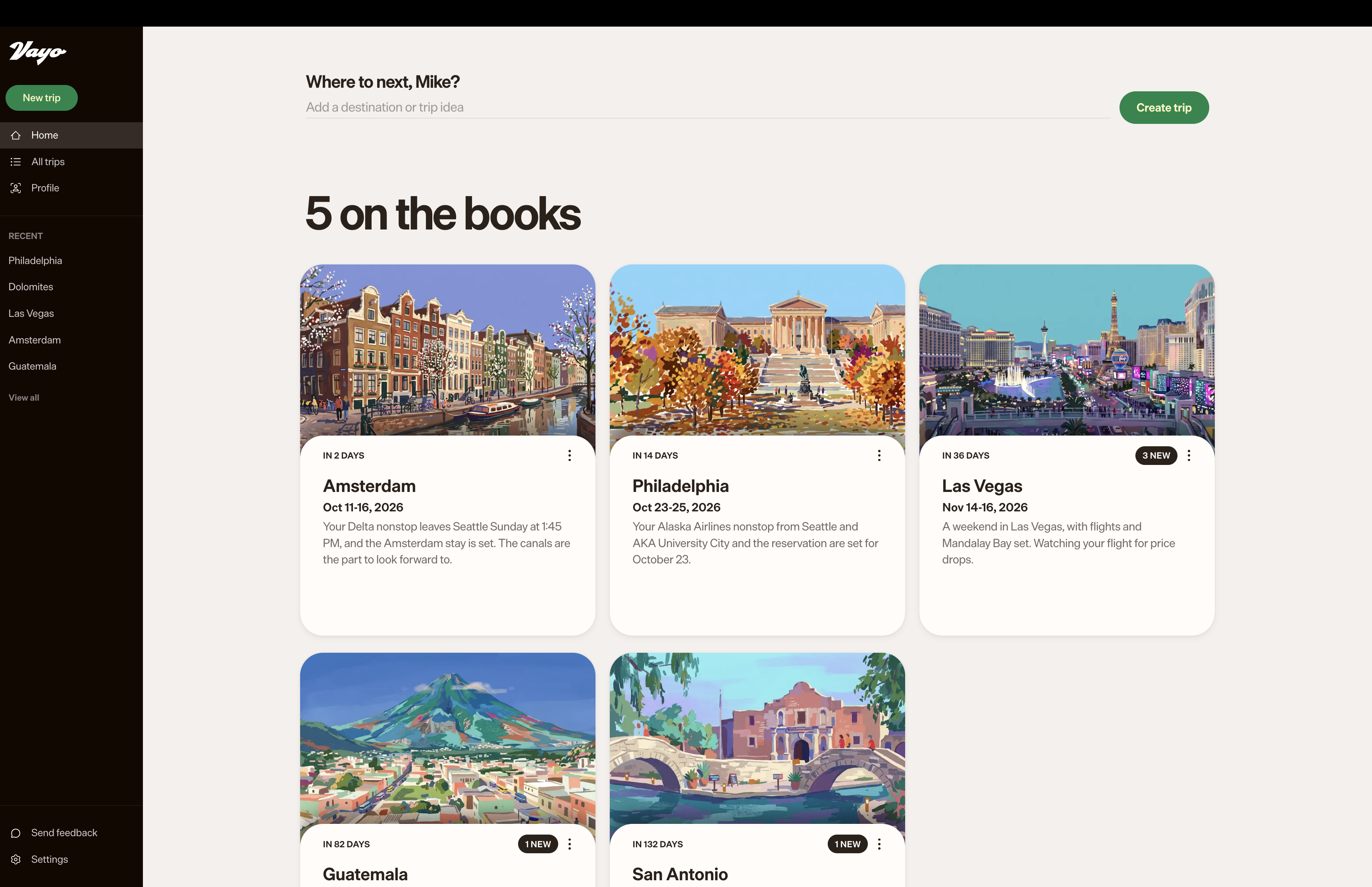
The launch also says Vayo works with reservations beyond Booking’s brands, including direct bookings. That matters. A trip rarely respects a corporate boundary. The company that learned to show travelers which hotel they were buying is now testing whether it can help keep the rest of their plans from coming apart.
Reporting current to October 22, 2026. Financial figures in US dollars.