Tom Whicher trained to understand how boats work. At the University of Southampton he studied Ship Science, a subject whose name leaves refreshingly little room for interpretation. He became a qualified naval architect and sailed competitively, including at international level. The eventual chief executive of DrDoctor had first imagined a future designing boats. His career would take a longer route to a different sort of design problem: how people organise themselves to get something done.
There is a pleasing precision to that starting point. A boat must work outside the drawing office. Someone has to take it onto actual water, where an elegant theory can acquire a rather damp objection. Whicher’s subsequent career keeps returning to that relationship between a plan and the people expected to live with it. Engineering gave him a way to examine a system. Running a company would require him to keep examining the examiner.
In March 2019, he returned to Southampton for a Future Worlds founder talk. The student of ships was now being invited to explain the business he had helped build. Universities enjoy a circular journey; this one had taken in consultancy, manufacturing and a decision to start again.
An onion factory is a place to meet a co-founder
Before the company, there was Newton Europe. Whicher worked in process improvement, examining production lines and finding changes whose effects could be measured. In a July 2026 conversation, he recalled that the consultancy had about 38 people when he joined. Its work included factories supplying fast-moving consumer goods, with projects undertaken on a no-win, no-fee basis. Recommendations had to survive contact with the machinery.
One such assignment involved onions for a factory supplying Domino’s Pizza. There he met Rinesh Amin, who would become one of DrDoctor’s co-founders. Company histories tend to favour garages and university laboratories. An onion-processing line deserves its place in the literature. At least nobody could claim that the founders had failed to consider the layers.
The detail matters beyond the joke. These were colleagues learning about practical work together, seeing what could be changed, how a shift operated and whether an intervention made a difference. A shared assignment gave them something more useful than matching ambitions: experience of one another doing the job.
The arithmetic of staying in business
Whicher, Amin and Perran Pengelly founded DrDoctor in 2012. Bethnal Green Ventures provided an initial £15,000 seed investment. That is a modest opening figure beside the later funding announcements, and it helps explain the shape of the early story. The company grew through revenue for years before accepting a larger outside round in 2020. The founders had a business to keep going while they worked out how far it could travel.
The early customer list stayed at two clients for three years, Whicher later recalled. He described arriving too early for the market. That is an awkward commercial condition: being convinced that something will become normal while trying to pay for the period in which it remains unusual. A founder can possess excellent timing in theory and still have an exceedingly long Tuesday.
His recollection makes the later investment figures easier to read. They came after a prolonged apprenticeship in persistence. The first years required enough confidence to continue, together with enough restraint to remain in business. Both qualities are less photogenic than a cheque presentation. They also have to last considerably longer.
A clock on the workshop wall
By November 2017, Whicher was writing about time as the common resource behind apparently different technology companies. Uber removed the wait associated with finding a taxi. Netflix removed the trip associated with borrowing a film. The appeal lay in returning pieces of the day to their owners. His interest in automation began with the ordinary nuisance of spending time on something that could be simpler.
He also identified a danger after a successful rollout. Once a task runs automatically, people can lose sight of its purpose. A process may continue efficiently even after the reason for doing it has become obscure. Whicher wanted organisations to retain the knowledge behind an activity, so they could adapt when circumstances changed. His concern extended beyond getting a machine to repeat an instruction.
That is an engineer’s caution with a manager’s consequence. The useful question survives the installation: why do we do this? Software can make a habit faster. Someone still has to decide whether the habit deserves another year of everybody’s life. Whicher’s writing leaves that responsibility with the people doing the work.
Listening has a practical use
Another essay, published a month earlier, drew on his experience across aerospace and defence, consumer goods, industrial businesses and automotive work. He had watched organisations struggle to choose technology while weighing costs, security, implementation and training. The difficulties accumulated around the decision itself, long before anyone could admire the finished product.
His proposed response was practical. Understand how an organisation is divided. Expect competing priorities and complicated decisions. Get informed advice about the rules. Listen to customers, partners and prospects, because their frustrations reveal what a proposed change will actually encounter. This was a founder describing the work required around a sale, rather than assuming that a persuasive demonstration would settle everything.
It also gives his habit of talking about humility a specific meaning. Listening is a method for discovering where the plan is wrong. A person who has already decided that every objection is foolish will collect very little useful information. Whicher’s approach requires leaving room for somebody else to know something you need.
Forty people, then a different job
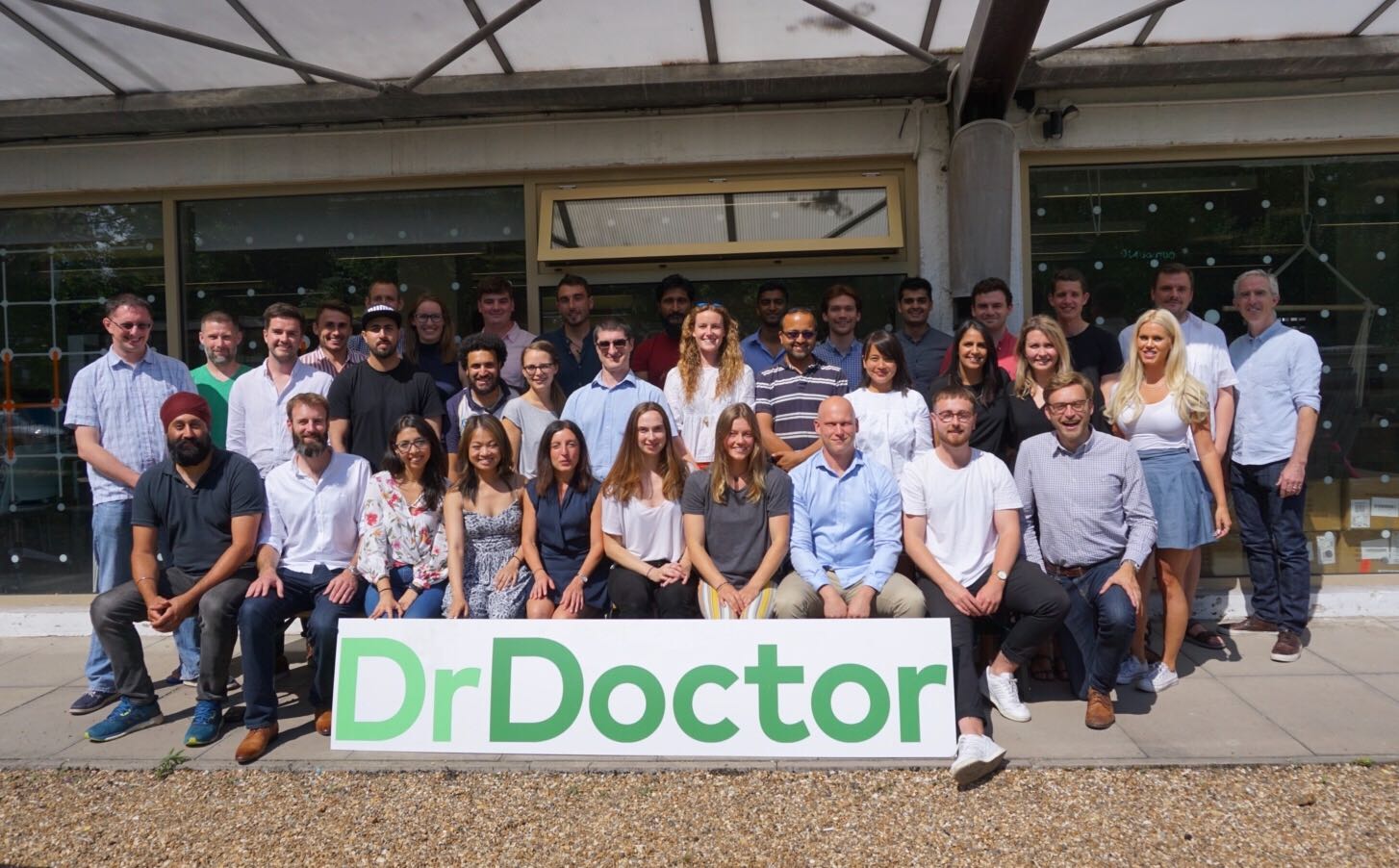
At DrDoctor’s seventh birthday in July 2019, the company counted 40 people. Whicher described the pleasure of entering a busy office and seeing the work presented at the fortnightly show-and-tells. He also enjoyed demonstrations interrupted by someone recognising the product from their own experience. For a founder, a familiar screen in somebody else’s life can make an abstract idea suddenly tangible.
In July 2022, his tenth-birthday reflections put the team at 108. By June 2025, the reported headcount was 146, following a year of 45% growth. These are dated snapshots of an organisation becoming a different size. Each extra colleague also changes the chief executive’s job: who hears a decision, how an explanation travels and which conversations the founders can still have themselves.
A £10 million funding round was announced in February 2023, led by YFM Equity Partners alongside existing investors. YFM’s portfolio record now lists investment in both 2023 and 2025. More capital meant more room to expand the team and develop the business. It also brought the unglamorous obligation to turn available resources into a company capable of using them.
Whicher had already described that personal challenge in 2018. At successive stages, a founder needed to become a recruiter, a manager or someone with an analytical skill. He found the changes of gear difficult. His answer was to learn what the next stage required and find people who could help. The company’s progress kept setting fresh homework for its founder.
Compassion belongs in the operating instructions
By December 2025, Whicher was emphasising kindness, communication and emotional intelligence as capabilities future leaders would need. He argued that people should have room to be themselves in an environment that supports their work. The position follows naturally from the earlier concern with listening: the information a leader needs will often arrive through someone who sees the company differently.
“One of our values is compassion,” he said. That puts an obligation on management as well as a word on the wall. A business that asks for other people’s judgement has to make it possible for them to offer it. The daily treatment of colleagues gives a stated value its meaning; the typography in the presentation can do very little on its own.
The same year, he spoke candidly about the founders’ difficulty bringing senior executives into their established group. A tightly bonded trio could make it hard for newcomers to contribute. Recognising the founders’ own part in that problem is a revealing admission. There comes a point when the people who built a company have to make space inside it.
“One of our values is compassion.”
Tom Whicher · December 2025
There is work to be done outside
Away from the office, Whicher’s interests have remained close to the water. In 2019 he talked about sailing, kite surfing and walking Dylan, his then seven-month-old cocker spaniel. Going outside helped him think, and he encouraged colleagues to take walks too. An office can contain plenty of discussion while offering very little fresh air.
His advice that year included humility, tenacity and enjoyment. He expected the work to take years and wanted people to remember to celebrate along the way. Patience can sound austere when presented as a virtue. Add a dog walk and the prospect becomes considerably more attractive. There is room in his account of a working life for liking the people beside you.
Reading offers another way out of the immediate surroundings. In March 2018, he described keeping fiction and nonfiction on the go together: Robert A. Heinlein’s Stranger in a Strange Land and Michael Lewis’s The Undoing Project were his choices then. One places a stranger among unfamiliar social conventions; the other examines human judgement. They make a suitable pair for someone interested in the gap between how systems are designed and how people behave.
His sailing story reaches further back still. As a child, Arthur Ransome’s Swallows and Amazons prompted him to ask his father to take him to Frensham Pond sailing club. A story led to a place, and the place helped set a direction. Long before the funding rounds and the expanding team, Whicher had found a reason to get out on the water. He has kept finding reasons to change course.