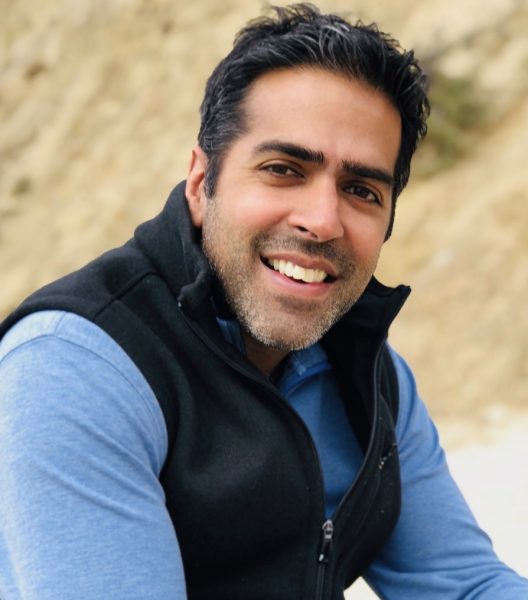
Profile
Mid-Stride, Mid-Market, Mid-Continent Laundry Routes
Pick up the laundry. Deliver it clean. Repeat, across every major U.S. city, for twelve years, while raising $70 million and teaching MBA students at Stanford how not to blow it. That's Ajay Prakash's actual schedule on any given week.
Rinse - the clothing care company Prakash co-founded in 2013 with Dartmouth classmate James Joun and CTO Sam Cheng - isn't the startup story with a pivot buried somewhere in act two. There's no pivot. They found a market (pickup and delivery laundry), decided to serve it with W-2 employees rather than gig contractors, and kept running. The simplicity is deceptive. Execution at that scale, that consistently, for that long, is the whole trick.
"The barriers to entry are really low," Prakash has said, "but the barriers to scale are incredibly challenging." He'd know. He sat with Bain & Company for three years, watched private equity at Berkshire Partners for two more, took an NBA consulting detour, and interned at a small apparel startup called Bonobos in the summer of 2009 - then wrote an angel check into it before graduating Stanford. His instincts for scale were calibrated well before he ever touched a laundry bag.
"The barriers to entry are really low, but the barriers to scale are incredibly challenging."
- Ajay Prakash, Rinse Co-Founder & CEOWhat separates Rinse from a dozen dead-on-arrival laundry apps isn't the app. It's the workforce model. Rinse's drivers and valets are W-2 employees, not 1099 contractors. Prakash has argued both that it's the ethical choice and that it's the strategic one - employees who are treated as employees tend to show up, solve problems, and stick around. That continuity is worth something in a business built on showing up at someone's door every week.
The sustainability angle adds another layer. Rinse works with local dry cleaners who operate PERC-free - without perchloroethylene, the chemical that made traditional dry cleaning effective and quietly toxic. "Make Mom Proud" is the company's core value. It works on at least two levels: employees should do work they'd want their mother to see, and the cleaning process shouldn't poison anyone's neighborhood in the process.
The COVID-19 pandemic tested both the model and the man. When demand for laundry pickup collapsed in early 2020, Prakash and Joun appeared on NPR's "How I Built This" with Guy Raz to talk resilience - not in the abstract motivational sense, but the actual operational kind. How do you manage payroll for W-2 employees when your volume drops overnight? How do you make decisions with incomplete data while keeping people employed? "It's important to remain balanced and objective in times of uncertainty and make decisions with available data," Prakash said. The company survived. The employees kept their jobs.
"The most important thing is managing your psyche to overcome obstacles."
- Ajay Prakash, on founder resilienceBy 2022, Stanford GSB invited him back - not just as an alumnus dropping in for a panel, but as a Lecturer in Management with his own course: Startup Garage: Design. The course is what it sounds like. Students form teams. They identify real-world needs. They design, test, and iterate on actual business concepts. Prakash teaches the parts of entrepreneurship that don't fit on a slide deck: how to find product-market fit, how to build a team, how to construct a business model that holds up when the whiteboard version meets reality. He's teaching from live ammunition, not case studies about other people's companies.
His Substack - called "Shadow Ajay," which should tell you something about his relationship with conventional CEO image management - documents personal and professional reflections with the kind of transparency that most founders avoid until their memoir. His Medium posts read the same way: candid notes on Rinse's rebranding, the mechanics of raising a Series B, the specific traps of on-demand businesses. If you want the unfiltered version of what building a services company actually looks like, the essays are there.
The LG investment - $23 million, announced in early 2025 as part of Rinse's Series D - is worth noting for what it signals. LG makes washing machines. Rinse picks up your laundry and brings it back clean. The partnership isn't arbitrary: clothing care as a category is finally large enough for a global appliance manufacturer to write a nine-figure check into a 12-year-old startup founded by two Dartmouth friends with an idea about pickup and delivery. Ajay Prakash has been in this specific business, building this specific thing, for longer than most startups in his cohort have existed at all. That's not persistence for its own sake. It's a bet that the boring, hard, operationally complex business is the one that's worth building.
At Stanford, he tells students the same thing he learned the long way around: the idea is the easy part. Getting your mom to be proud of how you ran it - that's the job.