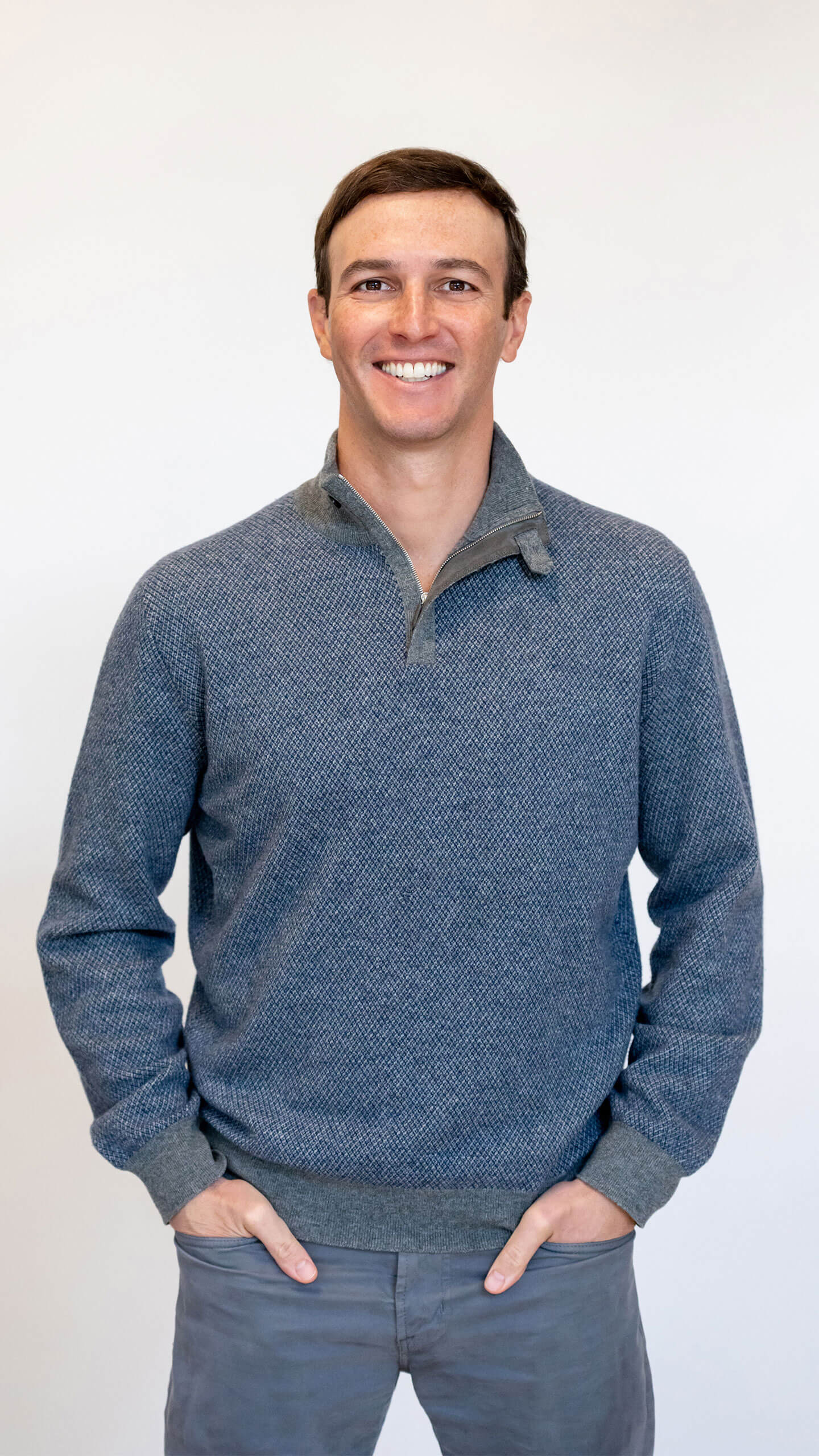
There is a Post-it note on David George's computer. One sentence. No elaboration. It has sat there for years - through $3.75 billion fund closes, board seats at companies reshaping defense, fintech, and AI, and a portfolio that reads like a greatest-hits album of the last decade in tech.
The note asks: "Is the market demanding more of my product?" That's it. No spreadsheet, no TAM calculation, no market-sizing deck can replace the answer to that question. Pull, not push. Demand, not manufacturing. George has built a $15 billion growth investing practice at Andreessen Horowitz on the back of that single filter - and the relentlessness to act when the answer is yes.
He grew up in Kentucky. Basketball, bourbon, horse racing - the holy trinity of that particular geography. He was a wrestler in high school, competing against an older brother two and a half years his senior. "You get your hand raised, and you win or you lose," he has said. Wrestling is a sport with no teammates to blame and no clock to run out. It is ruthless and clarifying in the same breath. George brought that disposition to venture capital, where most GPs spend considerable energy avoiding the word "lose."
"You get your hand raised, and you win or you lose."
David George - on what wrestling taught him about competitionThe Business Model Snob Who Built a $15 Billion Machine
George graduated summa cum laude from the University of Notre Dame. He picked up an MBA from Stanford Graduate School of Business. He joined William Blair as an investment banking analyst, moved to FFL Partners, then landed at General Atlantic - where he spent roughly seven years learning what it actually meant to invest at scale in companies already past the chaotic early stage.
At General Atlantic, he backed Airbnb before its IPO. He was in early on AppDynamics, CrowdStrike, Slack, and Uber - when those companies were large and fast-growing but not yet household names. He was learning a specific, undervalued craft: how to evaluate companies that had already found something real, and bet on whether they could become defining.
In March 2019, Andreessen Horowitz brought him in as the firm's first General Partner dedicated entirely to growth-stage investing. He was handed a blank page. No team, no playbook, no fund. Just a mandate and a conviction that late-stage investing deserved the same intellectual rigor the firm applied at seed and Series A. He built from there. Today, a16z Growth manages approximately $15 billion across four funds, the most recent a $3.75 billion vehicle. George calls himself a "business model snob" - not as a self-deprecating joke but as a precise description of what he actually does.
"Is the market demanding more of my product?"
The Frameworks That Drive the Machine
Most investors claim to have frameworks. Few can articulate them without resorting to the kind of vague generalities that survive no stress test. George's frameworks are unusually specific - the kind built from real pattern-matching across hundreds of companies over two decades, not the kind assembled from first principles on a whiteboard.
The most powerful companies reimagine what a product is - not just how it's delivered. Figma didn't improve Illustrator's delivery model. It reconceived what design software could be at a fundamental level. That's a "what." A DTC mattress company is a "how."
Is the market pulling your product out of your hands, or are you pushing it into the market? Pull means organic demand exceeding your ability to supply. It signals real product-market fit. The Post-it note is this framework distilled to its irreducible minimum.
Most technology markets are power laws: first prize captures 80-90% of total market cap. Second prize is steak knives. This shapes where George focuses diligence - not on downside scenarios, but on what the upside scenario actually looks like at full market capture.
Some companies grow faster and longer than any financial model predicts. Roblox. Anduril. The model says it should slow down, and it doesn't. These are the bets George most actively hunts - because they're systematically underpriced by conventional analysis.
The Glengarry Glen Ross Guide to Market Structure
George has a habit of reaching for Glengarry Glen Ross when explaining winner-take-all markets to founders. In the film, the sales contest prizes are: first prize, a Cadillac Eldorado. Second prize, a set of steak knives. Third prize, you're fired. George maps this directly onto technology sector dynamics - where most markets consolidate to one or two dominant players, and the difference between first and second is not incremental but existential.
80-90% of total market cap
Plays for scraps. Survives, barely.
Absorbed, acquired, or forgotten.
This isn't pessimism. It's a targeting mechanism. If you understand that markets are winner-take-all, then your entire diligence process reorients around one question: can this company win? Not survive, not hold a defensible niche - win. George focuses most of his analytical energy not on protecting against downside but on modeling out what the best-case scenario actually looks like, because in technology, the best case is often the only case that matters economically.
The Missed Bet
George is unusually candid about DoorDash. He looked at it. He thought hard about it. He passed. His concern was the business model - the unit economics of food delivery at that particular moment felt precarious. He weighted the model too heavily and the founder too lightly. Tony Xu turned out to be exceptional in exactly the ways that overcame the model concerns. George says this plainly, without defensive hedging, which is itself revealing about how he operates: if you don't study your misses, you repeat them.
Founder quality is not a qualitative overlay on top of quantitative analysis. It is quantitative. How a founder navigates a weak business model matters more than the model itself at certain stages. Overweighting the model and underweighting the operator is a systematic error, not a random one.
The AI Thesis: From Frosting to Sugar
George arrived at his AI framework by asking why incumbents seemed to be winning the first wave - and why startups would eventually win the next one. His answer: AI is currently "frosting" on existing products. It makes them better. Incumbents capture this phase because their distribution and existing user relationships give them the advantage. But frosting is not the endgame.
AI as add-on
Incumbents win
Rebuilding begins
Both can win
AI as foundation
Startups win
When AI becomes the "sugar" - the foundational ingredient that the entire product is built around - it ceases to enhance existing products and instead demands entirely new ones. Startups, unburdened by legacy architecture, have the structural advantage in that world. This is where George's growth bets are positioned.
George is equally direct about the AI infrastructure buildout. He argues the current capital deployment into data centers, compute, and foundational models exceeds the combined capex of broadband, the commercial internet, shale, and the Apollo program. The models consuming that capital will generate value exceeding the mobile and cloud computing waves combined. This is not a hot take for conference season. It is the organizing assumption behind a16z Growth's current fund strategy.
He has also staked out a specific position on the future of consumer AI: the transition from reactive to proactive. The current chatbot paradigm is reactive - you ask, it answers. The next wave is proactive software that anticipates needs, acts on them, and operates in the background. This is where he sees the frontier moving, and where he is watching most closely for the next generation of "modelbuster" companies.
"The future isn't a chatbot. The big shift will be reactive to proactive."
David George - on where consumer AI is headingTwo Paths, No Middle Ground
In March 2026, George published what became one of the more widely-circulated essays in enterprise software circles: "There are only two paths left for software." The argument was blunt. AI is dismantling the assumptions that underpin most software businesses. Every company must now choose: accelerate revenue growth by 10+ percentage points year-over-year through genuinely AI-native products, or rebuild operating structures to deliver 40-50% true operating margins. There is no survivable middle path. Incremental improvement dressed up as transformation will not work. The companies that try to thread that needle will find themselves with neither the growth story to command premium multiples nor the efficiency story to protect against compression.
This is George operating at his most characteristic: taking a complicated, uncomfortable reality and reducing it to its irreducible structure. Not to simplify for simplicity's sake - but because the underlying dynamic actually is binary, and pretending otherwise costs founders real options.
Portfolio: The Companies He Bet On
Before a16z, at General Atlantic, the list included Airbnb, Slack, CrowdStrike, Uber, and Opendoor. After joining a16z in 2019, the portfolio expanded to include some of the most closely-watched companies in technology:
Current board seats include Current, Greenlight, and Workrise - companies in consumer fintech, youth banking, and blue-collar workforce management. The breadth is deliberate: George's growth lens applies across sectors because the underlying dynamics of winner-take-all markets, pull vs. push demand, and founder quality are not sector-specific.
The Structure He Built
One of the less-discussed aspects of a16z Growth is how it makes decisions. George moved away from the traditional investment committee model - where a group of partners vote on whether to proceed, with all the social dynamics that structure produces. Instead, a16z Growth uses a "single trigger puller" model: one person is accountable for the decision. Everyone debates. But one person pulls the trigger, and that person owns the outcome fully.
George believes this produces more honest debate. In a traditional IC model, partners who aren't making the call have less skin in the intellectual game - they can voice skepticism without accepting accountability. When one person is accountable, the pre-decision conversation changes character. It becomes more useful because everyone knows that one person is listening to sort signal from noise, not to build consensus.
The AI Efficiency Standard
George has articulated a specific benchmark for evaluating AI companies at growth stage: $500,000 or more in annual revenue per full-time employee. This is not a threshold for perfection - it is a signal of genuine AI-driven leverage in the business model. A company that crosses this line is demonstrating that AI is functioning as productive infrastructure, not just a marketing claim. Below that line, George asks harder questions about whether the efficiency story is real or still aspirational.
He also distributes the value question clearly: 90% of the technological surplus generated by AI will flow to end users. Not to the companies building AI, not to the investors funding them. To users. This is a long-run equilibrium prediction, not a near-term one - but it shapes how George thinks about which business models are durable and which are temporary rent-extractors in a market that will eventually commoditize.
"90% of the technological surplus is going to go to the end users."
David George - on where AI value ultimately landsOutside the Office
George serves on the Board of Trustees and Investment Committee at Sacred Heart Schools-Atherton, and on the Advisory Council of the IDEA Center at the University of Notre Dame - a connection to his undergraduate roots that has persisted through two decades of career evolution. He is also a board member of the Foundation for Lucile Packard Children's Hospital Stanford.
The Kentucky constants - basketball, bourbon, horse racing - follow him to the Bay Area. He has talked about the competitive drive instilled by a childhood spent chasing an older brother who was always slightly ahead, and a sport where the outcome is announced immediately and unambiguously. That clarity, he says, has stayed with him. In venture, there is rarely a hand raised. The scoreboard updates slowly. But George has structured his own decision-making to get as close to that clarity as growth-stage investing allows: one filter, one question, one accountable decision-maker, and a fund large enough to act when the answer comes back yes.