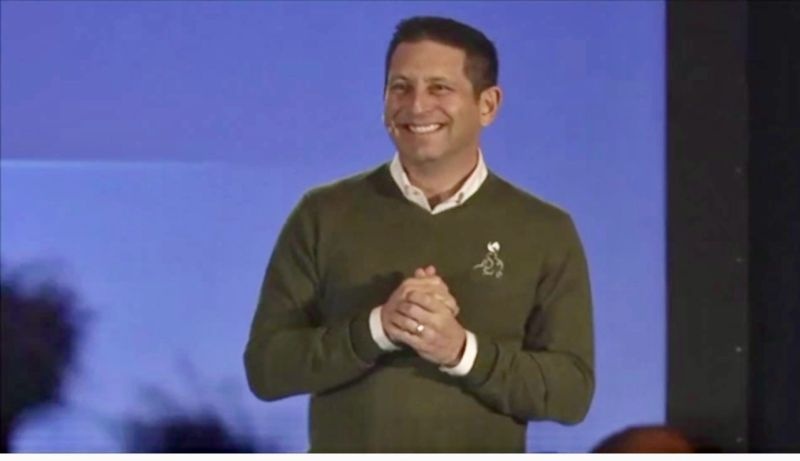
Steve Bilt kept the pictures. In one, he stands on a stage with his hands clasped, smiling at the room. In the other, people are on their feet between rows of conference chairs. They are screen grabs from his first meeting after returning to Smile Brands, the company he had helped found in 1998. In September 2026, ten years after the reacquisition, he shared them again. A transaction has a closing date. A reunion has faces.
By then, plenty of colleagues had joined without knowing the whole story. Bilt had built the business, left it, started another company with a familiar partner, and bought the old company back. The photographs offered a quick introduction to that peculiar career loop. They also raised a more interesting question: what, exactly, had he come back to recover?
The answer runs through his life in surprisingly ordinary objects: a newspaper cart, a dinner table, a wristband, a set of company accounts. Bilt works in a business of hundreds of locations, but his descriptions of leadership keep returning to the scale of a conversation. Who needs what? Who understands the arrangement? Who will still want to be here tomorrow?
The thirteen-year-old with the unpaid invoices
Bilt was born in New York City and raised in Denver. His first job was delivering The Denver Post in the snow. At thirteen, he bought the papers, delivered them, collected the money, paid his costs, and kept the margin. A neighbor who declined to pay could eat into the boy’s earnings. The newspaper had already made its sale.
It is an unusually practical introduction to entrepreneurship. The work involved stock, distribution, credit, and customers who sometimes behaved as though the subscription were a charitable suggestion. Weather supplied an additional department, usually an unhelpful one.
His father helped fold Sunday papers and pull the cart when the snow became too deep. At home, he also brought business questions to the dinner table and invited his son’s opinions. Bilt remembered learning that a business required continuing attention. Adults could be responsible for it without possessing every answer.
That last detail matters. A child invited to discuss a business problem gets to see uncertainty before it has been dressed for a board meeting. Bilt’s later emphasis on explaining decisions has an early counterpart here: a father making room for a boy’s questions while helping him get the papers delivered.
An accountant crosses to the other side of the desk
Bilt began his professional career at Ernst & Young. He then became chief financial officer at SCRS and later vice president of finance at Vivra. The sequence placed him inside businesses as they expanded, with responsibilities that included acquisitions and corporate finance. Numbers were his entry point. Running the organization would become his work.
He co-founded the business that became Smile Brands in 1998, initially serving as its chief financial officer. About a year and a half later, he became CEO. The venture proved more complicated to operate than its founders had anticipated. Bilt spent time developing relationships with the people running its individual locations and learning what support they needed.
The distinction between signing an acquisition and making it function is easy to miss from outside a company. A completed deal can look like an ending. For the operator, it hands over a new collection of questions, habits, systems, and expectations. Bilt’s move from finance to the CEO’s office put him in charge of that less tidy sequel.
His education continued alongside his career. He earned a business economics degree at the University of California, Santa Barbara, completed his Pepperdine MBA in 2001, and later completed Harvard Business School’s Presidents’ Program. The first two disciplines, economics and accounting, are useful preparation for understanding a business. Neither permits the people inside it to be rounded to the nearest decimal.
A familiar company, a different direction
Growth arrived through both acquisitions and new openings. Monarch Dental joined in 2003; Castle Dental followed in 2004. Bright Now! Dental was part of the corporate lineage, and the parent adopted the Smile Brands name in 2009. A collection of regional businesses was becoming a national operation.
Then came the departure. Bilt has dated his exit to the end of 2013 and described being encouraged to pursue other interests. In his telling, that polite phrase concealed a less voluntary decision. Subsequent investors wanted a different direction. He also acknowledged that, at the time, he did not know whether moving on might be right.
There is room for candor in that account without assigning motives to everyone else in the room. His version establishes what the separation meant to him: he discovered how much he missed the business. Knowing how to build a company and being ready to leave it are separate accomplishments.
In June 2015, Gryphon Investors announced a new venture with Bilt and Brad Schmidt, his longtime finance partner. OneSmile would acquire practices in the western United States. The partnership brought together people who had already worked with one another, including an investor that had backed the earlier business from 1998 to 2005.
Familiarity had commercial weight. When Gryphon announced OneSmile, it described Bilt and Schmidt’s earlier expansion to more than 400 locations and over $500 million in revenue. The new company began with a regional ambition and an experienced team. It soon found an acquisition with an unusually recognizable name.
- 2013Leaves Smile Brands
- 2015Starts OneSmile with Brad Schmidt and Gryphon
- 2016Reacquires Smile Brands with his partners
- 2026Shares photographs of the reunion, ten years on
Buying back the working relationship
On August 18, 2016, Gryphon announced its acquisition of Smile Brands. Bilt would resume the CEO role; Schmidt would return as CFO. At the time, Smile Brands supported nearly 350 offices across seventeen states. The purchase reunited the executives with a company they knew and a workforce that had continued without them.
The financial reset was substantial. In 2017, Bilt described more than $100 million of primary equity financing, used to reduce debt and support working capital. He also described a renewed emphasis on the company’s culture. By October, its acquisition search had widened from the West to the country as a whole.
“We are national,” he said. That year, he reported approximately 380 locations, 4,500 employees, and revenue up twenty percent year to date. Those figures belong to that stage of the comeback. They show the practical setting for the story: people were returning to a growing business with a repaired balance sheet, rather than simply attending a sentimental reunion.
A year after his return, Bilt and Schmidt’s turnaround was the subject of a scheduled keynote in Irvine. It is tempting to compress such a recovery into a leadership lesson. The details resist compression. Money had to be supplied, debt reduced, responsibilities resumed, and relationships rebuilt. The old slogan needed people willing to give it another hearing.

Three words, followed by the work
The phrase is “Smiles for Everyone.” Bilt introduced it at the organization’s annual leadership meeting in 2007. Its accompanying service routine, G3, breaks down into greeting, guiding, and gratitude. Say hello properly, help someone find the next step, and acknowledge the trust they have placed in you. It gives an ambitious phrase some everyday verbs.
There were other tangible features of the organization. In 2018, six of Bilt’s eight direct reports were women. The team included leaders in legal, marketing, human resources, and regional operations, with careers built through different routes. A company’s stated regard for people is more interesting when the account includes who gets responsibility.
Employee feedback supplied another kind of evidence. In 2018, Bilt ranked twelfth on Glassdoor’s list of one hundred Top CEOs for large companies. Such a ranking is a particular measurement at a particular moment. It gives the working relationship a public record, without turning it into a permanent verdict.
Bilt has a private reminder, too. He described taking off his mission wristband each evening and rolling it onto his wrist in the morning while renewing his commitment aloud. He also recalled explaining the company’s cash priorities when employees worried about being paid. Payroll came first; his own pay came last within payroll.
“The last person getting paid on payroll is me.”
Steve Bilt, recalling his explanation to employees
The interest lies in the specificity. A reassuring adjective asks people to take your word for it. Explaining the order in which money will move gives them something to understand. The wristband and the accounts operate at different scales, but both make an otherwise abstract intention harder to forget.
The next idea still has to work on Monday
In a February 2025 conversation with Amol Nirgudkar, Bilt discussed slower growth, rising labor costs, and more expensive debt. He favored small improvements that accumulate and acknowledged that internal closeness had drifted as new systems and technology arrived. His response included returning attention to the team.
That admission keeps the comeback from becoming a fairy tale with a final page. Culture can require repair after the founder has returned, too. Success at one stage provides neither immunity nor a waiver from doing the work again.
His conversations about newer technology carry a similar caution. He describes the need to understand existing infrastructure and actual workflows before making expansive promises. He also favors exchanges between functional leaders across companies, allowing operators, marketers, and human resources executives to compare experience directly. A CEO bringing home conference notes can only translate so much.
Bilt’s industry connections have been maintained over years. He helped found the Association of Dental Support Organizations, served as its president, and entered its inaugural Hall of Leaders in 2023. At the 2024 summit, he interviewed Denver Broncos legend Terrell Davis about leadership and discipline. Davis’s recollections included his own childhood paper route. Two careers, briefly meeting over early mornings and newspapers.
At home, Bilt has offered a less formal account of his abilities. His family bought a small farm property, and he learned about miniature goats while building their play structures, poorly by his own assessment. In a 2022 interview, he ended the personal questions because a new Labrador puppy wanted to play. Some stakeholders are remarkably direct about their priorities.
There is affection in those details, and a useful limit on the executive portrait. The career contains acquisitions, recognitions, and a return to office. It also contains snow, assistance from a father, and construction work that apparently fell short of the goats’ expectations. In the photographs Bilt brought out ten years later, the people in the room remain visible. They are the part of the transaction he chose to show.