Dan Vahdat was close enough to a doctorate for finishing to sound reasonable. His father thought so. Years of work already lay behind him; the title was within reach. Vahdat left. He had begun his PhD at Johns Hopkins and spent part of that period at Oxford. The company he would build, Huma, began in 2011. The decision is easy to compress into a founder biography. Living with it required considerably more space.
There is something wonderfully awkward about an unfinished degree. It resists the usual account of progress: enter an institution, collect a qualification, move to the next respectable thing. Vahdat had reached the point where the next respectable thing no longer interested him enough. That is a difficult proposition to explain at a family dinner, particularly when the respectable thing has already consumed several years.
A title left on the table
He describes a childhood in a small place in Iran, followed by a move to the capital, then the United States and the United Kingdom. His academic background included engineering and mathematics. Those moves matter because leaving university was entangled with immigration status and family expectations. A student from abroad has more to consider than whether the next semester looks interesting.
In Vahdat’s telling, his professors believed in him and he enjoyed the PhD work. Disliking the institution was not his explanation. He was asking where the work would lead. His father wanted him to finish; his mother was more accepting. The disagreement makes the decision feel human. Someone can love you, understand your abilities, and still wish you would take the route with fewer missing signposts.
Leaving also did not supply an instant business plan. He was experimenting with projects, including electric-car concepts that proved too expensive. Software offered another direction. The familiar version of entrepreneurship begins with a single idea and a straight line. Vahdat’s account has side roads. The expensive car experiment is a useful reminder that a founder’s early enthusiasm may need a budget before it needs a slogan.
The education after the education
The early sums were modest. Vahdat recalls a £2,000 grant and a subsequent £5,000 grant that did not arrive. He describes sleeping in an office provided by Oxford and getting up before the cleaners. Meals came from a cheap soup-and-baguette routine. These are his recollections of the beginning, when keeping the company going involved immediate questions about money and somewhere to sleep.
A small opening, followed by a closed door.
A grant is a particularly revealing kind of encouragement. It says someone believes enough to give you a start. It does not promise a customer. Nor does it guarantee the next grant. The difference between people approving of an idea and people paying for it would become part of his business education. Approval is pleasant company. It has a regrettable inability to settle an invoice.
Huma’s later financing announcements occupy another numerical universe. In July 2024, the company announced financing and related share issuances totaling more than $80 million, putting cumulative funding above $300 million. The backers included AstraZeneca, Hitachi Ventures and Leaps by Bayer. Those are company figures, and the distance between them and the early grant gives the story its scale.
Money raised records a set of decisions by investors. It also creates a new set of obligations for the founder. A larger business has more people waiting for answers, more commitments to honor, and more ways to spend a day badly. The early problem of getting started eventually becomes the problem of directing something that has acquired its own weight.
The trouble with an attractive opportunity
Vahdat has discussed a lesson about focus that he attributes to Jony Ive. The difficult refusal is an opportunity you want: something appealing, something you believe could be good, something you can already imagine pursuing. Declining the dreary project is comparatively painless. Declining the exciting one requires an actual choice.
For a platform business, that choice becomes recurring work. The appeal of shared infrastructure is that it can support many different applications. Each new possibility can sound like proof that the platform is working. It can also take people away from an existing commitment. A founder who enjoys building has to decide which things other people should build instead.
In 2023, Vahdat described Huma’s foundation as something the company had first built for its own use and then opened to others. That sequence makes practical sense: use the thing yourself, discover where it fails, and improve it before inviting more people in. The wider ambition grows out of work already done. Even a generous platform needs someone to attend to its plumbing.
A company with room for other founders
The organizational question became sharper as Huma grew. Vahdat says that, in 2022, the company had accumulated projects and complexity. His response was to divide it into smaller units with individual leaders. The language is revealing: Huma calls these people field CEOs. The intention is to give someone responsibility for a business rather than a narrow slice of a process.
He has described incentives tied to what those leaders generate, with profit sharing rather than an ordinary commission arrangement. They work with a common platform while taking responsibility for particular ventures. The company supplies a foundation; a leader supplies attention, judgment and accountability. It is an attempt to preserve some of the founder’s job inside a growing organization.
Business unitField CEO
Business unitField CEO
Business unit
That approach also gives a way to think about acquisitions. In his account, acquired businesses can join as units, retaining their brands and cultures while connecting technology and commercial opportunities. Combining companies always sounds tidy in an announcement. The harder work is getting people to cooperate when their habits, expectations and loyalties come from different rooms.
The field-CEO model does not remove that difficulty. It gives it an address. Someone has to understand the unit’s work and make consequential decisions about it. For Vahdat, inventing an operating model belongs alongside inventing software. Organization charts are rarely invited to the glamorous part of a founder’s story. Here, the chart earns its place.
A calendar, a contract, a conversation
Vahdat’s approach to partners is unusually specific about access. He has described wanting a quarterly conversation with a partner company’s CEO. He wants to explain what Huma is doing and understand the other organization’s challenges. A partnership may have a contract, a launch announcement and several enthusiastic teams. He also wants a recurring appointment with the person carrying the broadest responsibility.
There is a modest admission inside that requirement: he needs to learn. An outsider can see a promising technical opportunity and still misunderstand the organization expected to adopt it. Regular conversation creates a chance to discover the priorities behind a purchase. The calendar becomes part of the product’s chances of success.
His hiring arguments follow a similar preference for substance. He puts weight on people who care about the work and questions what a prestigious executive appointment can really solve for a young company. Experience matters, but an impressive previous employer cannot supply answers to every unfamiliar problem. A salary can be agreed in an afternoon. Useful judgment takes longer to demonstrate.
He also emphasizes adaptability. A company may operate in a period when investors reward growth, then find itself in a period when they demand profitability. The founder has to respond. Holding a long-term ambition and changing immediate decisions can coexist. The people doing the work still need wages this month, whatever the vision says about the next decade.
The border is part of the business plan
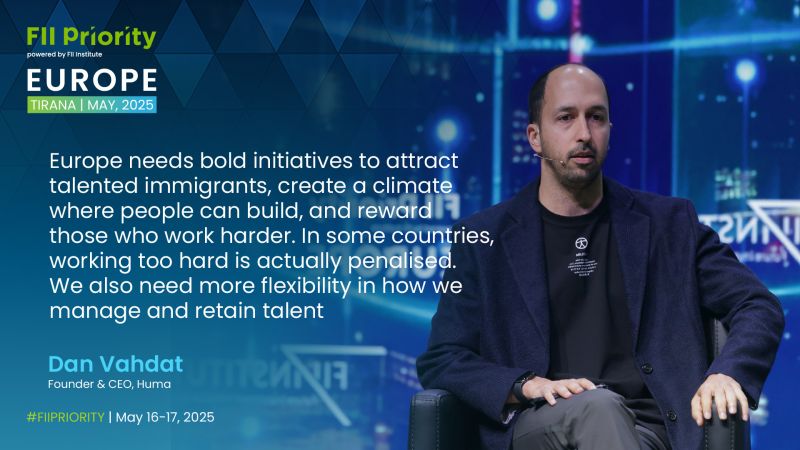
At FII Priority Europe in Tirana in May 2025, Vahdat argued for attracting talented immigrants, creating conditions where people can build, and rewarding hard work. He called for more flexibility in managing and retaining talent. The subject sits close to his own route through countries, universities and the decision to begin again.
A founder’s biography often gives migration the efficiency of an airport departure board. Iran. United States. United Kingdom. The individual has to navigate the spaces between those entries. Institutions decide who can study, who can remain, and which kinds of work offer a viable next step. Talent policy reaches into decisions that can look entirely personal from a distance.
His Tirana remarks broaden the question beyond one company’s recruitment. A country trying to attract builders has to think about what happens after they arrive. Ambition needs somewhere to go. That makes the unfinished degree part of a larger story about permission, opportunity and the places willing to accommodate a change of plan.
Still planting
In March 2026, Vahdat returned to persistence and company culture in a conversation with Dave Allen. He used the image of conversations as seeds: you keep planting, and the result may arrive later. It is a patient description of work that can look fruitless while it is happening. A conversation leaves little visible evidence until someone remembers it.
“Each conversation you have is a little seed you put in the soil.”
Dan Vahdat · March 2026
He also spoke about welcoming unconventional people and learning from mistakes. The combination matters. Giving colleagues room to be themselves asks something of the leader when the result is imperfect. Responsibility involves letting someone act before every possible objection has been resolved. Otherwise, the invitation to lead can quietly turn into a request to wait.
Fifteen years after Huma began, Vahdat’s story still circles the problem of giving people room to build. He wants others to create on the company’s foundation; he wants leaders inside it to own their work. The doctorate remains unfinished. The work he chose in its place has continued to produce new questions, new obligations, and plenty of reasons to get up in the morning.
Continue the conversation
Find Vahdat at Huma, visit the company website, or follow him on LinkedIn, X and Instagram.