A booking arrived, and the office came alive. During tiket.com’s difficult early stretch, the founders watched transaction reports closely enough for a single purchase to become an event. They sometimes telephoned the customer afterward. For Wenas Agusetiawan and his colleagues, the distance between a working website and a working business could be measured in the silence before the next order.
This was the company Wenas helped establish in August 2011 and led as its founding CEO. Travel would eventually bring together much of his earlier experience: software development, consumer applications, and the awkward business of persuading people to try something unfamiliar. But a traveller with a departure date is a rather demanding customer. A clever interface has limited charm if the booking does not go through.
The founding team included Gaery Undarsa, Dimas Surya Yaputra, and Natali Ardianto. Their early offering concentrated on hotels and concerts while they worked toward relationships with transport providers. The ambition was to bring several kinds of booking into one place. The practical question was how to earn enough confidence, one transaction and one partner at a time, to make that ambition useful.
Before departures, databases
Wenas had been dealing with busy websites before tiket.com existed. In October 2009, he appeared on the Indonesian technology podcast TemanMacet to discuss building websites at scale. The episode introduced him through work on Lintas Berita and Kaskus, and through an earlier job at Electronic Arts. Its subject matter was pleasingly unglamorous: database tuning, caching, and the use of analytics to decide what needed attention.
Those are the details that rarely survive a founder biography. They deserve some room here. Caching means keeping useful information ready so a system does not have to repeat the same work for every visitor. Database tuning concerns how quickly the machinery underneath a website can retrieve what it needs. Both reward an interest in how people actually use a product. A page that loads promptly is a small courtesy repeated many times.
Wenas also studied at the British Columbia Institute of Technology in Canada. By early 2010, he was building PhaseDev, or PT Phase Solusindo, with Jeffry Anthony and Dimas. Jeffry served as chief technology officer. The company developed mobile applications and produced several consumer ventures, including WayangForce and Bouncity. Wenas’s route into travel passed through a workshop with several projects on the bench.
- 2009Websites
at scale - 2010PhaseDev
software - 2011Books
& badges - 2011tiket.com
begins
Books, badges, and a BlackBerry
WayangForce put digital books and magazines within reach of readers on different devices. In 2011, Wenas explained the choice to support the iPad, Android, and the web by pointing to publishers’ need for broad access. The web audience mattered too. It was a fairly practical answer to a question that technology businesses sometimes turn into a doctrinal dispute: which device should everyone use? His product made room for several.
Bouncity approached the consumer from another direction. It combined location-based activity with a game: users could complete challenges and collect badges. It launched a BlackBerry application in June 2011. Within its first month, Wenas reported 16,000 users and roughly 325,000 completed activities. Those figures belong to that early period, when Bouncity was still finding its audience, and should be read as a snapshot rather than a lifetime score.
The product also connected to BlackBerry Messenger’s social features. Wenas described the integration as making Bouncity more social and widening its ability to share. A badge could travel through a user’s profile to friends. It was a business built around the phones and habits already in people’s pockets, with something playful attached to a visit to a real place.
In August 2011, a mobile browser version widened access beyond the BlackBerry app. Check-ins and quizzes could be completed through the browser, although some functions remained unavailable there. The compromise is revealing: broaden access, accept some differences between devices, and keep the service usable. Wenas was already working with the everyday constraints that any Indonesian consumer internet business would have to take seriously.
A ticket is a promise
The transition into travel added a different set of relationships. Gaery later described the founders’ frustration with building software for other businesses and their interest in having products of their own. Their proposed travel service would combine flights, rail, hotels, events, and car rental. That breadth was a plan to work toward. At the beginning, persuading airlines to work with an unfamiliar company proved difficult.
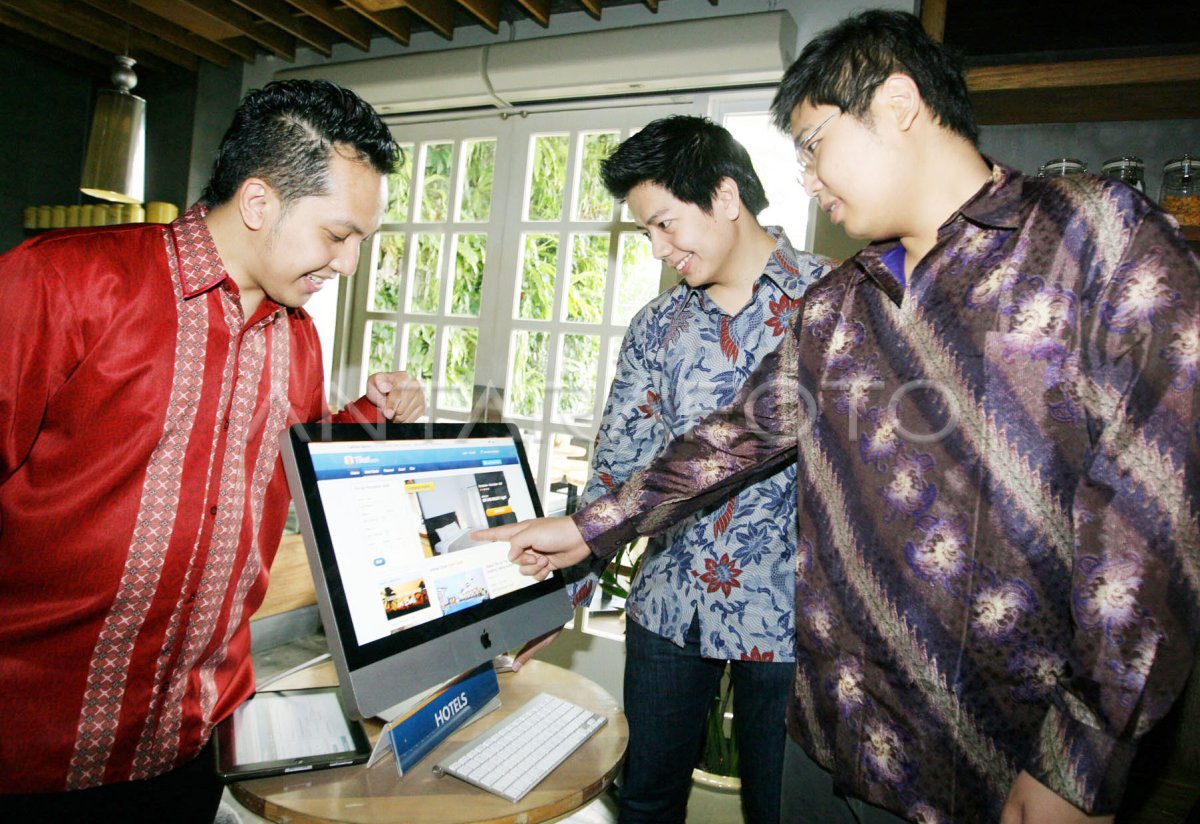
A photograph from the Jakarta launch on 3 May 2012 catches an earlier version of the business in miniature. Wenas stands on the right beside Gaery and Natali, pointing toward a desktop screen. The shirts are patterned, the computer is substantial, and the website is the object of everyone’s attention. There is something endearing about a travel business gathered around a machine that is clearly going nowhere.
The photograph also gives the story its proper scale. Three colleagues examine a product they are bringing into public view. A customer elsewhere will eventually ask it to produce a reservation. Between those two moments sit the supplier relationships, inventory, payment options, and confirmation systems that make a booking service credible. The launch could introduce the company; repeated successful purchases would have to establish it.
Fifteen minutes can be a very long time
Concerts supplied some memorable tests. In a 2013 conversation, Natali recalled selling 6,000 tickets for Big Bang’s October 2012 concert in 15 minutes. Tickets for L’Arc-en-Ciel had moved even faster in another sale: 1,000 in two minutes. These were episodes in the company’s early history, rather than figures for the whole travel business. They showed what happened when a highly motivated audience met an online ticket counter.
Natali also described a service with 14 online payment methods. Many of the young concertgoers did not have credit cards; some purchases appeared under parents’ names. The observation is funny because the behaviour is so recognisable. Admiration for a band can be independent. Paying for the ticket may remain a family project.
For Wenas’s company, such sales brought a concrete test of the original integrated idea. Entertainment belonged beside travel on the same booking platform. A concert could draw people who actively sought out tickets, while ordinary travel still required promotion. The two kinds of demand had different rhythms. A system that served both had to accommodate the sudden rush as well as the quieter, routine purchase.
in 15 minutes
Recalled by co-founder Natali Ardianto in 2013.
The railway changes the rhythm
The company’s own history dates its formal partnership with Kereta Api Indonesia to November 2012. Gaery remembered 2013 as the turning point when online rail booking brought a surge of demand. The partnership and the subsequent growth belong together: access to an established transport service gave an emerging booking company a useful place in an existing journey.
The mechanics mattered. The team had discussed online ticketing with KAI and prepared its own technology to connect with the railway’s system. Integration required work on both sides. For the customer, the result was considerably easier to understand than the engineering: a train journey could be booked online. The founders’ broad ambition had acquired a very specific use.
Tiket.com’s early years also included a startup competition win worth US$25,000. An Android application followed in June 2014. The sequence is useful because it restores the intervals that a success story tends to compress. Founding, launch, partnership, and mobile application were separate steps. Each exposed the business to a new kind of scrutiny. The people who once waited for an order were now building more ways for one to arrive.
A different seat after the acquisition
In June 2017, Blibli’s acquisition brought a change at the top. George Hendrata was introduced as CEO, succeeding Wenas, who had held the position since 2011. It closed the founding CEO chapter without erasing Wenas’s connection to the business. Subsequent accounts identify him with a technology leadership role, and the 2022 Blibli prospectus describes his involvement in tiket.com’s innovation and growth over the preceding decade.
That prospectus also identifies Wenas as an active mentor in the technology startup community. His public participation had begun much earlier. In June 2011, while leading PhaseDev, he spoke at a BINUS University event on technology entrepreneurship. In November 2012, he appeared among speakers at Indonesia’s creative products exhibition. The subjects changed with the setting, from building a business to the opportunities of the digital economy.
By June 2025, coverage of another leadership transition identified Wenas as co-CTO while Dimas moved into the CEO role. The continuation matters more than an inflated title would. His career at tiket.com includes starting it, leading it, and remaining associated with its technology. Those are distinct kinds of work inside a company that had outgrown its first arrangements.
“He has been instrumental on the early days of tiket.com.”
Wenas Agusetiawan, crediting frontend developer Zamroni
The work behind the click
There is a modest personal detail in Wenas’s public endorsement of frontend developer Zamroni: he credits the developer’s contribution during tiket.com’s early days and says he would work with him again. It places another person inside the founding story. Booking websites emerge from teams, including people whose names do not ordinarily appear beside the company logo.
Wenas’s earlier projects help explain why his story is more interesting than a list of travel milestones. The digital reader dealt with access across devices. The game dealt with places and social behaviour. His discussion of large websites dealt with performance. Travel brought these concerns into contact with a customer who needed an actual seat, a room, or entry to a show.
The quiet office at the beginning remains a useful image. An individual booking once deserved a phone call and a burst of attention. Years later, the feature a customer wants most may be the absence of drama: choose a journey, pay, receive the confirmation, get on with the day. Wenas helped build a business around that ordinary expectation. There is quite a lot of work inside an uneventful click.