A plane ticket is a neat little object. A business trip is a less tidy proposition. It has a traveller, a budget, an approving manager and, eventually, somebody trying to make the accounts agree. Edward Nelson Jusuf has spent much of his working life among those less visible arrangements. The flight is the part that moves. The paperwork has ambitions of its own.
Jusuf is the founder and chief executive of Opsigo, the travel technology business established in 2014. Based in Jakarta, he came to the company with a career in corporate travel that included Thomas Cook, Carlson Wagonlit Travel, Travelex, Rosenbluth and FCM. The work brought him close to the operational questions a booking screen tends to conceal: how companies buy travel, how agencies serve them and how the money is controlled.
There is also a smaller vehicle in this biography. Jusuf’s professional record includes MiniSprouts, a garage devoted to classic Minis. Restoration and engine work sit alongside reservations and corporate accounts. The juxtaposition is pleasing. Here is a travel executive whose recorded interests include getting an older, rather compact form of transport into working order.
The bill arrives before the idea
Long before Opsigo, Jusuf was talking about the cost of corporate journeys. In 2003, as president director of Travelex Indonesia, he described business travel as a potentially substantial operating expense for large companies. He argued for corporate travel management that made spending transparent and accountable. The concern was already there: a company needed to understand what it was buying.
That earlier argument matters because it gives his later business a history. Opsigo did not introduce him to corporate travel’s administrative complications. He had been working inside the industry, where a traveller’s request becomes a service obligation and a service obligation becomes an expense. The eventual technology company grew in territory he already knew.
By April 2025, his public comments were still circling the same practical concern. An unsuitable ticket price or a hotel outside the appropriate category could look modest in isolation. Repeated across thousands of employees and many trips, the spending deserved closer attention. His emphasis was on a structured process that companies could follow and examine.
The continuity is more revealing than a dramatic founding legend. There is no need to manufacture an epiphany at an airport gate. The documented story contains a recurring business problem, an executive who kept encountering it and a company organized to deal with more of its parts.
An agency gets its tools
Opsigo began in 2014. The original audience included conventional travel agencies facing customers increasingly accustomed to buying online. An agency could have relationships, knowledge and service experience while still needing a better way to make reservations. Building booking technology from scratch meant another kind of undertaking, with its own costs and risks.
By December 2016, Opsigo’s offer was concrete: agents could process reservations in one system rather than opening airline websites individually. Subscription software gave agencies access to tools they could use without developing an entire booking system themselves. The company reported more than 30 agency customers at the time, including Antavaya, Bayu Buana, Golden Rama and Golden Nusa.
The ticket count supplied an early measure of activity. Opsigo reported 55,000 issued tickets in 2015 and 210,000 in 2016. Those are historical figures, belonging to that stage of the business. Their interest lies in the increased use of an operational tool, a measure much closer to the agency desk than a sweeping prediction about the future of travel.
At the centre of the offer was a fairly human proposition. A travel agent should be able to use the technology customers expected while continuing to do the work customers valued. A booking system could take over repeatable tasks. The agency still had a relationship to maintain.
Three jobs hiding inside one trip
Jusuf’s company now gives separate names to responsibilities that a traveller may experience as one journey. Opsigo supplies agency booking technology. Opsicorp handles corporate travel management. Opsifin addresses the agency’s financial and accounting work. The similar names are a small tongue-twister; the division of labour is useful.
Consider the corporate side. Opsicorp includes travel policies, budgets, allowances and approval processes. A company can work with its preferred travel agency or travel management company and use its own airline fares. These details matter because a business already has purchasing relationships and internal rules. The system has to accommodate those arrangements for its booking choices to be usable.
Approvals also give the trip a sequence. A request needs permission, a booking needs to fit policy and an expense needs to fit the budget. Opsicorp offers multiple approval levels and reporting tools that put these tasks into a common process. The appeal is administrative clarity: people can see where a proposed journey sits before it becomes another bill.
On the agency side, Opsifin carries the transaction further. Its features include automated invoicing, accounting journal entries, financial reporting and connections with banks and tax authorities. Credit limits and reconciliation are part of the same financial territory. Selling a ticket starts a chain of obligations that persists after the passenger has departed.
An invoice is unlikely to inspire a travel poster. It does, however, deserve to match the booking that produced it. That is the sort of unglamorous connection the product suite addresses. The commercial story becomes easier to understand when one follows the work all the way through, past the point where the customer has something to print.
The last few kilometres
Distribution depends on connections outside the company as well. In September 2019, AirAsia announced a partnership that allowed its MyCorporate customers to book through OpsiGo’s online portal and mobile application. Registered agency partners could also access the booking system. For Jusuf, the announcement was about giving agencies and corporations another integrated route to buy AirAsia tickets.
That partnership concerned access to flights. Ground transport offers a more domestic-sounding operational problem: making sure the driver appears. In a testimonial for Trransfer, Jusuf described an increase in airport transfer requests and less time spent by staff calling drivers to check they would arrive.
“Our staff is loving the technology”
Edward Nelson Jusuf, in his Trransfer testimonial
It is a refreshingly specific account of what software can change. The benefit has a recognizable unit: a phone call someone no longer has to make. The airport transfer sits beyond the airline reservation, but it belongs to the same journey. A corporate traveller will experience the connection, or its failure, without much interest in which supplier owns the task.
Data security adds another responsibility. In 2022, Jusuf described the importance of protecting a business tied closely to financial transactions. Opsigo used Microsoft Azure for processing and storing transaction data. He also pointed to the usefulness of integration with corporate customers already using Microsoft’s systems. Compatibility and trust were part of making the service workable.
A map with room on it
By February 2023, Opsigo’s reported monthly transaction value exceeded Rp1 trillion. The number describes transactions moving through its service. It provides a sense of the financial activity the systems were handling at that date, rather than a statement of the company’s revenue. Keeping the description precise makes the operational responsibility more legible.
Monthly transaction value through Opsigo.
Transaction value, not company revenue.
Jusuf’s letter in the company’s 2024 impact report recorded expansion into Singapore and Malaysia. It also set out preparations for the Philippines, Thailand and Vietnam. The distinction between an expansion already reported and a destination being planned is part of the story. A regional ambition still contains work to do.
The same letter described a carbon tracker developed with Jejakin for flight bookings in Opsicorp, with an aspiration to extend calculations to other transport modes. It added another consideration to the booking process: measuring the consequences of a journey alongside managing its cost. That is a stated direction for the business, attached to an existing corporate travel product.
In December 2025, the work brought Jusuf onto a stage at the JW Marriott Hotel Jakarta for Opsigo Lumina. He joined Evalany of Antavaya and M. Indharto of Patra Jasa in a discussion about collaboration and travel digitalization, moderated by Vitri Zulianti of Synergy MDI. The participants placed an agency, a corporate travel stakeholder and the technology provider in the same conversation.
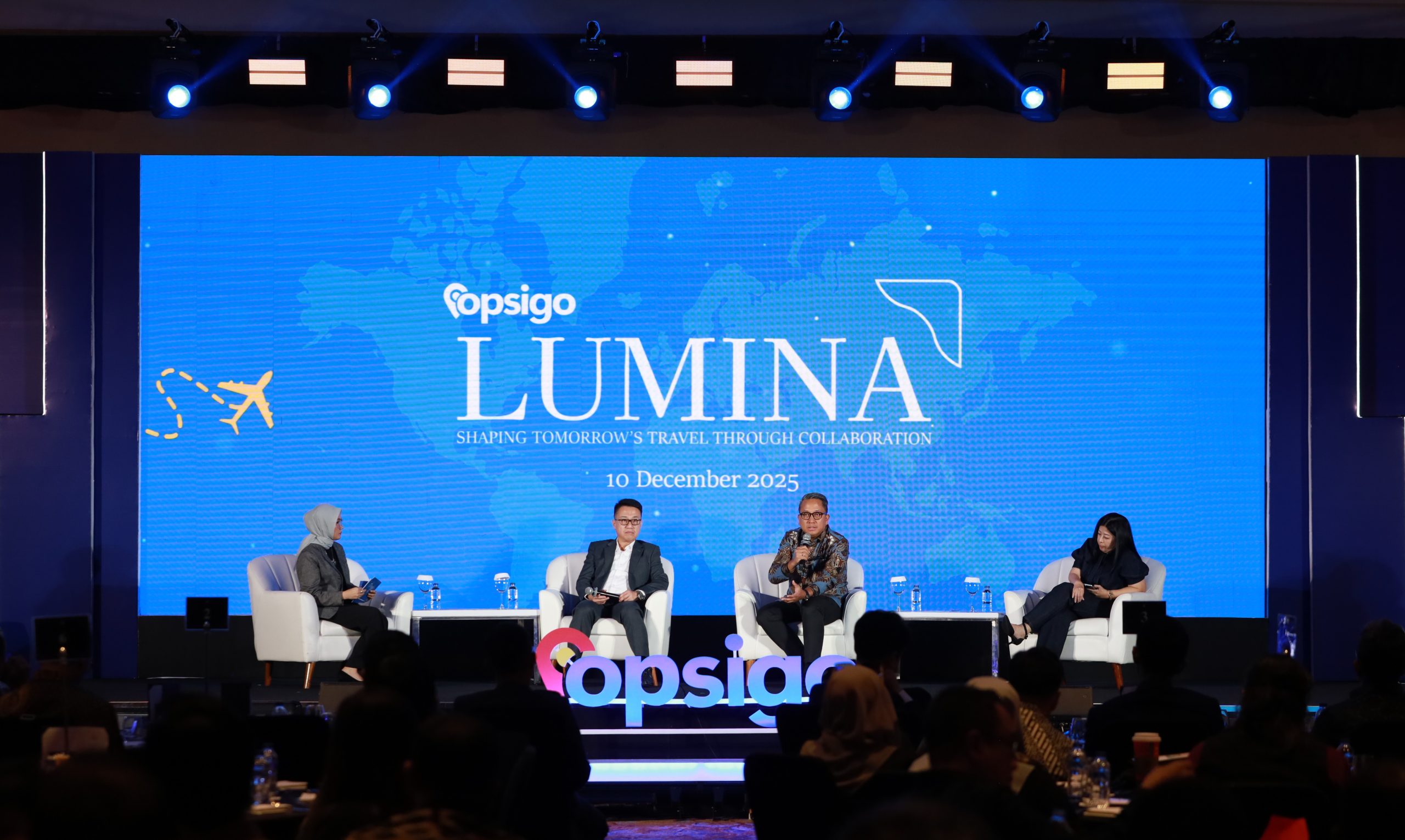
It was a fitting setting for a company built between organizations. An agency brings one set of requirements; a corporation brings another. The technology has to make their dealings manageable. The people in the room remain part of that undertaking, however much of the repetitive work a system can carry.
A small car enters the picture
The classic Minis provide a final change of scale. Jusuf lists ownership of MiniSprouts from 2010 and a term as president of Jakarta Morris Club from 2007 to 2013. The garage’s recorded services include restoration, engine overhauls, modifications and engine swaps. These are concrete interests, with parts and practical consequences.
The juxtaposition should stay modest. A garage does not explain every business decision, and a classic car need not become a philosophy of entrepreneurship. It gives the portrait something more particular: alongside a career organizing corporate journeys, Jusuf has recorded a business concerned with keeping small, older cars going.
There is a pleasing mechanical vocabulary across the two subjects. Systems need connections. Changes have consequences elsewhere. Useful work often happens out of sight. In Jusuf’s business, those observations return to the bookings, permissions and financial records that allow another person to get on with a trip.
His career has stayed close to that backstage work. The traveller gets a destination. The agency gets a reservation. The company gets an account of what happened. Making those parts agree is a substantial enough undertaking, even when the final result looks wonderfully ordinary: somebody arrives, and the bill makes sense.