A financial model can be beautifully arranged and still misunderstand the business it describes. Dane Putranto was writing about that problem in 2017. Among his examples was a hotel: a business where occupancy matters. Years later, as co-founder and CEO of Kozystay, he would be responsible for rather more than the cells containing that number. Someone also has to prepare the room.
There is a pleasing circularity to this career. Before he ran a hospitality company, Putranto explained how to think about companies. He published advice on financial modelling, helped other businesses interpret their numbers, and argued for knowing the industry behind a calculation. Today, his work sits where an owner's investment meets a guest's everyday expectations. The spreadsheet has acquired a front door.
A hotel appeared in the spreadsheet
Putranto studied finance and management at the State University of New York at Albany, graduating in 2010. His career subsequently included valuation and financial model consulting at Deloitte. He also co-founded Numarus, which built tailored financial models and business intelligence tools. Before Kozystay, he was already working on the machinery of business decisions: turning information into something a person could use.
In November 2017, he published an essay called The 3 Pillars of Financial Modelling. The pillars were modelling skills, accounting, and industry knowledge. The last category gave the argument its bite. A model copied from one industry into another could be misleading, however tidy its formatting. A hotel might watch occupancy; a manufacturer might concentrate on working capital. Knowing Excel did not excuse misunderstanding the enterprise.
It is a practical argument with consequences beyond consulting. If the wrong variables drive a model, an impressive answer can arrive attached to the wrong question. Putranto urged modellers to investigate the business first. That advice supplies a useful way to read his later career: learn what actually makes a property work before asking how many more properties a company can manage.
Please spare the next person your formulas
By March 2018, Putranto was writing about transparency. A good financial model, he argued, should let another person understand its mechanism. He described familiar office predicaments: the developer leaves, or a sceptical boss wants each formula explained. An elaborate workbook then becomes someone else's afternoon.
His remedy was simplicity. Shorten tangled formulas. Arrange calculations so a reader can follow them. Avoid making a compact sheet so cryptic that its apparent neatness creates extra work. The concern running through the essay is the person who has to use what somebody else has built. Technical ability matters, but so does the courtesy of making the result comprehensible.
In another essay, published in April, he considered financial models as a means of communication between startup founders and investors. A founder's strategy needs translation into assumptions, forecasts, and cash requirements. A readable model lets the conversation move beyond enthusiasm. It also forces the entrepreneur to ask whether the plan and the available money can coexist.
These were written arguments, rather than motivational slogans pinned above a desk. Putranto also published a project finance model for a toll road with a 30-year concession. It considered construction, operations, debt, and cash flows over time. The horizon is a useful counterweight to the romance of a launch: infrastructure has to keep working well after the announcement.
“Transparency should drive structure”
Dane Putranto, writing on financial models in 2018
The apartment already existed
Kozystay grew from an observation Putranto shared with co-founder Frans Winarto: Indonesia had underused apartments and travellers looking for professionally managed accommodation. The company's approach was to bring existing properties into the rental market and take responsibility for the work of hosting. An empty apartment could become useful without first becoming a new building.
That proposition contains two customers. An owner wants a property to perform and remain well maintained. A guest wants a place that delivers what the booking promised. Between those interests sits an operator, handling prices, arrivals, cleaning, and the practical consequences of somebody staying somewhere unfamiliar.
The early pace was modest: Kozystay took two years to sign its first 25 units. The number gives the story a scale a person can picture. Twenty-five properties are enough to expose the difference between a repeatable process and a habit that works only when someone remembers to intervene.
The company's profit-sharing arrangement with owners also matters. Both parties participate in property-level profit, rather than Kozystay simply committing to fixed long-term rent. As a business design, it makes the property's operating results central to the relationship. The finance background has found something tangible to organise.
A small beginning for a business built around repeatable property operations.
A signature, then the work
In October 2023, Putranto confirmed seed investment from Cercano Management. The amount was undisclosed. The same month, he signed a cooperation agreement with PT Prospek Duta Sukses, the developer of Antasari Place in South Jakarta. The arrangement gave apartment owners a route to rental management through Kozystay.
At the signing, Putranto described an ambition to improve owners' investment results while keeping their properties cared for. That pairing is revealing. A rental yield belongs on a financial statement; the condition of a home belongs in a resident's experience. A property manager is accountable for the connection between them.
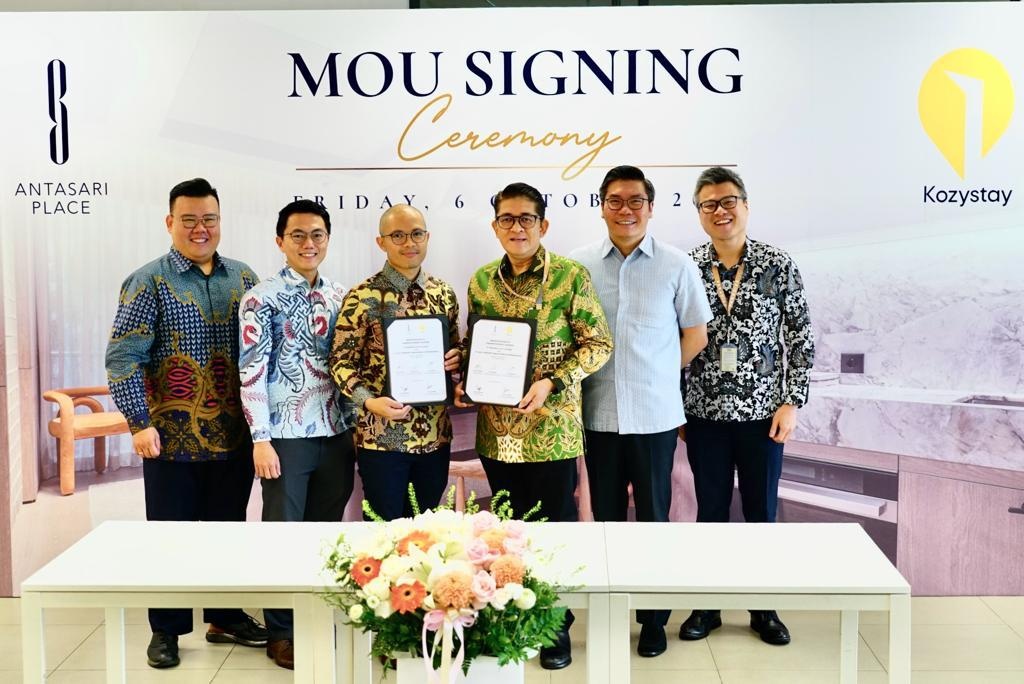
The ceremony photograph has the familiar furniture of a business milestone: documents, a backdrop, flowers, and people smiling together. Its importance lies in what follows. Agreements turn a founder's proposition into responsibilities shared with another organisation. The promise has an address, an owner, and a set of expectations that will outlast the photograph.
More keys, more people to please
In August 2025, Kozystay announced a Series A backed by Integra Partners, Cercano Management, and Intudo Ventures. Its plans included expanding the managed portfolio and reaching additional Indonesian destinations. Jakarta, Bali, and Bandung were part of the growth story; Surabaya, Bogor, and Lombok appeared in expansion plans. Those plans described future intentions, rather than proof that each new market was already operating.
Putranto and Winarto also presented at Integra's 2025 Investor Day. A founder presentation is a different kind of hospitality: the visitors want to understand the business, rather than check into it. Here, Putranto's earlier interest in communicating with investors had an obvious setting.
The BaliSuperHost partnership added another dimension. Announced in August 2025, it brought together a combined portfolio of more than 1,000 properties. BaliSuperHost contributed experience managing villas, while Kozystay contributed its technology and management systems. Putranto spoke about improving efficiency through technology. The partnership's stated ambitions extended from Indonesia toward regional and eventually global expansion.
Bringing businesses together raises an ordinary but demanding question: which methods travel well? Software can be shared, but a villa operation also depends on people who understand the properties. The stated rationale recognised both. For a founder with a background in modelling, it is an unusually physical version of integrating two systems.
Room to live in Menteng
Another 2025 collaboration, with Toda Group, brought Kozystay to Menteng Eksekutif Apartment in Jakarta. More than 100 apartments were to become Rasamala & Cendana at Menteng. The accommodation included kitchens, washing machines, and balconies. These details make the proposition legible without a pitch deck. A washing machine starts to matter when a trip lasts longer than the clothes in a suitcase.
Putranto described the project as joining the comfort of home with technology and hotel service. The appeal rests on habits people carry with them: preparing food, unpacking, finding somewhere to sit. Longer stays make those habits harder to ignore. A room may be beautifully photographed and still leave its occupant wondering where dinner is supposed to happen.
By June 2026, the Cendana Tower renovation was being described in terms of preserving its original spacious layouts while updating the interiors. Putranto spoke about guests wanting room to live, beyond somewhere to sleep. The project makes a specific case for improving older accommodation while keeping the qualities that give it residential character.
The next door opens in South Jakarta
In April 2026, Astra Land Indonesia announced a partnership with Kozystay at Arumaya Residences. The plan combined rental management with digital locks for self check-in, centralised reservations, and dynamic pricing. Operations were scheduled to begin in the second quarter of 2026. The announcement supplied a concrete next step for Putranto's company, and another developer relationship.
Each of those tools addresses a recognisable task. A lock helps an arriving guest enter. A reservation system organises availability. Pricing responds to demand. Their usefulness is easier to judge at the property than in the abstract: does the guest get in, and does the operator know what has been booked?
Putranto's career has moved from advising on decisions to living with their consequences across a property business. His early essays make an apt companion to that work. Understand the industry. Make the workings clear. Give other people something they can use. In hospitality, those ideas meet a particularly brisk examiner: a guest standing outside the door, ready to begin a stay.