Adrianus Hitijahubessy had already found work for his idea. In emerging markets, he was building artificial intelligence tools to help assess borrowers. The technology had a purpose, the work had customers, and the countries being served were far from the country where he was born. Then a different question intruded: why was he doing this for everyone else?
In 2017, explaining the origins of JULO, he said he had come to believe “I should be helping people in my home country”. He had lived abroad for 20 years. In 2016, he returned to Indonesia. A career built around calculating other people's risks had acquired a decision of its own.
There is a pleasing lack of theatrical equipment in this origin story. No borrowed garage mythology is required. The ingredients were professional experience, a country with unmet demand for credit, and a founder willing to move. Adrianus joined Hans Sebastian and Victor Darmadi to build JULO, established in late 2016. The Android lending app followed in 2017.
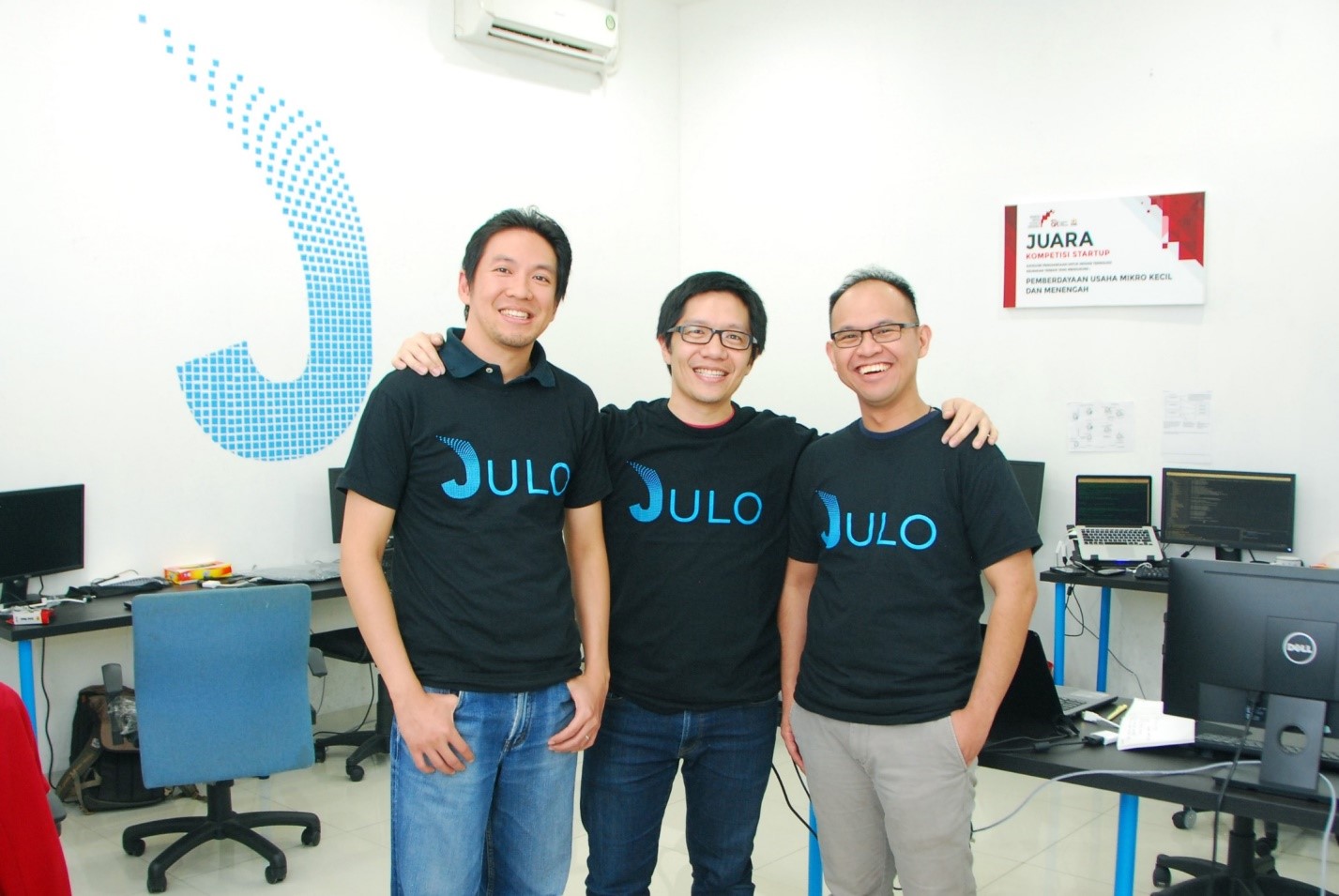
An early photograph catches the three founders shoulder to shoulder in matching company T-shirts. Adrianus stands in the middle, smiling, with computer screens behind him. The room looks like somewhere work happens. For a business whose difficult part takes place inside statistical models, it is a useful reminder that someone still has to sit down at the desk.
A mechanical engineer learns about money
Born in Pekanbaru, Adrianus studied at Victoria Junior College in Singapore before earning bachelor's and master's degrees in mechanical engineering at the University of Texas at Austin. His master's training included mechatronics. The route toward consumer lending began with an education in systems, rather than a degree bearing the word finance.
His professional itinerary then becomes unusually legible. Capital One, from 2006 to 2012, supplied the banking chapter. His public career history includes service operations, recoveries and collections, followed by customer analytics, risk analytics and risk management. Lending comes with an aftermath; those jobs placed him close to it.
At eBay, between 2012 and 2014, he worked in business and product analytics in the San Francisco Bay Area. Experimentation and product measurement entered the picture. The financial customer and the online customer were now parts of the same career, even before they became parts of the same application.
Cignifi brought the strands together. Adrianus worked in product and risk analytics and became head of product, dealing with credit scoring and marketplace lending. His LinkedIn dates that chapter to 2014-2016 and lists work connected with the Philippines, Mexico and Africa. He had encountered the problem of evaluating borrowers in several markets before bringing it back to Indonesia.
Read in that order, the job changes look less like a collection of fashionable employers than an accumulation of tools. Collections asks what happens after money leaves. Product analytics asks how people behave. Credit scoring asks what that behavior can tell a lender before money leaves. JULO would need all three questions answered.
- 2006Capital One
Operations & risk - 2012eBay
Product analytics - 2014Cignifi
Credit scoring - 2016Indonesia
JULO begins
The missing connection
Adrianus's early explanation of JULO was almost embarrassingly practical. Indonesia had people who needed credit and people willing to supply it. What he saw missing was a connection between them. The app was meant to make that connection possible, with technology helping decide which applications could responsibly proceed.
By the end of 2018, JULO reported a million Google Play downloads. In its third year, it announced 100,000 disbursements. Downloads and loans are different measures, and the distinction matters: opening the door is only the beginning. Lending requires a decision about the person who has walked through it.
The early financing rounds gave the founders resources to develop that machinery. A $5 million Series A was announced in May 2018, led by Skystar Capital and East Ventures. Adrianus described plans for additional products, nationwide expansion, and continued work on technology and analytics. The ambitions combined distribution with the less photogenic business of improving decisions.
In September 2019, JULO announced a further $10 million Series A extension led by Quona Capital. The stated use included improving its proprietary credit-scoring technology. Ganesh Rengaswamy of Quona, Abraham Hidayat of Skystar, Willson Cuaca of East Ventures and Adrian Li of Convergence were among the investors publicly discussing the company. Adrianus's return had become a venture supported by a wider circle.
A, B and C are doing rather a lot of work
In a 2023 conversation with Adrian Li and podcast host Leighton Cosseboom, Adrianus explained lending through three scores. A concerns the application. B concerns behavior after a customer receives a limit. C concerns collection strategy. It is a compact alphabet for a relationship that continues well beyond the first approval.
He also described a limitation of simply testing borrowers with small loans. Repaying a $50 loan does not necessarily predict how someone will handle $500 or $1,000. The amount changes the problem. JULO's approach invests in information before making a lending decision, rather than treating each small repayment as an automatic invitation to lend much more.
The point is easy to lose behind the glamour of artificial intelligence. A model must inform a specific decision about a specific sum. The useful question is whether the decision holds up when the circumstances change. A clever prediction, on its own, has yet to pay a bill.
In February 2022, Adrianus described JULO's use of big data, machine learning and Indonesia's Fintech Data Centre to evaluate applications and check credit histories. He emphasized verification at the beginning of the process. The work of keeping a loan portfolio manageable started with selecting the customers it approved.
That emphasis gives his engineering background a visible place in the story. JULO's proposition depends on a working system of assessment, verification and follow-through. The friendly interface is what a customer sees. The founder's public explanations repeatedly return to what has to function behind it.
Adrianus’s explanation, 2023. A framework, not a description of every current model input.
An umbrella with a credit limit
JULO introduced its digital credit product in 2021. The change expanded the uses of its app beyond a cash loan: customers could make payments, transfer funds and handle other transactions through a credit facility. Its pay-later functionality became available in June that year. The product was becoming more useful across different kinds of spending.
Adrianus's description of reusable credit in 2023 reached for a familiar Indonesian saying: “Prepare the umbrella before it rains.” Customers could have a credit limit available ahead of a need, instead of starting the relationship anew each time. In that conversation, he said retention had risen from percentages in the mid-teens to around the mid-sixties after the revolving product launched.
Those are his reported figures, describing that period. Their significance lies in the product change they accompany. A lender offering one transaction must keep finding the next transaction. A reusable facility offers a reason to maintain the relationship. An umbrella, after all, is a rather poor subscription if it must be ordered after every cloud appears.
Education gave the broader product a concrete task. In June 2023, JULO launched a feature for paying education expenses through the customer's existing digital credit limit. Its announced coverage included schools, universities and online courses across Indonesia. A tuition payment became something the product was explicitly designed to accommodate.
Two customers in that announcement supplied different reasons for welcoming it. Yuyus valued a feature focused on his child's education. Dedi said ordinary cash loans could be diverted to other spending, allowing school fees to slip down the list. The appeal lay partly in directing money toward an intended purpose, a small design choice with an ordinary household consequence.
“Prepare the umbrella
before it rains.”Adrianus Hitijahubessy, 2023
Building with the banks
Adrianus has also been clear about the institutions around him. During a 2022 Helicap webinar, he said “we never see banks as the competitors.” His argument was that collaboration between banks and fintech lenders would shape the market. That position leaves room for the expertise and capital of established finance within the founder's ambitions.
The financing announced with Credit Saison in April 2022 made the distinction tangible. The $80 million package combined $30 million in equity with $50 million in debt. One supported the company; the other supported lending. Treating the whole amount as an ordinary venture equity cheque would miss how the arrangement worked.
At the time, Adrianus said 72% of JULO's loans were used for purposes including business capital, home renovation and education. His stated ambition was to reach more underserved people through the partnership. The examples were conspicuously everyday: stock for a business, repairs to a home, money for learning. A financial inclusion pitch eventually has to arrive somewhere a person can recognize.
His involvement extended beyond his own company. Startup Studio Indonesia lists Adrianus as a coach, and the government's 2023 mentor roster includes him as JULO's founder. It is another setting for the experience he brought home: helping other founders work through the problems of building a business.
Credit Saison financing. The package included both forms of capital.
The return keeps getting bigger
By December 2023, JULO reported reaching operating profit breakeven. It also reported $454 million in loan disbursements during that year and 50% growth in disbursement volume. These were company milestones reached by a team, rather than personal trophies. They added an operating test to the original argument for the business.
In March 2025, Adrianus discussed JULO's arrival on iOS, describing an opportunity to reach a broader segment of Indonesian users. An undertaking that began with an Android app was extending its distribution. The mechanics of access still mattered, even after the credit product had become more elaborate.
The scale had changed again by July 2026. JULO reported cumulative financing exceeding Rp28 trillion, more than 3.3 million users and a presence across all 38 Indonesian provinces. Within that total, it identified Rp6.3 trillion used for business capital and Rp1.89 trillion for education. The numbers give specific dimensions to the uses Adrianus had discussed years earlier.
The current leadership structure also has distinct layers. Adrianus remains publicly identified as JULO's CEO and co-founder on LinkedIn; PT Julo Teknologi Finansial's leadership page lists him as a commissioner and Harri Suhendra as president director. The operating company's governance and the founder's public role both belong in the picture.
His story began with a change in geography. Its continuing subject is the quality of a connection: between a borrower and a lender, between a decision and its consequences, between experience earned abroad and work done at home. The original question was personal. The answer now has millions of people on the other side of it.