The red Honda Jazz was supposed to be the pleasure of Martin Reyhan Suryohusodo’s school years. He liked modifying it. He changed components, visited workshops and became acquainted with the particular uncertainty that accompanies a car enthusiast’s bill. By his own account, the car spent more time in workshops than on the road. A hobby had acquired a rather inconvenient address.
He could love the car and dislike the business of looking after it. In a repair shop, enthusiasm does not necessarily buy you information. You may know what you want your car to look like and still have little way of judging whether a part is genuine or a price reasonable. Martin’s frustration would eventually become the starting point for Otoklix, the Indonesian automotive services company he co-founded in 2019.
The interesting part is what happened between the irritation and the company. Martin studied commerce, worked in consulting, recruited a childhood friend and went looking for workshop owners who would take a chance on an unfamiliar proposition. The idea travelled through ordinary doors before it appeared on investors’ screens.
A family of founders, a student of numbers
Born in Surabaya on June 11, 1997, Martin grew up there before studying in Australia. Business was familiar territory at home. His father started a company in his early twenties; his aunts and uncles were entrepreneurs too. He has described that family background as an early reason for wanting to build something of his own, although automotive services were hardly a childhood career plan.
At the University of Melbourne, he took a Bachelor of Commerce in accounting and finance, studying from 2015 to 2018. His route into the garage therefore came through balance sheets rather than an engineering degree. During his student years he also worked in digital marketing at Catch.com.au, the Australian ecommerce business.
After university he joined EY-Parthenon in Jakarta. His consulting work ran from October 2018 to August 2019. That put him close to the Indonesian technology business and the ways startups were connecting online discovery with services delivered in the physical world. His old dissatisfaction with workshops now had a possible business model attached.
Cars made the gap particularly conspicuous. You could put the booking on a screen, but somebody still had to source the part, inspect the vehicle and perform the work. For Martin, that connection between the digital promise and the physical transaction became the company’s subject.
Three founders, three kinds of knowledge
Joseph Alexander Ananto was a childhood friend with an engineering background and experience in American manufacturing. When Martin wanted to build a company, he could begin with somebody whose interest in entrepreneurship he already knew. Joseph brought Benny Sutedjo into the conversation. Benny had spent more than fifteen years in automotive businesses, including spare-parts distribution, sales and car insurance.
It was a useful distribution of experience: a consultant, an engineer and somebody who knew the trade. A customer’s bad workshop visit can reveal a problem; it cannot teach everything about stocking parts or dealing with suppliers. Otoklix had to work for businesses already doing those things every day.
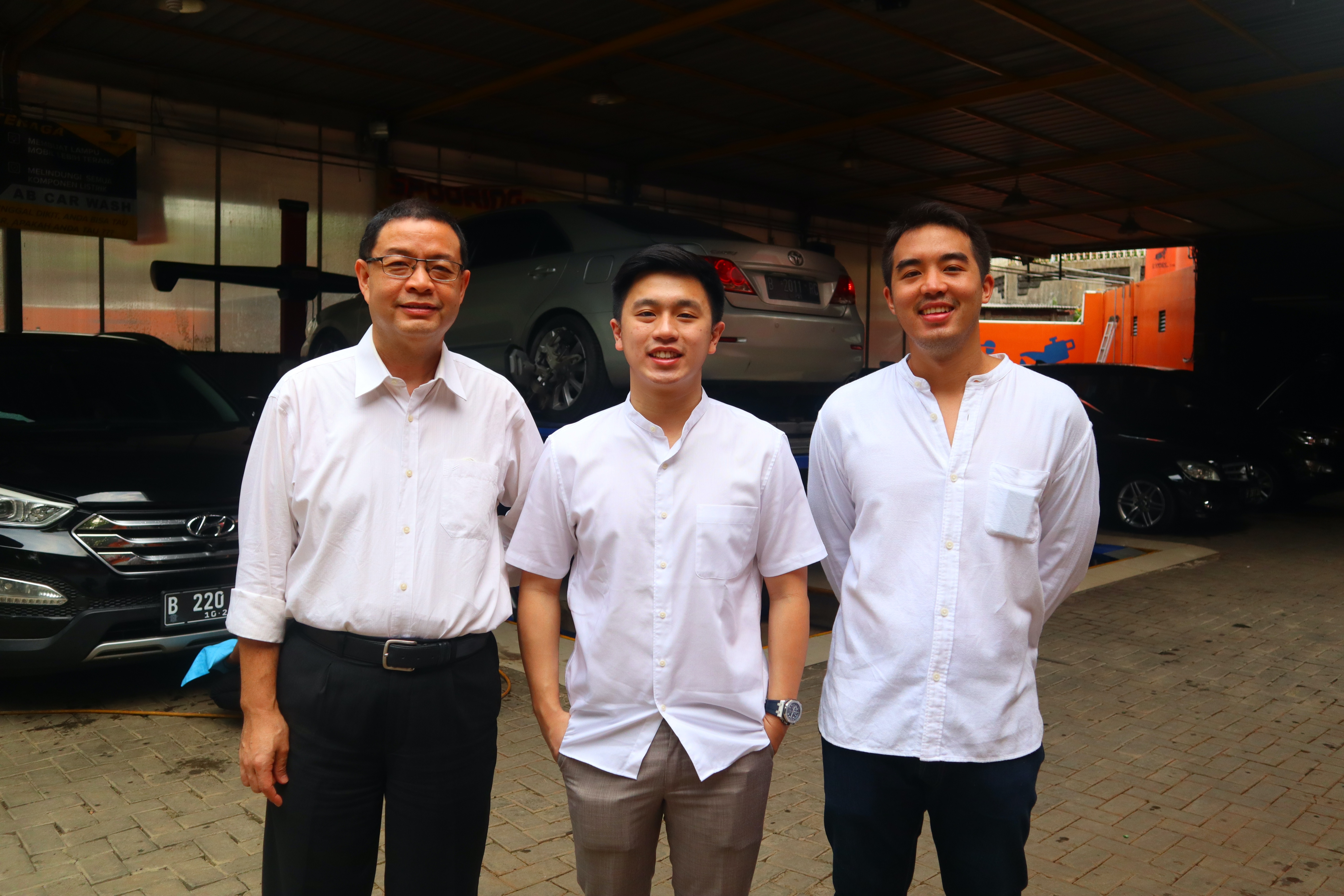
Joseph had his own reason to appreciate an independent mechanic. After an expensive diagnosis for his BMW, he found a specialist who identified a much narrower repair: a water pump. The experience gave him an appreciation for capable mechanics outside the authorized-dealer system. He later discussed the opportunity with Martin over drinks during a visit home.
That second perspective matters. The founders’ experiences pointed both to disappointing transactions and to good technicians who deserved to be easier to find. A network would need to give customers grounds for confidence while giving workshops a reason to join.
The consultant who looked like an insurance agent
Early on, Martin went to workshops himself. He still dressed as somebody coming from consulting, and owners sometimes mistook him for an insurance agent. It is a small, excellent indignity: having a proposition about the future of an industry does not guarantee that anyone recognizes your job.
He described his role as “Chief Everything Officer.” Before the application was built, he used word of mouth to bring customers to participating workshops. The point was to make the benefit visible. A workshop owner could examine actual business arriving through the relationship before being asked to believe in an online platform.
One recruitment effort involved repeated drives between Jakarta and Cibitung. Martin said he kept visiting a reluctant owner daily for about a month before the owner agreed to join. The application began being built in December 2019. For this founder, the first stage of digitization included a considerable amount of driving.
Those early visits give the later network figures some texture. Every partnership contains a person deciding whether the promised customers, parts or systems are worth the trouble of changing an existing routine.
The price depends on the part
In explaining Otoklix’s model, Martin has separated workshop service from spare-parts procurement. His workshop visits showed him that both needed attention. An unclear bill was one problem. The path a component took to reach the mechanic was another, involving intermediaries, sourcing costs and uncertain demand.
He has said Otoklix initially concentrated on spare parts before developing into a broader platform that helped owners find nearby workshops. That order is revealing. Making a service easier to book leaves much of its cost untouched if the workshop is still buying through the same expensive chain.
The customer side offered booking, standardized prices, repair histories and warranties. The workshop side offered software for customer relationships and supply-chain management, alongside access to parts ordered through Otoklix. Both sides belonged to the same transaction. A saving or a mistake upstream could find its way into the final invoice.
See a price
Book a service
Source parts
Carry out repairs
Otoklix works on the connection between the two.
This is where Martin’s original complaint became more demanding. Publishing a price requires deciding what it includes. Promising a part requires having a route to obtain it. Providing a warranty requires accepting a relationship that continues after the customer drives away.
An award is a short-term milestone
In December 2020, Otoklix announced a $2 million financing led by Sequoia Capital India’s Surge program. The following year, Martin and Joseph appeared in Forbes’ 30 Under 30 Asia list in Industry, Manufacturing & Energy. Martin also received recognition in Forbes Indonesia’s 30 Under 30.
His response to his old school’s questions about the recognition was measured. He was pleased, but aware that it brought greater expectations. He wanted to keep his attention on the long-term objective: making Otoklix the name people associated with automotive services in Southeast Asia.
“I want to continue to look into the long-term goal”Martin, reflecting on his Forbes recognition
In December 2021, a $10 million Series A followed, co-led by Alpha JWC Ventures and AC Ventures. Participants included Surge, former Astra International CEO Prijono Sugiarto, YouTube co-founder Steve Chen and Google executives in XA Network. The company said it had more than 1,900 partner workshops and served over 100,000 customers annually.
Those were dated measures of a business taking shape. The financing also supported plans for company-managed flagship workshops. Owning a service location made the physical side of the model more direct: the company could be responsible for the place where its promise met the customer’s car.
A new engine changes the homework
Electric vehicles introduced a fresh set of workshop requirements. In February 2023, Otoklix signed an after-sales agreement with Segway Motors Indonesia. For Martin, the challenge included making sure technicians could handle electric motorcycles and their different mechanical systems.
By his June 2024 discussion of the VinFast relationship, training had become a substantial part of the story. Otoklix had launched an academy for mechanics learning EV service. Martin emphasized software and electrical components as well as familiar work such as brakes and tires. In that account, the VinFast arrangement was then limited to Otoklix’s proprietary outlets.
His thinking about the next decade included sourcing more affordable components through manufacturing partners, rather than making them inside Otoklix. He also expected gasoline vehicles and hybrids to coexist with EVs. A workshop business has to prepare for the vehicles customers bring through the door, including the ones that refuse to fit a tidy forecast.
The same practical attention had appeared in fleet services. In August 2023, Otoklix for Business offered a fourteen-day workmanship warranty to companies maintaining operational vehicles. Martin pointed to the cost and extra work created by repeated repairs. Trust had acquired a deadline and a return policy.
Forty appointed, another 110 planned
On April 11, 2025, VinFast announced an expanded service agreement with Otoklix. It said forty workshops had already been appointed that month, with another 110 planned. Otoklix would distribute genuine parts and provide maintenance, repairs and warranty work; VinFast would contribute training and technical support.
150 was the intended total under the agreement. The announcement distinguished appointments from plans.
In June 2025, Martin represented Otoklix at the signing of an agreement with NETA in Simprug, Jakarta. The arrangement covered service access, parts availability and maintenance according to NETA’s technical protocols. He discussed helping customers locate verified workshops, particularly in provincial capitals.
In July, DFSK and SERES announced that selected Otoklix locations would become authorized workshops, initially including Depok, Simprug, Ciputat and Daan Mogot. Certified technicians and genuine parts were part of the arrangement. The independent-workshop platform was now also building relationships with vehicle manufacturers.
There is still a car at the end of it
Martin’s recollections of school offer a less corporate picture. He remembers practicing daily with his basketball teammates and reaching the final four. He misses camping: cooking proper food without canned shortcuts, sleeping in tents and remembering the uncomfortable rocks beneath them. The memories are about doing things with other people, including the inconvenient bits.
That is an apt place to leave a founder whose early sales work involved explaining himself in garages. Otoklix’s ambitions stretch across an industry, but the original question remains close to one owner and one bill. Can the person paying understand what is being done, what it costs and who will answer if it goes wrong?
The red Jazz helped Martin ask that question. Years later, with manufacturer agreements and mechanic training added to the business, it still gives his work a recognizable purpose. Someone wants to enjoy driving a car. A workshop visit ought to help.