The hinge in Larry Ridwan's career was a fish that needed to stay frozen. During the first year of the pandemic, after two decades spent around bank portfolios, broadband networks, balance sheets and base stations, Ridwan tried selling fish from his family's cold-storage business. Demand could travel online in an instant. The product could not. Jakarta's familiar motorcycle couriers were quick, nimble and plentiful, but a motorbike is a poor substitute for a freezer. Instant delivery over distance was expensive; temperature was an unforgiving clock. What looked like a simple ecommerce sale exposed an awkward piece of national infrastructure.
Ridwan had been thinking about starting a company before Covid-19 arrived. The failed elegance of that transaction gave the ambition a shape. His proposed fix was not another delivery app. Inventory should sit closer to the buyer, inside small cold-chain fulfillment centers distributed across the city. He imagined them roughly every eight kilometers: near enough to reduce time, cost and risk, yet shared by enough businesses to make sophisticated storage and fulfillment practical.
Fresh Factory began in 2020 and became fully operational in 2021. Its work is deliberately unphotogenic: receive goods, verify temperature, store them, pick an order, pack it, move it, document the handover, reconcile the inventory, and do it again before anything thaws. It is a company built around the least forgiving fact in logistics. Heat does not accept apologies.
01 · The originAmbon in the rear-view mirror
The idea also reached back to Ridwan's birthplace. Ambon, in eastern Indonesia, is closely tied to fisheries, and his family had cold storage for fish. That connection mattered when he encountered the last-mile problem as a would-be online seller. He did not have to imagine the value of temperature control. He could see where it stopped.
Indonesia makes the puzzle unusually sharp. It is tropical, geographically dispersed and home to producers and consumers separated by water, traffic and uneven infrastructure. In large cities, households are getting smaller while demand for convenient, protein-rich and ready-to-cook food grows. A frozen product may have an eager buyer and a perfectly good warehouse, yet fail in the distance between them. Ridwan's insight was to change the geometry.
A conventional cold warehouse often sits outside the dense urban core and wins through scale. Fresh Factory's model distributes capacity closer to demand and coordinates it with warehouse management software, transport, order systems and sensors. Ridwan calls the incumbents' model a mid-mile, asset-centered play. His network concentrates on the last mile and can complement those larger facilities. The warehouse becomes less a fortress and more a node.
“The vision was to establish decentralized hyperlocal centers, located approximately every 8 kilometers, where businesses could store their inventory.”Larry Ridwan
02 · The apprenticeshipA career made of systems
The frozen-food leap looks less eccentric when Ridwan's earlier work is read as one long education in systems. He graduated cum laude in management information systems from Ohio State in 2001. While in the United States, he managed a McDonald's and worked at the university as a Java and COBOL consultant. One job dealt in queues, consistency and rush hours; the other in logic. Both turned out to be useful preparation for operations.
Back in Indonesia, he joined Citi and moved through management training, card-business planning, product management, portfolio leadership and the mass-market segment. Those roles taught a quantitative language of cohorts, margins and behavior at scale. He then became finance chief at First Media, where the numbers sat beneath cables, broadband and capital expenditure.
Telecom pulled him closer to the network itself. At PT Internux, operator of BOLT!, he served as chief commercial officer during a period when the 4G brand launched a smartphone and reached one million users in a year. From 2016 to 2020, he led Net1, a telecom operator with a particular interest in connecting harder-to-reach parts of Indonesia. Coverage maps, distributed infrastructure, unit economics and service reliability were daily concerns. Fresh Factory would ask many of the same questions, only with pallets and compressors.
His public motto is Acta non verba: deeds, not words. It could sound severe, but Ridwan's own founder bio softens it with domestic pride. He describes himself as the father of three “impressive kids” and the husband of one “very supporting wife.” The phrasing is wry and specific. A man may spend his day optimizing warehouses and still count his finest portfolio at the dinner table.
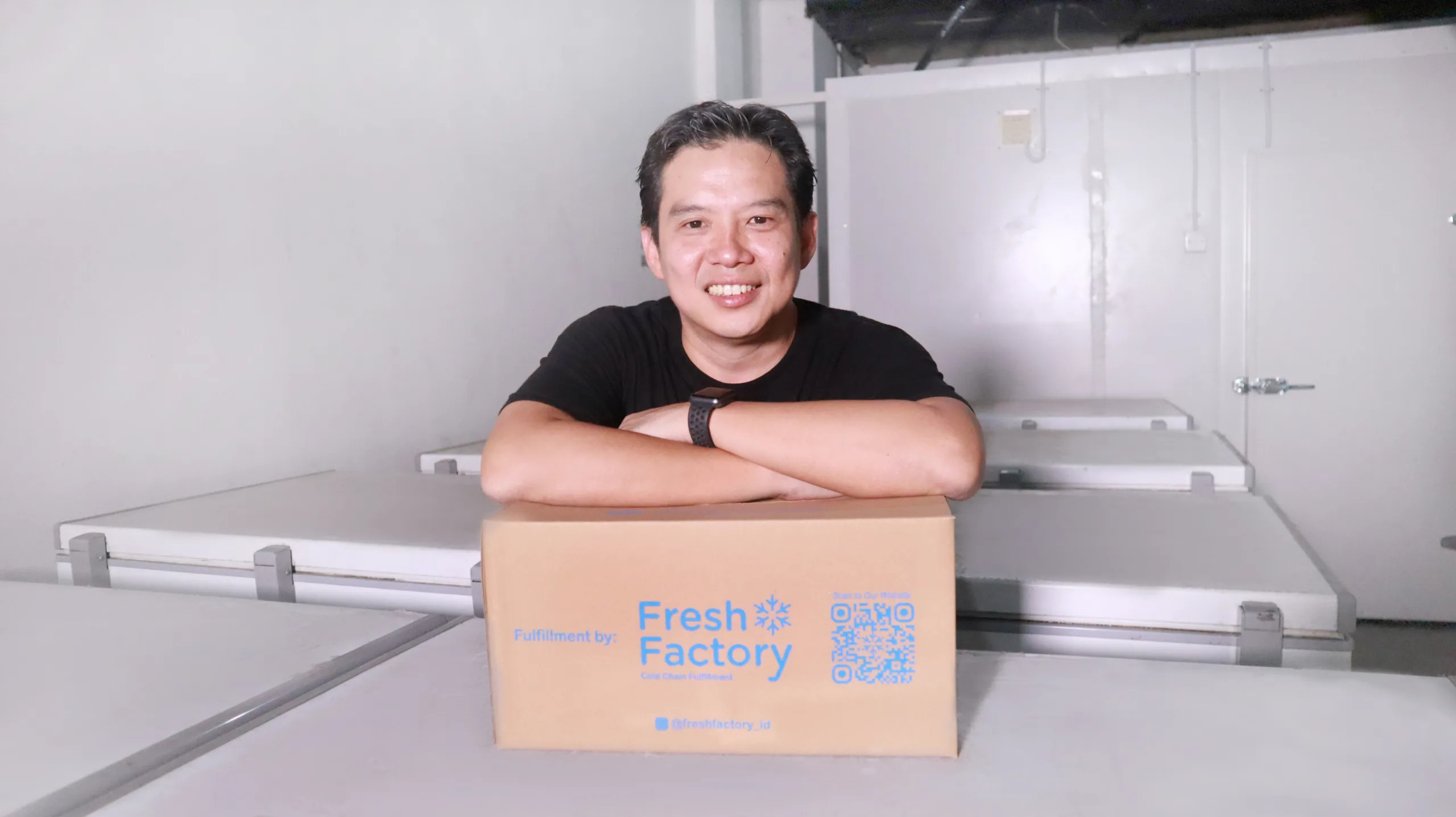
03 · The buildMaking reliability boring
Fresh Factory was bootstrapped at first. Once operations began, the network grew quickly. In a 2024 conversation, Ridwan described 48 fulfillment centers across 27 Indonesian cities, access to more than 2,000 partner warehouses and roughly 300 business customers. Such figures are snapshots in a moving company, but they show the appetite for shared cold-chain infrastructure. The company had joined Y Combinator's Winter 2022 batch, learning remotely at unusual hours from Jakarta and gaining a shorthand that made early-stage investors quicker to understand the story.
The operating story continued to mature. In December 2025, Fresh Factory said it had recorded six consecutive months of steady EBITDA profitability. It then described a footprint of more than 40 warehouses, more than 400 active clients and 98 percent adherence to service-level commitments across its core 4PL, enabler and distribution businesses.
Profitability is particularly telling in a business where growth can be purchased with concrete, rent and vehicles. Fresh Factory has emphasized a less asset-heavy approach, integrating partner capacity where useful and applying technology to a decentralized network. The system must know what arrived, which temperature zone received it, when it should leave, what stock moves first and whether the handover happened. Software does not make the compressor glamorous. It makes the promise auditable.
Ridwan's recent descriptions of a working day sound closer to a railway timetable than a startup slogan. Retail orders begin loading at 5 a.m. Fleets leave at 6. Temperature checks follow products across storage, loading, transit and arrival. Orders close with proof of delivery and inventory reconciliation. Returns split into stock that can re-enter inventory and stock that cannot. Preventive maintenance runs beside reactive maintenance. People cover shifts seven days a week, nearly around the clock.
There is a useful paradox here. The more complicated the operation becomes inside, the less eventful it should feel outside. A customer orders ice cream. Ice cream arrives frozen. Nobody applauds the chain of custody, sensor readings or shift handoffs. Infrastructure earns trust by disappearing into the expected.
04 · The wider mapCold rooms meet sunlight
Ridwan's ambition extends beyond urban convenience. He has framed Fresh Factory as shared infrastructure that could help smaller and growing businesses distribute nationally, a capability once easier for large cold-chain companies to command. Lower minimum requirements for warehousing, fulfillment and transportation can turn geography from a barrier into a service line.
The environmental side of refrigeration is harder to ignore. In August 2024, Fresh Factory signed a collaboration with IPB University and GIZ around solar-powered cooling technology and reducing food waste. That October, it agreed with electric-mobility company KALISTA to trial an electric blind van for cold-chain logistics. Neither experiment removes the physical cost of keeping goods cold. Both acknowledge that expansion cannot be measured only in warehouse pins.
There are also public milestones: inclusion in the 2023 Forbes Asia 100 to Watch list; participation in a FedEx small-business competition forum; investor backing; and partnerships with established logistics players. Ridwan's response to the Forbes recognition was revealingly unfinished. He called it a beginning rather than a final goal and credited the guidance around the company. The operator in him distrusts the victory lap. A cold chain, after all, is only as good as tomorrow's shift.
“We aspire to revolutionize the entire cold chain industry in Indonesia.”Larry Ridwan
05 · The lessonLook for the awkward handoff
What can another founder borrow from this story? Begin where a digital promise collides with a physical constraint. The fish had a product page and a buyer. The failure lived between the click and the kitchen. Ridwan stayed with that awkward handoff long enough to see a category: not merely cold storage, but an end-to-end service spanning inventory, fulfillment and movement.
The second lesson is to reuse one's past without being trapped by it. Banking gave him measurement. Finance gave him discipline. Telecom gave him a feel for distributed networks and the political economy of reach. Ambon gave the problem texture. None dictated a cold-chain startup, but together they made its logic legible.
Fresh Factory's future still rests on stubborn particulars: a city added, a center placed, a temperature held, a delivery made, a small brand able to travel farther than before. Ridwan's eight-kilometer circle is modest on a map. Repeat it enough times across an archipelago, and modesty begins to look like infrastructure.