A shopping website can begin with a surprisingly unglamorous problem: finding a phone without spending the afternoon hunting through other shopping websites. Before Telunjuk became a company, Redya Febriyanto built a crawling system for his own gadget searches. His friend Hanindia Narendrata Rahiesa used it too. The useful thing on somebody's computer became a reason for the two of them to start a business.
There is something pleasingly modest about that beginning. No invented customer was required. One person had a nuisance, built a tool, and found that another person wanted it. Telunjuk, Indonesian for “index finger,” would point shoppers toward products and prices. Its name promised direction rather than possession. You could find what you needed and continue to somebody else's shop.
Years later, Narendrata would be explaining an altogether different shopping question: how a business could understand its position among competitors. The customer had changed sides of the counter. The underlying difficulty remained familiar. A crowded market offers plenty to look at and much less help deciding what matters.
Before the shopping tabs
Narendrata studied telecommunications engineering at Institut Teknologi Bandung from 2003 to 2008. His early professional work was at Indosat. In his older professional biography, he described business development work involving the assessment of future businesses and their marketing strategies, alongside an interest in digital startups adjacent to the telecommunications company's existing operations.
That combination helps explain the two halves of his later career: a technical product and the business of persuading people to use it. An engineering qualification appears at the beginning, but his early Telunjuk title was co-founder and chief marketing officer. The work called for attention to customers as well as to the machinery serving them.
Football also appears in the record. At ITB, he lists participation in the university football organization; at SMAN 70, the Bulungan Football Club 70. His personal profile declares support for Manchester United. A founder interested in performance tables has, apparently, allowed himself at least one table over which he has no executive authority.
An index finger, then a wider map
Telunjuk entered incubation with Project Eden in November 2011, and the company was founded in 2012. The early service let people search for laptops and phones by specification, compare prices across shops, and follow through to a retailer. Flight searches redirected users to airlines. A PriceAlert feature offered notifications when a product's price fell into the shopper's budget.
The appeal was practical. A buyer did not need another place to admire a laptop. The buyer needed to discover which laptop fitted the requirement and where it could be bought at a suitable price. Comparison turns an assortment into a decision. It also asks a service to be useful at the precise moment someone is ready to act.
By March 2013, Narendrata was discussing a broader product range. Gadgets, electronics, and travel were already part of Telunjuk's offering; fashion and other lifestyle products were on the agenda. His marketing brief involved following the categories Indonesian consumers wanted, extending the shopping question beyond the devices that had helped start the company.
Investment brought other people into that effort. Project Eden was followed by Venture Republic, and then Series A backing from Lippo Digital Ventures in 2015. The investment announcement kept Narendrata and Redya on the company's board of directors. Rudy Ramawy, previously a leader at Google Indonesia, was named to its board of commissioners.
For two founders coming from telecommunications, the company was becoming a meeting point for different kinds of experience: engineering, marketing, investors, and online retail. Narendrata's partnership with Redya remained central. The original tool and the work of turning it into a service were parts of the same undertaking.
In 2016, the ambitions were geographical as well as commercial. Narendrata spoke of trying several Southeast Asian markets and aiming for a top-three position in three countries over the following three years. He also discussed additional services and an early internal use of big data. These were plans being explored at the time, an expansive moment in a company still figuring out the reach of its original idea.
The customer crosses the counter
Telunjuk began pursuing business customers in 2019. Its experience gathering product information across marketplaces could answer questions for sellers as well as shoppers. Compas emerged from the same team, turning accumulated e-commerce information into business intelligence. The company's own account of the transition describes eight years spent in Indonesia's online retail market before recognizing this demand.
Compas launched in June 2020. Narendrata's stated goal included helping smaller Indonesian businesses become more comfortable using data. In August that year, he set out an ambition to reach at least 70,000 digital small and medium-sized enterprises by year-end through collaborations. That number was a target. The point of the proposal was access: making market information useful beyond businesses already equipped to commission it.
By January 2021, Compas had seven clients. Narendrata explained its value through coffee: how large the online market was, which brands sold well, who ranked first, second, or third, and where a particular seller stood. The average monthly service price he discussed was around Rp15 million, with charges varying by features and customization.
Coffee is a helpful example because it makes the abstraction tangible. A seller's own orders answer one question. They cannot, alone, describe everybody else's orders. Market share adds a denominator. A ranking adds neighbors. A price comparison adds alternatives. Each changes what a business can reasonably conclude from the number it already knows.
This is the intriguing continuity in Narendrata's career. Telunjuk arranged choices for the person with a shopping basket. Compas arranged context for the business hoping to fill it. The service moved upstream, but the everyday problem of deciding among alternatives kept its place.
When a client becomes a shareholder
Diamond was among Compas's early clients. Discussions with its subsidiary, PT Sukanda Djaya, developed into a closer relationship. In late 2021, Sukanda Djaya signed a conditional share-purchase agreement for 81% ownership of PT Telunjuk Komputasi Indonesia. A customer relationship had become the route to a new ownership chapter.
After the deal, Narendrata described continuing to develop Compas while maintaining Telunjuk's price-comparison product. He remained a director. He also emphasized the fit between the two organizations, including openness and a sense of family. The attraction, in his account, included the chance to work with an experienced company and observe its planning, governance, and execution.
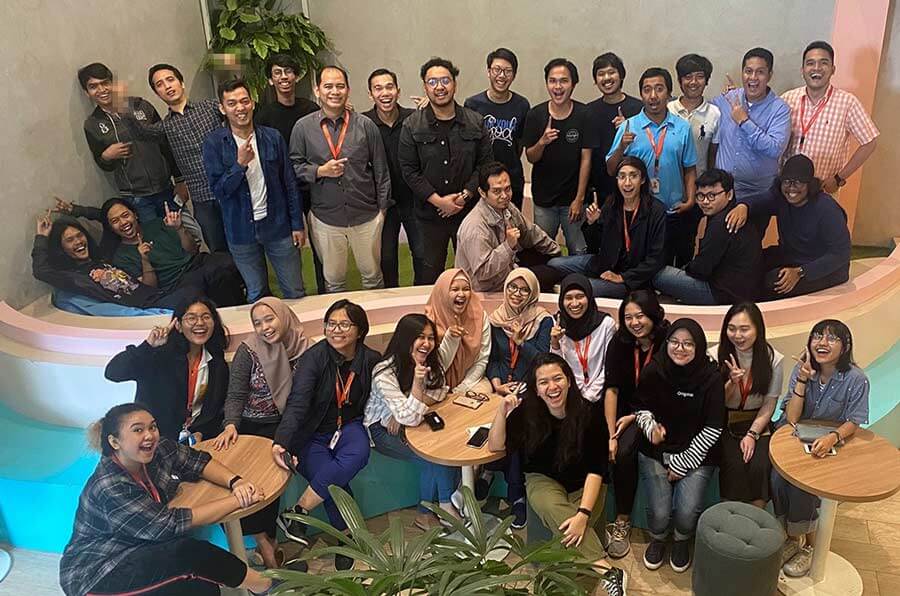
The sequence matters. Compas first had to be useful enough for a client to want a deeper relationship. The acquisition story therefore contains a fairly concrete test of the product: somebody using its work wanted to become more closely involved in the business producing it.
Virality still has to meet the checkout
By December 2023, Narendrata was discussing another gap between appearance and results. At MarkPlus Conference 2024 in Jakarta, held on December 7, 2023, he joined the “Brands Going Viral” panel. His presentation examined how The Originote and Oatside translated attention into e-commerce transactions, and how they continued to sell after the initial burst of interest.
His recommendations included a strong product with appropriate variants, credible information about competitors, and a plan for maintaining traffic. These are less theatrical concerns than going viral, which may explain their usefulness. Attention creates a moment. Stock, price, distribution, and the next purchase determine what the business can do with it.
He also brought this commercial discussion to other audiences. In July 2023, he appeared on Podcast Literasi Digital to discuss how a digital business earns profit. Earlier, in July 2018, he was among the speakers preparing computer-science students at IPB for practical work placements. His public appearances connect business-building with explaining the work to people who are learning it.
Read the basket, then read it again
In January 2026, Narendrata was commenting on the growth of men's perfume sales online. Compas reported a 70% annual increase in that segment during 2025. His interpretation focused on men seeking products that were practical, affordable, and expressive of their lifestyles. The category provided a specific example of how a changing shopping habit becomes a business question.
In August 2026, Compas published its first-half market report: Rp88.4 trillion in tracked online FMCG sales. Food and beverages accounted for 23.3% of that total. The report also found that existing brands supplied around 90% of the increase over the previous year's first half. A growing market can still reward companies already inside it.
Compas's tracked FMCG e-commerce sales, January-June 2026. Market sales, not company revenue.
Narendrata's accompanying commentary drew attention to sales value and unit volume growing together. That distinction is useful: more money changing hands and more products changing hands are related measures, with different meanings. The habit of comparing them suits a career that began by placing competing offers alongside one another.
The latest numbers give his work a present tense. They also bring it back to ordinary decisions: what to stock, which marketplace to prioritize, what consumers are buying, and how a brand's own performance fits the surrounding market.
A place for the next founder
Outside his executive title, Narendrata introduces himself as a Christian, a husband, and a father of two. His professional self-description emphasizes continuing to learn and helping younger people find purpose and make a contribution. Family and work appear together in his account of himself, rather than as competing versions of the person.
In 2022, he spoke about wanting to mentor the next generation of startups, crediting the community that had helped him early on. He encouraged collaboration and greater openness, including when a business was struggling. The advice carries the memory of having needed other people himself.
“Intinya harus bisa lebih terbuka.”
Hanindia Narendrata, 2022
“The point is to be more open.” Translation from Indonesian.
His story began with a friend finding a use for another friend's invention. It has since passed through marketing, investment, market intelligence, and a client becoming a shareholder. Mentoring offers another way for that same social machinery to work: experience made useful to somebody facing a decision for the first time.
There is no need to make that sound grander than it is. A founder needs a partner. A shopper needs a comparison. A seller needs context. A younger entrepreneur needs someone willing to talk. Across Narendrata's career, the interesting work happens where a question meets a person or a tool capable of improving the answer.
Follow the questions
More from Hanindia Narendrata and the work around him.